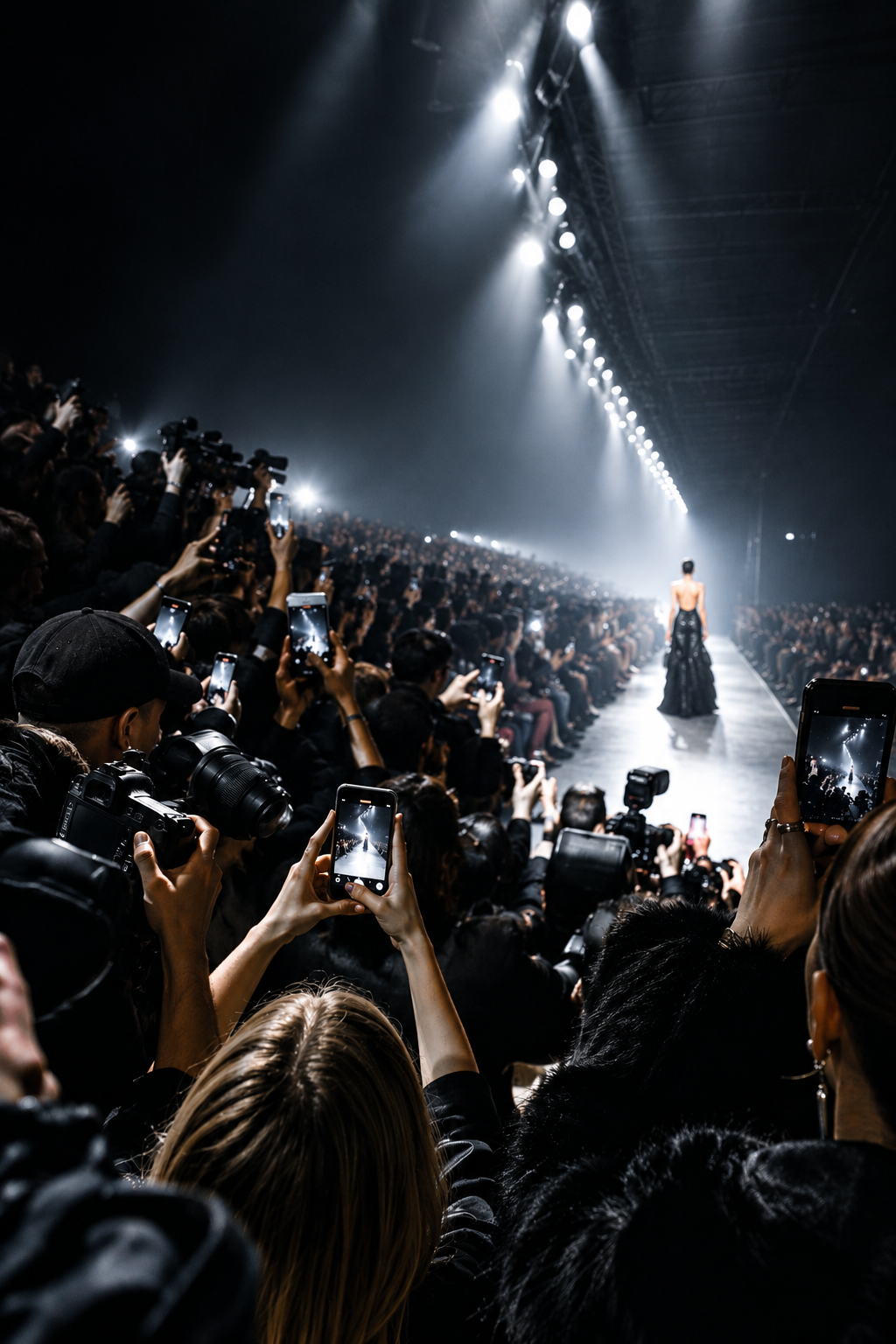
When did the circus become the show?
I have been thinking about this question throughout Fashion Month.
Not because I believe fashion is dead.
Quite the opposite.
I am asking it because I still care enough to be disturbed by what I see.
I have spent a significant part of my life inside this system: watching collections, writing about them, discussing them, traveling from one fashion capital to another, observing how the industry changed, how the audience changed, how the media changed, how the clothes changed; and, perhaps most importantly, how our relationship with fashion changed.
This is not a funeral.
It is an intervention.
The fashion circus has never been small. It has always had its characters, its drama, its excess, its front rows, its photographers, its parties, its egos, its scandals and its mythology. Fashion has always understood spectacle.
The difference is that the spectacle used to orbit the collection.
Today, I sometimes wonder whether the collection is orbiting the spectacle.
That distinction changes everything.
THE CIRCUS
There was a time when going to a fashion show meant going to work.
I remember shows as professional environments populated primarily by people who were there for a reason: editors, journalists, buyers, stylists, photographers, industry professionals.
There was a certain uniformity to the room.
Black.
A lot of black.
It was almost a professional code. You were not necessarily trying to disappear because you were conservative or elitist. You were disappearing because you were not supposed to be the story.
There was also an unwritten rule that, at least in my experience, was almost sacred: if you were attending a show, you did not wear that brand.
You were there to observe it.
You were not there to advertise it.
Observer and subject.
Critic and object.
Journalist and advertisement.
Then street style changed everything.
And I want to be very clear about this: I loved that revolution.
I still do.
Street style was one of the most exciting things that happened to fashion in decades because it reversed the traditional direction of influence.
For a long time, fashion went from the runway to the street.
Then the street started going to the runway.
Scott Schuman, Tommy Ton, Yvan Rodic, Phil Oh, Adam Katz, and the photographers who built the modern street-style ecosystem transformed the pavement outside the shows into a new fashion laboratory.
That was not the death of fashion.
That was fashion becoming more democratic.
People who had never been invited into the traditional system suddenly had something valuable: their own style.
Clothes became a language of identity.
That was beautiful.
The problem came later.
The look stopped being only a way of expressing who you were and increasingly became a way of demonstrating that you belonged to the fashion system.
The question subtly changed from:
“Who are you?”
to:
“Will someone photograph you?”
That is a very different proposition.
Today, street style can sometimes feel less like the discovery of an individual and more like an outdoor advertising department.
The street that once influenced fashion risks becoming the place where fashion is simply photographed.
The revolution has almost reversed itself.
Street style was born when fashion started looking at the street.
Today, the street sometimes looks at fashion and tries to prove that it belongs to it.
THE FIVE LOOKS
I had another moment during Fashion Week.
I was sitting at a show.
Not in the front row.
And honestly, I do not care.
The front row has changed. Celebrity and talent culture are now an established part of the architecture of fashion shows. This is not a complaint about invitations, status or access. It is simply a fact of the contemporary system.
Five celebrities or talents arrived one after another.
Five different people.
Five different audiences.
Potentially five different continents.
All wearing exactly the same look from the same brand.
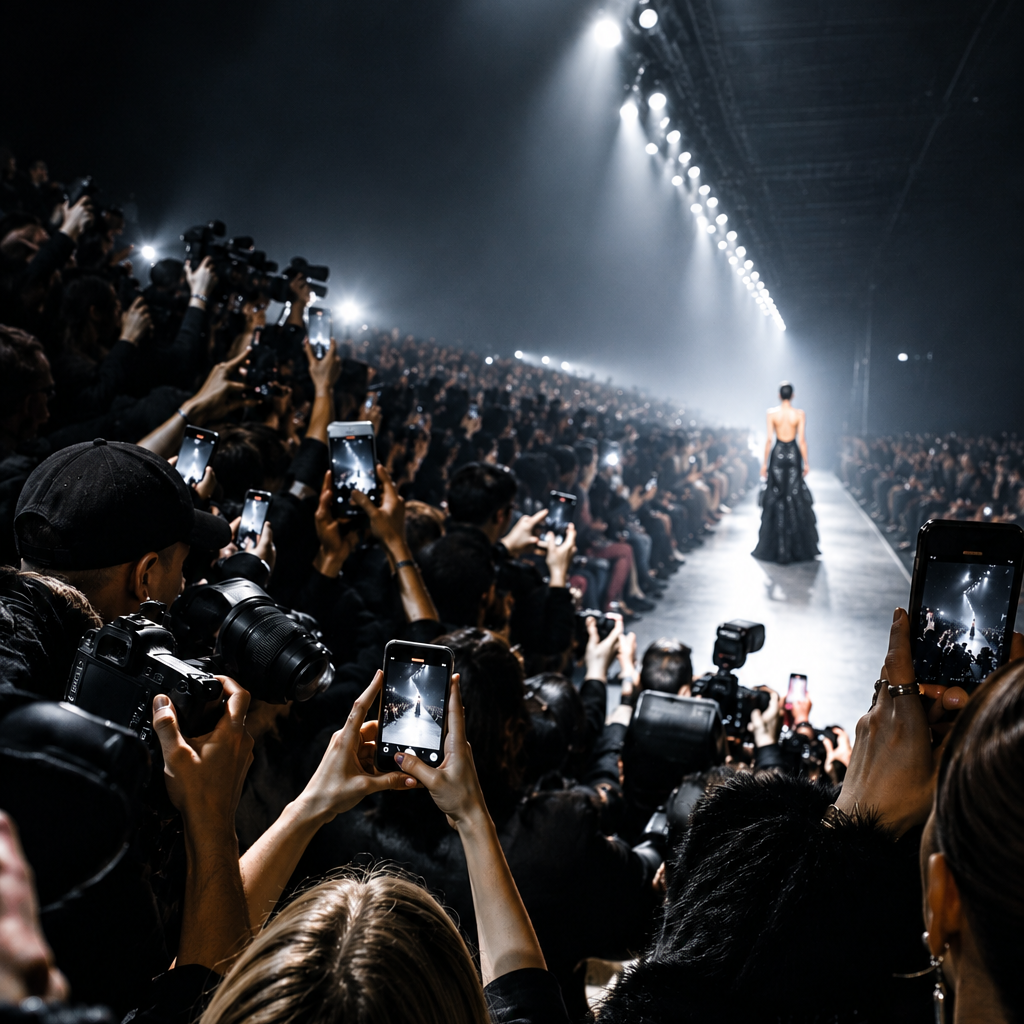
The photographers started shooting.
One celebrity.
The look.
Another celebrity.
The same look.
Another.
The same look again.
Different faces.
Same product.
And I suddenly thought:
What kind of marketing are we actually doing here?
The obvious answer is: very effective marketing.
The look travels across different audiences. The celebrity provides reach. The images generate social content. The brand becomes visible across multiple digital communities.
The machine works.
The question is whether the machine is building something beyond visibility.
Because attention is not the same thing as meaning.
Five people can generate five times the content.
They do not necessarily generate five times the idea.
This is where I think the industry needs to distinguish between amplification and construction.
Amplification makes something louder.
Construction makes something stronger.
A celebrity can amplify a collection.
A great collection can construct a world.
Those are not the same investment.
And when enormous amounts of money, access and energy are directed toward producing images of the same product on different famous bodies, I cannot help asking whether some of those resources could also be invested in something with a longer life.
A deeper collection.
A stronger artistic proposition.
Better materials.
More research.
More experimentation.
More support for young designers.
More cultural projects.
More social meaning.
More time.
More vision.
Because a photograph can last twenty-four hours.
An idea can last twenty years.
WHEN THE MEDIA BECAME PART OF THE MACHINE
The uncomfortable part is that the brands are not alone.
We are part of it too.
Look at fashion media today.
Even the most authoritative publications – including those that traditionally positioned themselves as critical, disruptive or intellectually independent – devote enormous attention to who attended a show, what a celebrity wore, which actor sat next to which singer, which ambassador wore which look.
The celebrity is no longer merely part of the fashion story.
In many cases, the celebrity is the story.
That makes perfect business sense.
A collection requires attention.
A celebrity comes with an audience.
The audience produces clicks.
Clicks produce engagement.
Engagement produces advertising value.
The algorithm notices.
The algorithm distributes.
The brand sees the numbers.
The cycle begins again.
The media ecosystem has effectively become another component of the fashion machine.
And here is where I think we need to talk about something that sounds old-fashioned but is actually becoming radical: critical thinking.
THE DANGEROUS THING CALLED AN OPINION
Fashion criticism used to be part of the job.
You went to a show.
You looked.
You thought.
You judged.
You wrote.
You could love it.
You could hate it.
You could be disappointed.
You could say that a collection was commercially smart but creatively weak.
You could say that a famous designer had lost the plot.
You could say that a beautiful collection was completely irrelevant.
The point was not that the critic was always right.
The point was that someone was willing to have an opinion.
Today, that freedom feels increasingly complicated.
The economics of fashion media are not exactly designed to encourage confrontation. Advertising matters. Partnerships matter. Sponsored content matters. Access matters. Relationships matter.
And access, in fashion, is a strange form of currency.
You do not necessarily receive an invoice when you lose it.
You simply stop receiving the invitation.
The seating gets a little further back.
The call stops coming.
The showroom appointment becomes mysteriously unavailable.
The WhatsApp goes quiet.
Nothing dramatic.
Nothing official.
Just a tiny shift in the temperature of the room.
And everybody understands.
This is one of the industry’s least discussed pressures.
Nobody needs to formally tell a critic to shut up.
The system can teach you to moderate yourself.
You learn which names are safe.
Which brands are commercially important.
Which opinions will cause trouble.
Which sentence should probably be softened.
Which adjective is better avoided.
Which review can wait until after the advertising campaign.
Suddenly criticism becomes diplomacy.
Diplomacy becomes self-censorship.
Self-censorship becomes editorial strategy.
Editorial strategy starts looking suspiciously like PR.
That is dangerous.
Not because fashion criticism needs to be cruel.
It does not.
Not because every collection deserves a negative review.
It certainly does not.
It is dangerous because a fashion industry without independent criticism eventually loses one of the mechanisms that allows it to evolve.
A critic is not supposed to destroy a brand.
A critic is supposed to challenge it.
Sometimes the most useful thing you can say to a designer is:
“This is not good enough.”
Sometimes it is:
“You can do better.”
That is not an act of hostility.
That can be an act of belief.
THE SPONSORED OPINION
There is another uncomfortable contradiction.
We have become extremely sophisticated at identifying advertising when it looks like advertising.
We are much less comfortable when advertising looks like editorial.
The boundaries between media, influencer culture, brand partnerships and advertising have become increasingly fluid.
That is not necessarily evil.
It is simply the reality of the contemporary media economy.
The problem is transparency.
If everything is branded, everything is sponsored and everything is optimised for engagement, where does independent opinion live?
A magazine needs advertisers.
A creator needs sponsors.
A platform needs revenue.
A brand needs visibility.
Everybody needs something.
That is precisely why editorial integrity matters more, not less.
The answer cannot be pretending the commercial system does not exist.
The answer is making the distinction visible.
This is advertising.
This is editorial.
This is sponsored.
This is my opinion.
Simple.
Clear.
Adult.
The audience is intelligent enough to understand the difference.
What the audience does not deserve is to be treated as an engagement metric without being told what it is actually consuming.
THE BUSINESS OF DESIRE
None of this works without acknowledging the obvious:fashion is business.
Huge business.
Luxury is an industrial ecosystem involving design, manufacturing, retail, logistics, advertising, real estate, media, hospitality, technology and employment across multiple countries.
The consolidation of luxury into powerful groups was one of the defining transformations of modern fashion.
The designer became a brand.
The brand became a corporation.
The corporation became a global cultural platform.
That evolution created extraordinary possibilities.
It also created extraordinary pressure.
Because once a fashion house is a major business, creativity has to perform.
The collection has to sell.
The store has to perform.
The celebrity strategy has to perform.
The campaign has to perform.
The creative director has to perform.
The runway has to perform.
The internet has to perform.
Everything becomes accountable to a number.
Revenue.
Traffic.
Reach.
Conversion.
Followers.
Engagement.
EMV.
Sell-through.
Share price.
The numbers are real.
The problem begins when the numbers become the only language through which value can be understood.
Luxury is currently confronting precisely this problem.
The 2026 State of Luxury research from The Business of Fashion and McKinsey found emotional connection to be a leading driver of luxury desirability among surveyed consumers, while many consumers increasingly see newer brands as more reflective of their identity than established houses.
That is fascinating.
At the precise moment when luxury has become extraordinarily sophisticated at manufacturing visibility, consumers are asking for something less mechanical: connection.
They want a reason to care.
A reason to desire.
A reason to believe.
Luxury is not suffering because people have stopped wanting beautiful things.
Luxury is suffering because people are increasingly asking whether the price still corresponds to the desire.
That is a much more dangerous question.
THE FAST-FASHION CLOCK
Then came fast fashion.
It did not simply make clothes cheaper.
It changed our understanding of time.
Zara and H&M helped establish a model built around rapid response, constantly refreshed assortments and compressed design-to-distribution cycles.
The result was profound.
Fashion stopped being something you waited for.
Fashion became something you refreshed.
The new collection became the new drop.
The trend became the product.
The product became disposable.
The desire cycle accelerated.
Then social media arrived and accelerated it again.
Instagram launched in 2010.
By the 2010s, the fashion industry had moved into a visual economy in which followers, impressions, fan engagement and online influence became part of how fashion success was measured.
Fashion had entered a feedback loop.
See it.
Want it.
Post it.
Copy it.
Sell it.
Replace it.
Repeat.
The system became incredibly efficient at creating desire.
The paradox is that too much efficiency can eventually destroy desire.
If everything is available immediately, what is there left to anticipate?
If every trend arrives instantly, how can a trend feel revolutionary?
If every image becomes a product, how can an image remain magical?
THE COUTURE QUESTION
This is why I increasingly think about couture differently.
Couture should not simply be understood as the most expensive corner of fashion.
It should be understood as fashion’s slowest form of thinking.
Time.
Craft.
Research.
Technique.
Handwork.
Imagination.
Memory.
Identity.
Couture can be a place where a house remembers who it is.
It can be a laboratory where the DNA of a brand is not simplified for immediate consumption but pushed, challenged and reinvented.
That is why the distinction between fast fashion and couture is not merely about price.
It is about time.
Fast fashion asks:
“How quickly can we turn desire into product?”
Couture should also ask:
“How long can we make an idea live?”
Those questions can coexist.
They should not become enemies.
Fashion needs commerce.
Commerce needs desire.
Desire needs imagination.
Imagination needs time.
That is the balance we are in danger of losing.
JOHN GALLIANO FOR ZARA
This is why John Galliano for Zara is such an interesting provocation.
Not because it is simply “good” or “bad”.
Because it collapses several worlds into one image.
Galliano represents one of fashion’s great traditions of theatrical authorship, historical research, fantasy and spectacle.
Zara represents speed, scale, accessibility and one of the most sophisticated fast-fashion business models ever developed.
Their encounter asks a question that is much more interesting than whether the collaboration is cool:
“What happens when one of fashion’s great storytellers enters one of fashion’s most efficient distribution systems?”
The answer may be democratisation.
It may be commercialisation.
It may be both.
The collaboration is a cultural signal.
The walls between fashion categories are disappearing.
The question is whether, when those walls disappear, the differences between the worlds disappear with them.
THE BODY HAS A MEMORY
There is another contradiction we should not ignore.
Fashion has spent years talking about diversity, inclusion and representation.
The runway numbers tell a more complicated story.
For Fall/Winter 2026, Vogue Business analysed 7,817 looks across 182 shows and found that 97.6% were straight-size, 2.1% mid-size and only 0.3% plus-size.
Menswear was even more stark: across 2,523 looks in Milan and Paris, only 0.2% were shown on plus-size models.
These are not simply casting statistics.
They tell us something about the cultural imagination of the industry.
The body is not a neutral surface.
Fashion tells people what kind of body is desirable.
The return of extremely thin silhouettes alongside the growing cultural conversation around GLP-1 weight-loss drugs makes this question even more complicated.
Then came another extraordinary collision.
At Vogue World: Milano, Eli Lilly – manufacturer of the weight-loss drug Mounjaro – appeared among the event’s sponsors, prompting criticism from health campaigners who saw an uncomfortable connection between fashion’s thinness imagery and pharmaceutical weight-loss culture.
Again, the point is not moral panic.
The point is contradiction.
Fashion should be good at discussing contradiction.
It is literally what it does for a living.
THE ROBOT
Then came the robot.
Four humanoid robots walked the runway at Vogue World: Milano during an act called “The Age of Intelligence”.
The concept was explicitly about fashion, technology and human creativity.
The internet had other ideas.
The robots became the story.
Not the craftsmanship.
Not the clothes.
Not the historical references.
Not the Italian manufacturing heritage.
The robots.
That is the circus in one image.
And there is something even more revealing about it.
The creative team understood that controversy would generate engagement.
The machine knows how the machine works.
Controversy produces attention.
Attention produces numbers.
Numbers justify the spectacle.
The spectacle produces more attention.
The circus has become self-aware.
WE HAVE DONE THIS BEFORE
None of this appeared overnight.
The history of modern fashion is a history of successive democratisations followed by new forms of concentration.
In the 1970s, subcultures and street movements entered fashion.
Punk challenged the authority of the establishment.
The street became a source of creative legitimacy.
In the 1980s, designers became brands.
In the 1990s, brands became global corporations.
In the 2000s, fast fashion accelerated the clock.
In 2004, Karl Lagerfeld’s collaboration with H&M made a symbolic bridge between designer authorship and mass retail.
Then street style became media.
Then Instagram made everybody a potential publisher.
Then influencers became brands.
Then brands became personalities.
Then designers became influencers.
Virgil Abloh became a perfect emblem of this new world: designer, DJ, architect, cultural connector, social-media personality, streetwear thinker and luxury creative director in one body.
Then Rana Plaza happened.
The collapse killed more than 1,100 people and injured another 2,500, exposing the human cost hidden inside global fashion supply chains and helping trigger Fashion Revolution.
Fashion learned that its supply chain was part of its story.
Then the pandemic temporarily removed the physical show.
Fashion experimented with films, digital presentations, gaming, virtual worlds and direct-to-consumer communication.
When physical Fashion Week returned, the spectacle came back with it.
Stronger.
Larger.
More expensive.
More social.
More desperate for attention.
We have spent fifty years changing the relationship between fashion and its audience.
Now we need to change the relationship between fashion and attention.
THE CRITIC AS A LUXURY
Probably, the most radical thing fashion media could offer today is not more access.
It is independence.
A real opinion has become a luxury.
Not because opinions are rare.
Because consequences are expensive.
A journalist should not have to wonder whether a negative review will cost them tomorrow’s invitation.
An editor should not have to calculate whether a critical paragraph will affect a media partnership.
A publication should not have to turn every uncomfortable observation into a diplomatic euphemism.
A critic should be allowed to say:
This is brilliant.
This is disappointing.
This is derivative.
This is important.
This is beautiful but empty.
This is commercial and necessary.
This is spectacular and completely irrelevant.
That does not make criticism anti-fashion.
It makes criticism pro-fashion.
A healthy industry needs people willing to challenge it.
Without friction, there is no evolution.
Without disagreement, there is no debate.
Without debate, there is eventually only consensus.
And consensus is a terrible creative director.
VISION
There is one word I keep coming back to.
Vision.
It is overused in fashion.
Visionary designer.
Visionary brand.
Visionary creative director.
The word has become almost meaningless.
It should mean something very simple: knowing what you want to say before deciding how to make people look at you.
Vision is not an aesthetic.
It is a position.
It is knowing why the silhouette exists.
Why the material exists.
Why the collection exists.
Why the brand exists.
Why the designer needs to make it.
Vision is what remains when you remove the celebrity.
When you remove the front row.
When you remove the Instagram post.
When you remove the venue.
When you remove the campaign.
When you remove the hype.
What is left?
That is the brand.
That is the designer.
That is the fashion.
THE HOPE
This is why I refuse to believe that the system has lost its ability to create meaningful fashion.
Look at Dries Van Noten by Julian Klausner.
Rick Owens.
Celine by Michael Rider.
Comme des Garçons.
Tom Ford by Haider Ackermann.
Junya Watanabe.
Mugler by Miguel Castro Freitas.
Yohji Yamamoto.
Chanel by Matthieu Blazy.
(Among others.)
Nine radically different worlds.
Nine different ways of understanding fashion.
The point is not that they represent one aesthetic.
The point is that they represent authorship.
They have languages.
They have positions.
They have worlds.
They remind us that commercial fashion can still contain radical thought.
Young designers matter even more.
Some will fail.
Some will be absorbed by corporations.
Some will become famous.
Some will disappear.
Some may become the designers we will talk about in twenty years.
What matters is that they enter the system with something more important than a social-media strategy.
They enter with an idea.
That is where the future of fashion lives.
SO, WHAT DO WE DO WITH THE CIRCUS?
I do not want fewer people.
I do not want fewer celebrities.
I do not want fashion to become elitist again.
I do not want to kill social media.
I do not want to kill the business.
I do not want to return to an imaginary golden age in which fashion was somehow pure.
It never was.
Fashion has always been commerce, fantasy, status, politics, aspiration, entertainment and identity.
The answer is not to remove the contradictions.
The answer is to make them productive again.
Let the celebrity amplify the collection.
Let social media democratize access.
Let pop culture make fashion bigger.
Let technology open new creative possibilities.
Let business fund creativity.
Let marketing tell stories.
Let critics challenge the stories.
Let editors preserve the space to disagree.
Then ask one more question:
“What are we actually building?”
Fashion Week could be smaller in some places and bigger in others.
Shows could be fewer but more meaningful.
Emerging designers could share production infrastructure.
Cities could support independent labels with spaces and funding.
Success could be measured by more than EMV.
A brand could be judged by product longevity, customer loyalty, cultural relevance, inclusivity, craftsmanship, wages, innovation and environmental impact.
Media could publish the celebrity image and then do the harder thing: explain the collection.
Brands could spend less on manufacturing endless moments and more on manufacturing reasons to care.
Luxury could stop asking only how to increase price and start asking why someone should desire the object at that price.
Couture could become once again a laboratory of possibility.
Criticism could become once again a form of participation.
The industry could stop trying to make everything immediately understandable.
Some things deserve time.
Some ideas deserve silence.
Some clothes deserve to be looked at twice.
I STILL BELIEVE
The easiest position would be cynicism.
Fashion is finished.
Social media ruined everything.
Celebrities took over.
Fast fashion killed creativity.
Nobody cares about clothes anymore.
The shows are all marketing.
The magazines are all chasing clicks.
The industry is just money.
The circus won.
Fine.
It is an easy story.
I do not believe it.
I could not write this if I did.
I am still here because I care.
I have invested time, energy, work, curiosity and hope in this industry.
I have watched it change.
I have criticized it.
I have loved it.
I have been frustrated by it.
I have been surprised by it.
I have been inspired by it.
I still want it to surprise me again.
That is why this is not a criticism of fashion for the sake of criticism.
It is a demand.
A demand that fashion remember the extraordinary power it still has.
Because fashion can be business without becoming only business.
It can be pop without becoming shallow.
It can be spectacular without becoming empty.
It can be commercial without becoming disposable.
It can use celebrities without becoming about celebrities.
It can use social media without allowing the algorithm to decide what matters.
It can embrace technology without forgetting the human hand.
It can grow without losing its soul.
It can have a circus.
It just needs to remember what the circus is there for.
The circus should make us want to enter the tent.
The show should make us want to see the collection.
The collection should make us want to understand the idea.
The idea should make us want to believe in the brand.
The critic should make us question it.
And the brand should make us want to come back.
Because attention disappears.
Desire remains.
Criticism keeps the system honest.
Vision turns desire into culture.
That is what I am still looking for when I sit down at a fashion show.
Not an invitation.
Not a celebrity.
Not a viral moment.
Not a million views.
I am looking for that second when the lights go down, the first look comes out, and for a few minutes the entire circus disappears.
That is when I remember why I still believe in fashion.