Edward Shissorhands: A Cruel Fairy Tale, a Love Frozen in Time, and the Snow That Refuses to Melt
What remains of a love that cannot become a life?
Every year, at the end of November, I return to Edward Scissorhands. It has become a private ritual, an appointment with a film that belongs to my personal mythology as much as it belongs to the history of cinema. One of my favorite films, by one of my favorite directors, starring actors whose faces and performances are tied to a particularly formative moment of my adolescence. There is something deeply personal about returning to it, something that goes beyond nostalgia or the comfort of familiarity. Every viewing feels like opening a door to an earlier version of myself while discovering, with the eyes of the person I have since become, everything I was not yet old enough to understand.
Tim Burton’s gothic universe has been part of my aesthetic and emotional DNA for as long as I can remember. Its strange creatures, romantic darkness, grotesque silhouettes, melancholy, theatricality, and peculiar sense of beauty have never felt like a passing adolescent fascination. They have remained a way of looking at the world: finding tenderness in the unsettling, poetry in the imperfect, and humanity in those who have been placed outside its accepted boundaries.
Released in 1990, Edward Scissorhands has only grown more resonant with time. Its pastel suburbia, its dark romanticism, its artificial cheerfulness, and its profoundly wounded protagonist seem to belong to a fairy tale that has quietly become a diagnosis of modern life. What initially appears to be a whimsical fantasy about an unfinished artificial man gradually reveals itself as something much more unsettling: a story about social conformity, conditional acceptance, the commodification of difference, and the violence hidden beneath the language of belonging.
Yet the film’s most powerful image is not its castle, its scissors, or even Edward’s extraordinary appearance. It is snow.
A snowfall born from an act of creation. A dance between two people who cannot have the life they might have wanted. A memory that survives long after the moment itself has disappeared.
The snow is where the film’s beauty and cruelty become inseparable.
THE MONSTER WHO WAS MORE HUMAN THAN THE WORLD AROUND HIM
Edward is introduced as an unfinished creation. His inventor, an eccentric old man played by Vincent Price, has given him a face, a body, a mind, and the capacity to feel, but dies before he can replace the temporary blades attached to his hands with human ones. Edward is left suspended between invention and completion, between the artificial and the human, between the desire to participate in the world and the physical impossibility of doing so without causing harm.
His condition immediately evokes Mary Shelley’s Frankenstein, although Burton transforms the familiar monster narrative into something more intimate and unexpectedly tender. Both stories question the responsibility of the creator, the ethics of abandonment, and the cruelty of judging a being by the circumstances of its creation. The creature becomes monstrous in the eyes of society long before society has any evidence of its moral character.
Edward, however, is not a monster trying to become human. He is a sensitive being who already possesses the emotional qualities that make us human, desperately trying to be recognized as such.
His scissors are both his identity and his sentence. They allow him to create, but prevent him from touching. They give him extraordinary precision while denying him the simplest forms of intimacy. He can sculpt a hedge into an animal, transform a dog’s coat, invent astonishing hairstyles, carve ice into an ephemeral masterpiece. He can make the world more beautiful, yet cannot safely reach out and hold the hand of someone he loves.
This is the central paradox of his existence: the same hands that create beauty can inflict pain. His physical difference is not merely an eccentric visual detail; it is a permanent condition of vulnerability, a reminder that every gesture of affection carries the possibility of injury.
Edward’s body becomes a metaphor for the human condition itself. Everyone carries some form of limitation, some history of damage, some invisible mechanism that makes certain gestures harder than they appear. We all have our own scissors: fears, defenses, wounds, inherited imperfections, and experiences we did not choose. The question is not whether we can become flawless, but whether we can learn to live with our limitations without allowing them to destroy our capacity for tenderness.
Edward never receives the hands he was supposed to have. He must find another language.
He finds it in art.
THE SUBURB AS A PERFECT LITTLE NIGHTMARE
Burton’s visual architecture is one of the film’s most sophisticated achievements. At the top of the hill stands Edward’s castle: dark, monumental, isolated, almost expressionist in its silhouette. Below it stretches a suburban neighborhood composed of pastel houses, manicured lawns, immaculate surfaces, and coordinated colors.
The contrast is immediate and almost aggressively artificial. The castle looks like the home of a creature from a gothic legend; the neighborhood resembles an advertisement for domestic happiness. One world is visibly strange. The other is strange precisely because it insists so desperately on appearing normal.
The cinematography by Stefan Czapsky, the production design by Bo Welch, and Colleen Atwood’s costumes create two visual languages that seem to contradict each other. The castle is filled with shadows, textures, and architectural excess. The suburb is bright, symmetrical, polished, and repetitive. Edward looks like a figure who has escaped from a black-and-white nightmare and accidentally entered a Technicolor commercial.
Burton reverses the traditional moral symbolism of light and darkness. The darkness of the castle is not necessarily evil; it is where Edward’s solitude, imagination, and vulnerability reside. The brightness of the neighborhood is not necessarily benevolent; it conceals gossip, competition, prejudice, and a frightening appetite for conformity.
The suburb is a visual machine for producing sameness. Its residents inhabit a world in which appearance functions as social currency, where the lawn, the house, the body, the car, and even leisure become signs of status. Its pastel palette is almost suffocating in its uniformity. Everything is cheerful, but very little feels alive.
Edward’s arrival disrupts this carefully maintained arrangement. He is not simply an outsider entering a community. He is an image that exposes the community’s dependence on appearances.
The neighborhood initially sees him as an extraordinary novelty. His difference is fascinating because it can be consumed without being understood. His talent makes him desirable. His strangeness becomes an attraction. His presence offers entertainment, social distinction, and an opportunity for the residents to experience something unusual without having to question their own assumptions.
This is where the fairy tale begins to reveal its sociological teeth.
YOU ARE WELCOME UNTIL YOU STOP BEING USEFUL
There is a particularly cruel mechanism at work in the neighborhood’s relationship with Edward: the community does not simply reject difference. It first discovers how to profit from it.
His hands become a local sensation. He sculpts the hedges, transforms dogs into impeccably groomed creatures, creates extravagant hairstyles, and turns his unusual physical condition into a source of aesthetic pleasure. Suddenly, the same feature that might have inspired fear becomes an asset.
Edward is invited into the neighborhood because he can do something nobody else can do.
The distinction is devastating: the residents appreciate what Edward can produce, but rarely ask what it means to be Edward.
They admire the results of his scissors without considering the pain of living with them. They enjoy his ability to transform their gardens, their pets, and their appearance, yet do not fully confront the fact that he cannot perform the most ordinary gestures of affection. They want his talent, his novelty, his usefulness. They are less prepared to accept his vulnerability.
This is the difference between being admired and being recognized. Between being included as a resource and being accepted as a person.
Erving Goffman’s theory of stigma offers a useful framework here. Edward’s physical difference marks him as socially discredited, but his exceptional abilities temporarily compensate for that stigma. His talent allows the community to suspend its discomfort. It does not erase the underlying prejudice. Acceptance remains conditional, dependent on the pleasure and advantages he provides.
Guy Debord’s The Society of the Spectacle also seems uncannily relevant. Edward becomes an image, a spectacle to be consumed. His existence is translated into services, appearances, gossip, and entertainment. The neighborhood is fascinated by the spectacle of difference while remaining largely indifferent to the person behind it.
Michel Foucault’s reflections on normality and deviance illuminate another dimension of the story. Edward is judged against an unspoken social standard that determines which bodies, gestures, and behaviors are acceptable. The community does not need to understand him in order to classify him. His difference is enough to place him outside the boundaries of normality.
The neighborhood’s enthusiasm is therefore unstable from the beginning. It is not necessarily that every resident is consciously malicious. Burton’s satire is more subtle than a simple division between good and evil. People can be curious, generous, amused, opportunistic, frightened, and cruel, sometimes within the same afternoon. Their kindness is real in certain moments, but it is also easily withdrawn.
Edward is welcomed while his difference remains entertaining. He becomes threatening when that same difference can no longer be controlled, packaged, or enjoyed.
René Girard’s theory of the scapegoat offers a further reading of the community’s transformation. When tensions emerge, the group can redirect its anxieties toward an individual whose outsider status makes him an easy target. Edward becomes the convenient container for fears and contradictions that belong to the community itself.
The tragedy is not simply that society rejects someone who is different. It is that society first teaches him to believe he has finally been accepted.
Everyone wants to use Edward’s scissors. Almost nobody stops to think about the person who has to live with them.
A FAIRY TALE WITH ITS TEETH SHOWING
Calling Edward Scissorhands a fairy tale is not a way of softening its darkness. It is precisely what makes the film so effective.
Fairy tales have always been concerned with the instability of appearances, the danger of entering unfamiliar spaces, the cruelty of social rules, and the vulnerability of those who do not fit. Their worlds are populated by beautiful monsters, abandoned children, impossible desires, enchanted objects, and transformations that rarely come without a price.
Burton draws on this tradition while mixing it with gothic horror, German Expressionist visual influences, romantic melodrama, fantasy, and dark comedy. The result is a world that can make us smile one moment and expose something deeply uncomfortable the next.
Edward belongs to the archetype of the innocent outsider: the misunderstood creature whose apparent monstrosity reveals the moral limitations of those who judge him. He can also be read through the Jungian idea of the Shadow, not as a clinical diagnosis but as a symbolic interpretation. The community projects its fears and contradictions onto Edward, turning him into the embodiment of everything it cannot comfortably recognize within itself.
His innocence is not the innocence of ignorance alone. It is the vulnerability of someone who has not learned to protect himself through cynicism. He approaches the world with an almost childlike openness, even after the world has given him reasons to fear it.
There is something profoundly disturbing about that innocence. It exposes how easily tenderness can become a liability in a society organized around appearances, competition, and self-preservation.
The film’s comedy is therefore never entirely harmless. Its suburban rituals are funny because they are recognizable; its exaggerations are unsettling because they reveal something real. The smiles, the gossip, the social performances, the fascination with novelty: all become part of a fairy tale in which the most frightening creature may not be the one living in the castle.
THE SNOW DANCE: AN IMPOSSIBLE LOVE FINDS ITS LANGUAGE
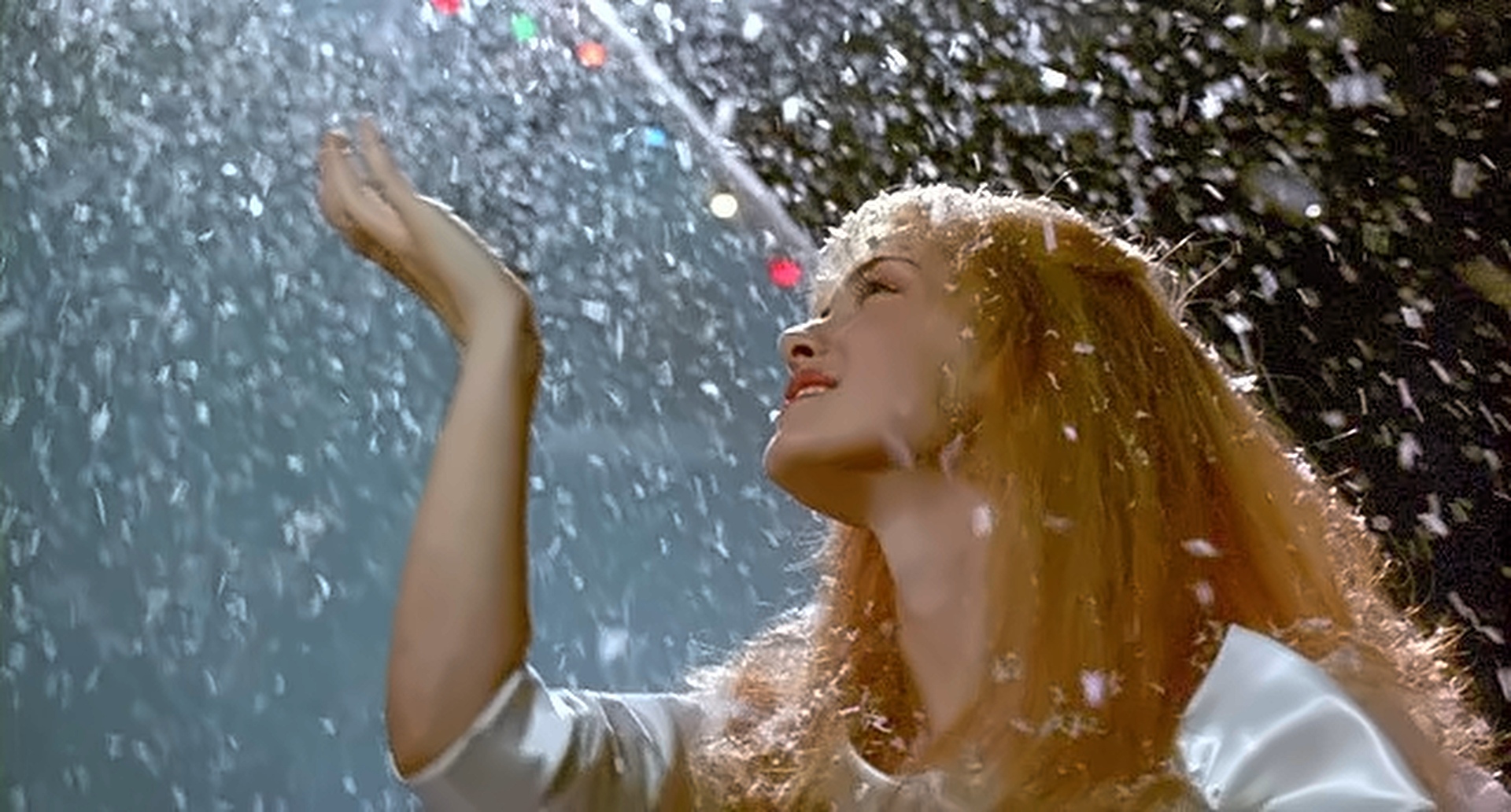
Then comes the snow.
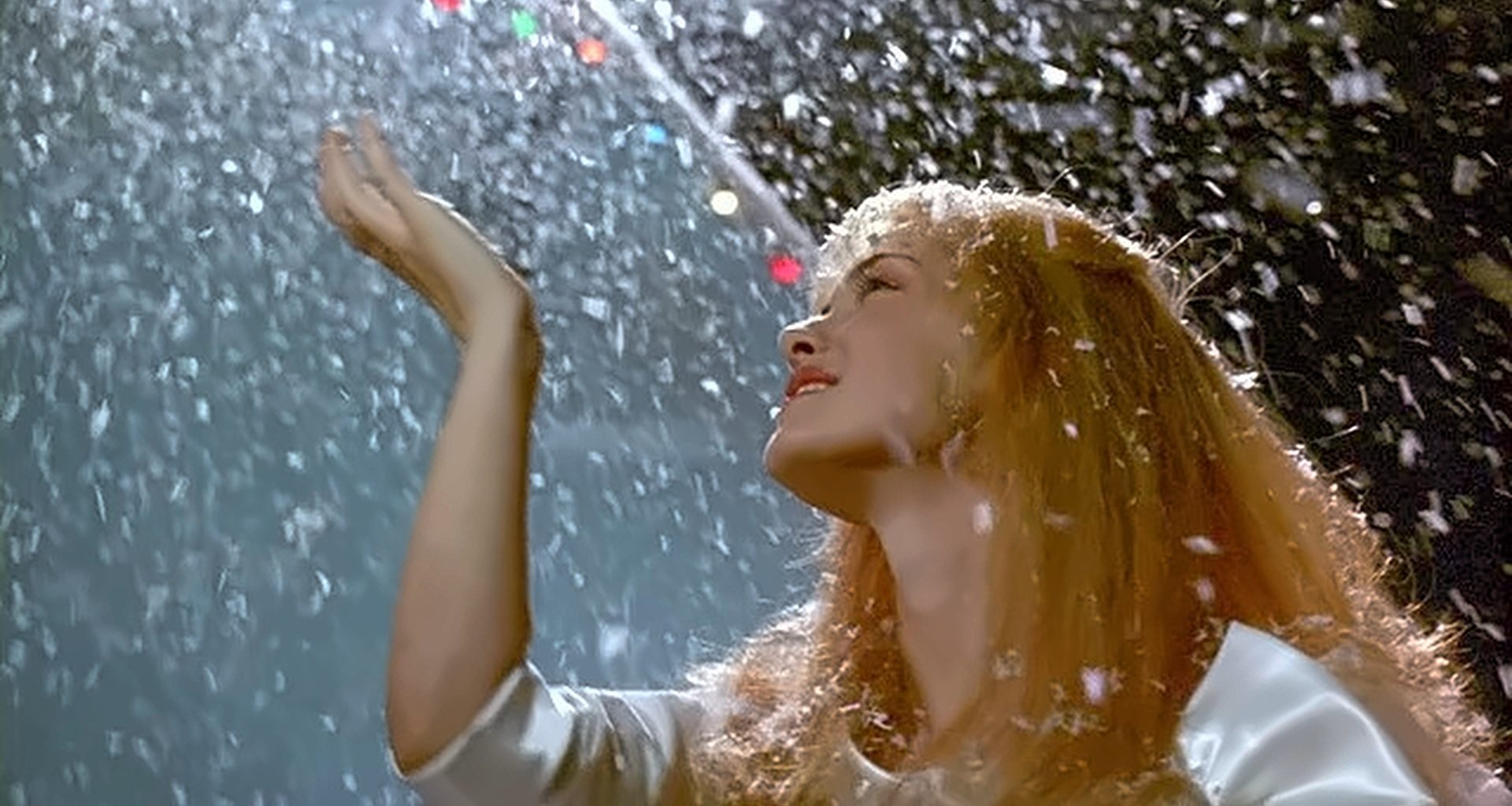
The emotional center of the film, the sequence in which Edward carves ice while Kim dances beneath the falling fragments, is one of the most beautiful expressions of love in modern fantasy cinema. It is also one of its most devastating.
Edward, played by Johnny Depp, and Kim, played by Winona Ryder, inhabit a moment that seems to exist outside the social world that has been judging them. The music by Danny Elfman gives the sequence its otherworldly pulse, turning the falling ice into something almost weightless, almost sacred. Kim dances beneath the fragments, her body moving through a snowfall that Edward has created with his own hands.
The image is deceptively simple. Its emotional implications are immense.
Edward cannot hold Kim. He cannot touch her face without risking a cut. He cannot embrace her in the way romantic cinema has taught us to expect. His hands, the very instruments through which he expresses himself, are also the barriers that prevent him from experiencing physical intimacy.
Yet he can create a world around her.
His inability to touch becomes the condition of an extraordinary artistic gesture. He transforms the limitations of his body into an act of beauty. The scissors that have marked him as dangerous become instruments of tenderness. His art says what his hands cannot.
The snow dance is not simply a romantic interlude. It is the film’s central philosophical statement: love does not always find its expression through possession, proximity, or the conventional forms of a shared life. Sometimes it appears as an offering, a gesture that asks for nothing beyond the possibility of reaching another person.
Kim does not merely watch Edward create. She enters the world he has made. Her dance completes his sculpture. For a brief moment, they share a language that belongs to neither of them alone.
The sequence also transforms the meaning of beauty. Edward’s creation is extraordinary precisely because it cannot last. The ice melts. The snow disappears. The dance ends. Its perfection is inseparable from its fragility.
This is not a fairy tale in which love conquers every obstacle. It is a fairy tale in which love becomes visible even when the world refuses to make room for it.
The most intimate thing Edward can give Kim is a snowfall.
THE BODY, THE LIMIT, THE ARTIST
The snow dance also changes how we understand Edward’s hands.
Throughout the film, his scissors function as a source of anxiety, fascination, and danger. They are the physical evidence of his incompleteness, the reason he cannot participate in ordinary intimacy, and the feature that makes him both desirable and frightening to the neighborhood.
Art offers him a way to inhabit this contradiction without resolving it.
Edward does not become beautiful by overcoming his difference. He creates beauty through it. His work does not erase the wound; it gives the wound a form.
There is an important distinction here between perfection and expression. The neighborhood is obsessed with polished surfaces, controlled appearances, and socially acceptable forms. Edward’s creations are different. His sculptures and hairstyles are imaginative, excessive, sometimes almost surreal. They introduce movement and fantasy into a world built on repetition.
His art is not an escape from his condition. It is an answer to it.
The ice sculpture is the purest expression of this idea. Edward takes a material that is cold, fragile, and destined to disappear, then transforms it into something capable of producing warmth in another person. The paradox feels almost like a definition of artistic creation itself: giving form to what cannot be held, making something visible out of an emotion that has no ordinary language.
Danny Elfman’s score deepens this transformation. Its choral textures and fantastical orchestration do not merely accompany the images; they seem to give Edward an interior voice. The music articulates what the character cannot express in words, allowing the emotional world of the film to expand beyond dialogue.
The snow dance is cinema at its most expressive: movement, sound, light, texture, and emotion working together until an image becomes a memory before it has even ended.
FROM THE AMERICAN DREAM TO THE DIGITAL CROWD
The film’s suburban setting also carries a distinctly historical charge.
Released in 1990, Edward Scissorhands emerged from an American culture shaped by the consumer optimism and status-conscious suburban ideal of the preceding decade. The film’s neighborhoods evoke a world in which domestic comfort, personal appearance, and material success are presented as evidence of a well-ordered life. Its residents live inside a carefully maintained image of happiness.
Burton does not offer a documentary portrait of American society. He constructs a stylized, satirical environment in which the contradictions of that ideal become impossible to ignore.
The manicured lawns, coordinated houses, beauty routines, and social performances reveal a culture that turns identity into something to be displayed and maintained. Edward enters this world as both a disruption and an opportunity. His talents can improve the neighborhood’s appearance, but his presence also exposes how superficial its idea of acceptance really is.
The film’s critique feels even sharper in the present.
Today’s suburban neighborhood has expanded into the digital crowd. The lawn has become the profile, the hairstyle has become the image, the local gossip has become the comment section, and the spectacle has become permanent. Difference can be celebrated, circulated, branded, and monetized, provided it remains visually appealing and emotionally convenient.
Contemporary culture often presents itself as more inclusive, more open, and more accepting than the world Edward encounters. Yet the same conditional logic can survive beneath the language of visibility. The outsider is welcomed when their difference is interesting, aesthetically compelling, commercially useful, or capable of generating attention. The welcome becomes less certain when difference demands patience, accommodation, or a reconsideration of established norms.
Edward’s story therefore speaks to a contradiction that remains unresolved: society can become fascinated by difference without becoming willing to live alongside it.
The future may offer new technologies, new forms of visibility, and new definitions of identity. None of these guarantees recognition. A society can become extraordinarily skilled at displaying people while remaining incapable of listening to them.
The question Edward raises is not simply whether we can tolerate those who are different. It is whether we can recognize their humanity when they are no longer useful to us.
THE LOVE THAT CANNOT STAY
The relationship between Edward and Kim is moving because it refuses the easy logic of romantic fulfillment.
Kim gradually sees beyond Edward’s appearance and discovers the sensitivity beneath his unusual exterior. Her feelings are not simply an attraction to the strange or the forbidden. They emerge through recognition: she begins to understand the emotional reality of someone whose body and circumstances make ordinary intimacy almost impossible.
Their love, however, cannot be separated from the world around them. Fear, violence, misunderstanding, and social pressure close in. Edward’s presence becomes increasingly difficult for the neighborhood to accept. The same people who once celebrated his abilities now see him through the lens of suspicion.
The film does not offer a conventional romantic ending because it understands that love and possession are not the same thing.
Kim and Edward cannot build an ordinary life together. Their separation is painful, but it also preserves something essential about Edward: his identity cannot be negotiated into a shape that would make him acceptable to the neighborhood. He cannot become the person society wants him to be without betraying the very qualities that make him who he is.
Love, in this sense, becomes an act of recognition rather than ownership. Kim’s final decision allows Edward to remain himself, even at the cost of their physical closeness.
There is no easy consolation in this. Some people enter our lives and change them without being able to stay. Some feelings never find a practical form. Some encounters remain suspended between what happened and what might have been.
Their impossibility does not make them less real.
THE SNOW THAT REMEMBERS
The final movement of the film returns us to the snow, and in doing so transforms everything we have seen.
Many years have passed. Kim is now an old woman, telling her granddaughter the story of Edward. She explains the origin of the snow, recalling the time when Edward carved the ice and the fragments fell around her like winter itself had been invented for that single dance.
The image that once represented the beginning of an impossible love now becomes the sign of its survival.
This return is essential. The snow is no longer simply the material produced by Edward’s art. It has become memory made visible. It connects the past to the present, the absent to the living, the moment that disappeared to the person who continues to remember it.
Edward cannot return to Kim’s life. He cannot restore their lost time or give her the ordinary intimacy they were denied. Yet the snow continues to fall. His creation has outlived the moment of its making, becoming a trace of his presence in the world.
The symbolism is extraordinarily tender. Snow is composed of individual crystals, each delicate and temporary, yet together they can transform an entire landscape. It covers familiar surfaces and makes the world appear newly imagined. Memory works in a similar way. A single encounter can change the emotional landscape of a life, even when the person who caused that change is no longer there.
The snow does not reverse time. It gives time another meaning.
Kim’s memory becomes the place where Edward continues to exist. Her story carries him beyond the castle, beyond the neighborhood, beyond the limits of his own physical presence. What he could not leave her as a shared future, he leaves her as an enduring image.
There is something almost cinematic about this idea. Film itself is an art of preservation and disappearance. Images move, vanish, and remain. A performance ends, a scene fades, the lights come up, yet something continues to exist inside the spectator. We carry fragments of films into our own lives, sometimes for decades, until they become inseparable from the memories through which we understand ourselves.
Edward’s snow is cinema’s snow: an image that melts on the screen but refuses to disappear from the imagination.
The ending does not erase the cruelty of the story. It does not pretend that memory can compensate for everything life has denied us. Its beauty comes from acknowledging loss without surrendering to it.
The world failed to make space for Edward, but it could not prevent him from creating something that would outlast its judgment.
The snow is what remains when love can no longer remain as presence. It is memory taking shape, tenderness surviving distance, and an impossible love crystallized in time.
THE PERSONAL MYTHOLOGY OF RETURNING
Every year, when November comes to an end, I watch the film again. The ritual has acquired a meaning of its own.
I return to Burton’s strange and beautiful world, to Johnny Depp’s fragile Edward and Winona Ryder’s Kim, to the music, the silhouettes, the castle, the pastel suburbia, and that extraordinary snowfall. I return to a film connected to my adolescence, to the gothic sensibility that helped shape my imagination, and to an earlier version of myself who could feel the melancholy of the story before fully understanding its philosophical weight.
The experience changes with time. The images remain familiar, but their meaning keeps unfolding. What once appeared to be a strange romantic fairy tale now feels like a meditation on social exclusion, the violence of conformity, the conditional nature of acceptance, and the difficulty of loving someone whose existence challenges the rules of the world.
The most personal aspect of returning to Edward Scissorhands is recognizing that the film has never really stayed in the past. It has grown alongside the person watching it.
Kim remembers Edward through the snow. I return to Edward through the film. Both gestures are forms of preservation, ways of allowing something that has passed to remain emotionally present.
The snow connects these different forms of memory. It belongs to the film, to Kim’s life, and to the private mythology of those who have carried its images for years. It is at once a fictional event, an artistic creation, a symbol of love, and a metaphor for the persistence of cinema itself.
A CRUEL FAIRY TALE. A BEAUTIFUL WOUND.
Edward Scissorhands remains a cruel fairy tale because it refuses to reward innocence with a conventional happy ending. Its protagonist does not receive the hands he needs, the home he deserves, or the love he might have hoped to live. The world does not become kinder simply because he has shown it how to create beauty.
Its poetry lies elsewhere.
Edward never allows the violence of rejection to extinguish his capacity for tenderness. He continues to create. He continues to feel. He transforms the very thing that separates him from the world into an expression of what he has to offer it.
The film’s greatest victory is therefore not social acceptance, romantic fulfillment, or a final reconciliation. It is the survival of beauty in the face of cruelty.
The neighborhood may remember Edward as a strange figure from the past. Kim remembers something else: a person who loved her, a dance that could never become a life, and the snow that still falls because of him.
The fairy tale does not give us the ending we want. It gives us an image we cannot forget.
Maybe that is why the snow feels so overwhelming. It is beautiful, but it is not innocent. It carries the weight of everything that could not happen. It is the visible form of an absence, the delicate evidence of a love that survived without being fulfilled.
Edward could never hold Kim in his arms. He could not offer her an ordinary future. He could only create a snowfall, and somehow that snowfall became enough to remain with her for a lifetime.
Some loves cannot become a life. Some memories refuse to become the past.
Edward could not give Kim forever. He gave her the snow. And every time it falls, love returns.