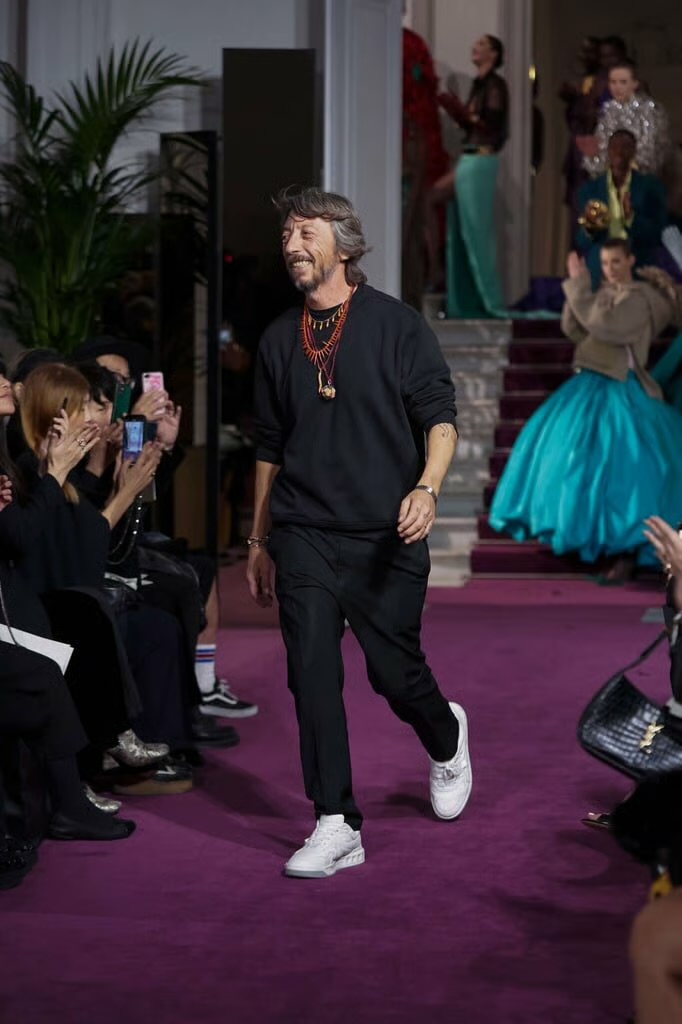


Meryll Rogge takes Marni apart to understand what still makes it Marni.

Meryll Rogge’s Spring Summer 2027 is less a return to the past than a question of what is still worth carrying forward
What happens when a fashion house has become more famous for its memory than for its present?
This is perhaps the question sitting quietly underneath Meryll Rogge’s second collection for Marni, presented in Milan for Spring Summer 2027. Not because Rogge is attempting to recreate the Marni of Consuelo Castiglioni, and certainly not because she is interested in nostalgia. Quite the opposite. Her project begins with a more uncomfortable exercise: deciding what deserves to survive.
When a designer enters a house with a history as dense as Marni’s, the archive becomes both material and burden. You inherit silhouettes, colours, prints, gestures, expectations, old customers, new customers and, most dangerously, a collective idea of what the brand is supposed to look like. Rogge has understood that the archive is not a wardrobe to be copied. It is a problem to be edited.
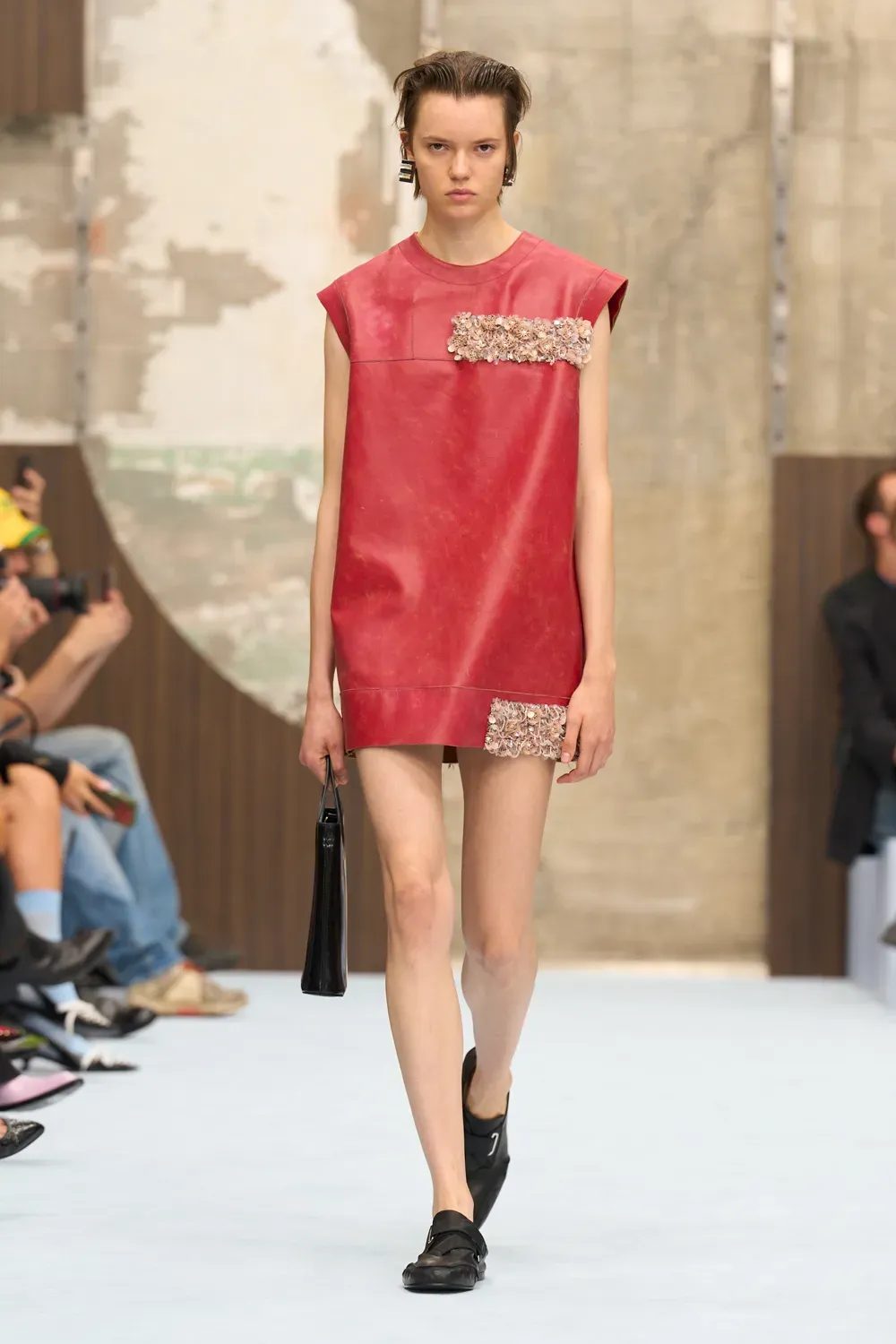
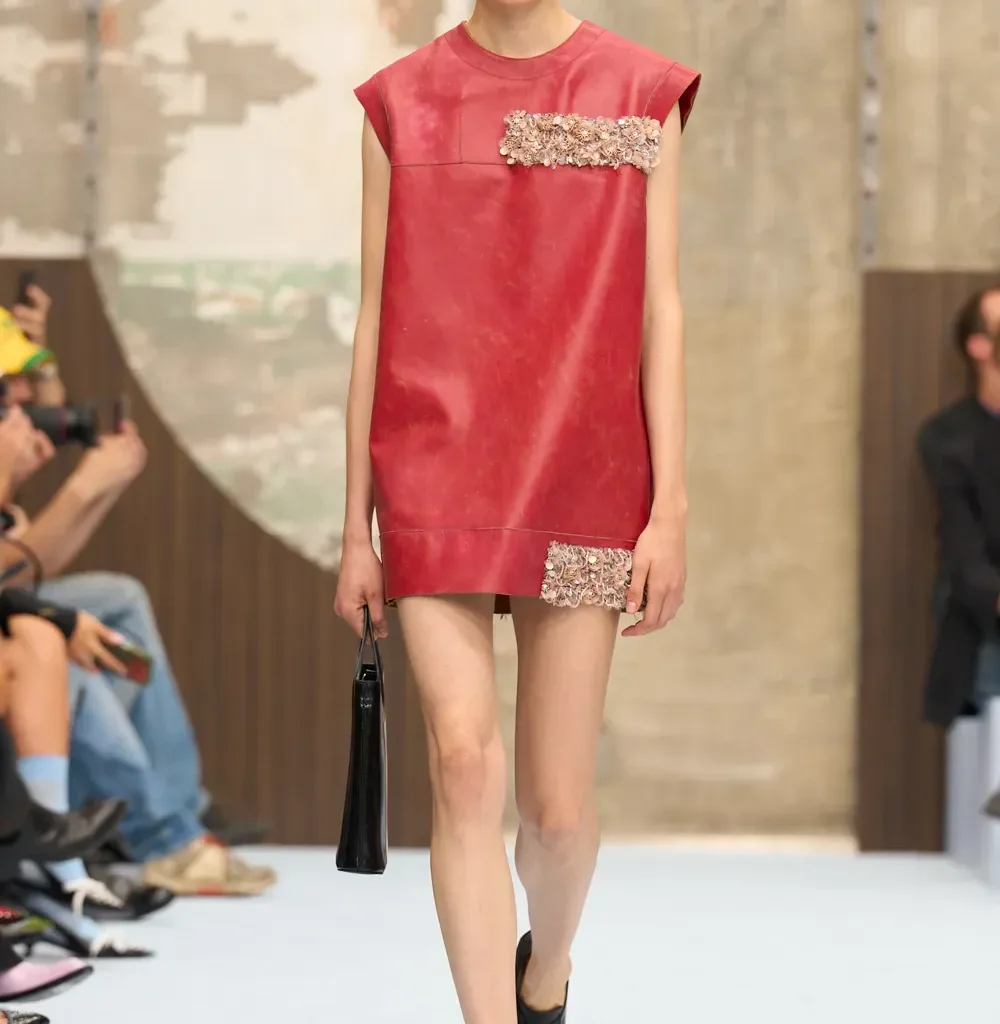
For Spring Summer 2027, that idea becomes literal. Garments appear interrupted by openings, metal loops, incomplete embroidery and details that seem almost accidentally unfinished. Some tops look as though they need another few centimetres of fabric. Something is always missing, displaced or deliberately left unresolved. Rogge has described these absences as a way of representing the things she has had to leave behind when entering Marni.
It is a surprisingly honest proposition.
Because creative direction is, in the end, an exercise in exclusion.
You cannot keep everything.
The house that was strange before strange became a strategy
Marni was founded in Milan in 1994 by Consuelo Castiglioni, a designer who never attended fashion school and nevertheless developed one of the most recognisable visual languages of her generation. Her Marni was not built around the conventional vocabulary of luxury. It was built around a peculiar kind of intelligence.
Castiglioni understood that sophistication did not require perfection.
A floral print could be awkward. A colour combination could be wrong on purpose. A precious fabric could be cut into something almost ordinary. Jewellery could look naïve. A polished coat could coexist with something deliberately homespun. The tension was the point.
Marni became luxurious without behaving like luxury.
That distinction matters because it is precisely where Rogge finds her way into the house.
Her own language was formed through a similarly contradictory instinct: taking recognisable things and making them slightly unstable. Her Belgian education at Antwerp’s Royal Academy taught her, above all, to think independently. Her years at Marc Jacobs in New York gave her an understanding of fashion as a vast collaborative machine, from pattern-cutting and production to image-making and communication. Then came Dries Van Noten, where colour, textile, historical references and the emotional intelligence of clothing became another kind of education.
Before arriving at Marni, Rogge had already developed a vocabulary of clashes: sporty and romantic, polished and naïve, decorative and functional, familiar and strange.
In that sense, the appointment was not as improbable as it initially appeared.
Rogge did not have to learn how to make something feel Marni.
She had to learn how to make Marni feel like itself again without becoming a replica of itself.
Consuelo, Francesco, Meryll
This is where the history becomes more complicated.
Castiglioni established the grammar.
Francesco Risso, who succeeded her in 2016, stretched that grammar almost to the point of abstraction. His Marni became more theatrical, emotional and surreal, less interested in the everyday wardrobe and increasingly fascinated by the possibilities of fashion as performance, art and spectacle.
Rogge arrives after that expansion.
Her instinct is almost the opposite.
She is bringing Marni back towards the body, the wardrobe, the street and the idea that clothes should actually have a life beyond the runway. Not banal clothes. Not safe clothes. But clothes that can participate in a person’s life rather than replace it.
This is why her Marni can look quieter than Risso’s while still being eccentric.
It is not trying to scream.
It is trying to be remembered.
And that is a considerably harder task.
The strange thing about nostalgia
Rogge has repeatedly rejected the idea that her work at Marni is nostalgic. She has a point.
Nostalgia implies that the past is being reconstructed because the present is insufficient. Rogge’s approach is different. She is interested in the mechanism of memory itself.
She has gone back to early Marni imagery, including work from the period before the brand became visually codified in the public imagination. That early Marni was not necessarily the hyper-coloured, heavily printed Marni that has survived as shorthand. There were dark colours, fitted silhouettes, restraint, animalier, geometric elements and a much more elusive form of eccentricity.
In other words, Rogge is not asking:
What did Marni look like?
She is asking:
Why did Marni feel like Marni?
That distinction may become the most important part of her tenure.
Because if the answer is simply flowers, chains, colour, prints, oversized jewellery and Castiglioni’s silhouettes, then Marni becomes an archive brand.
If the answer is a certain way of combining things that should not necessarily belong together, then Marni still has a future.





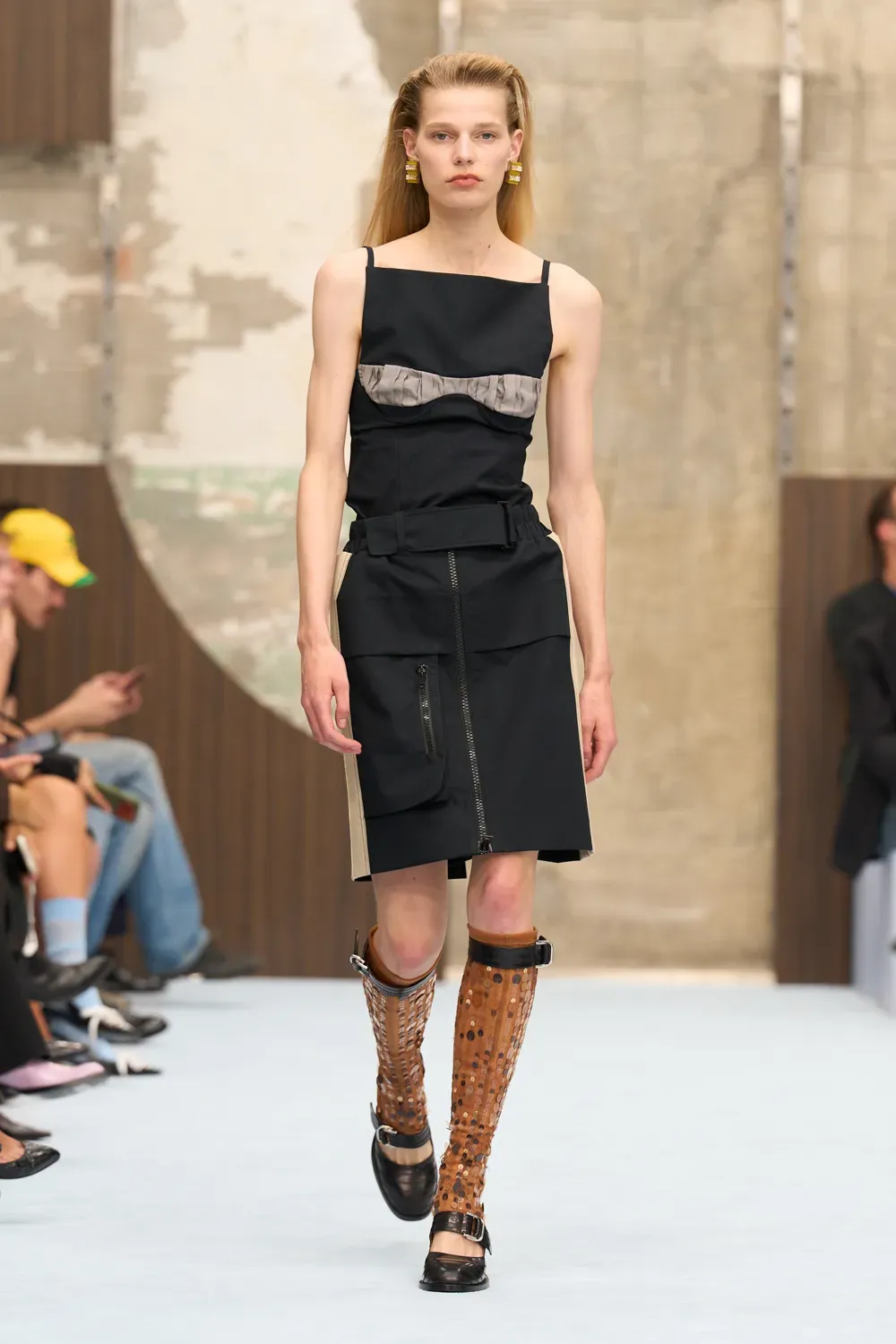


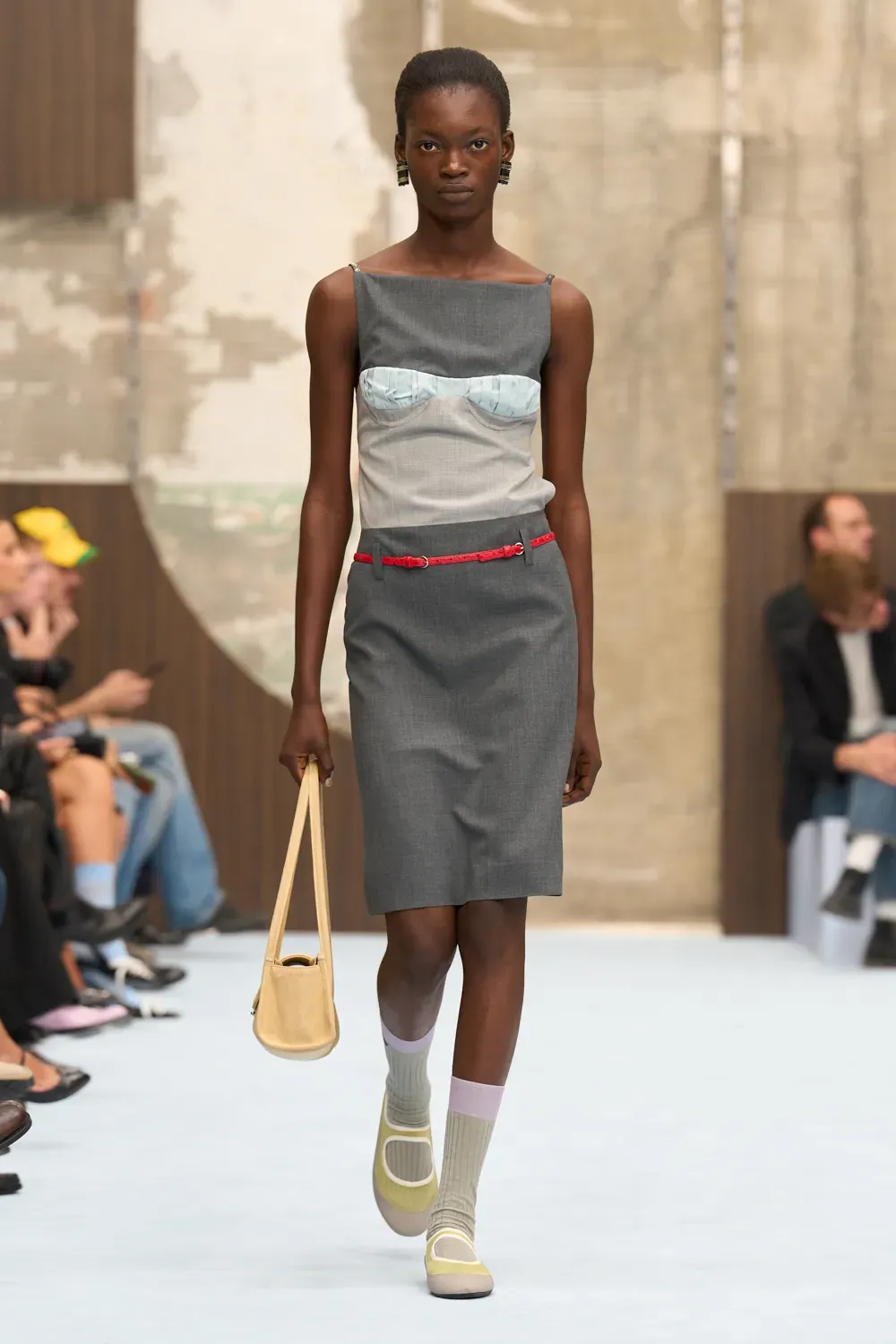

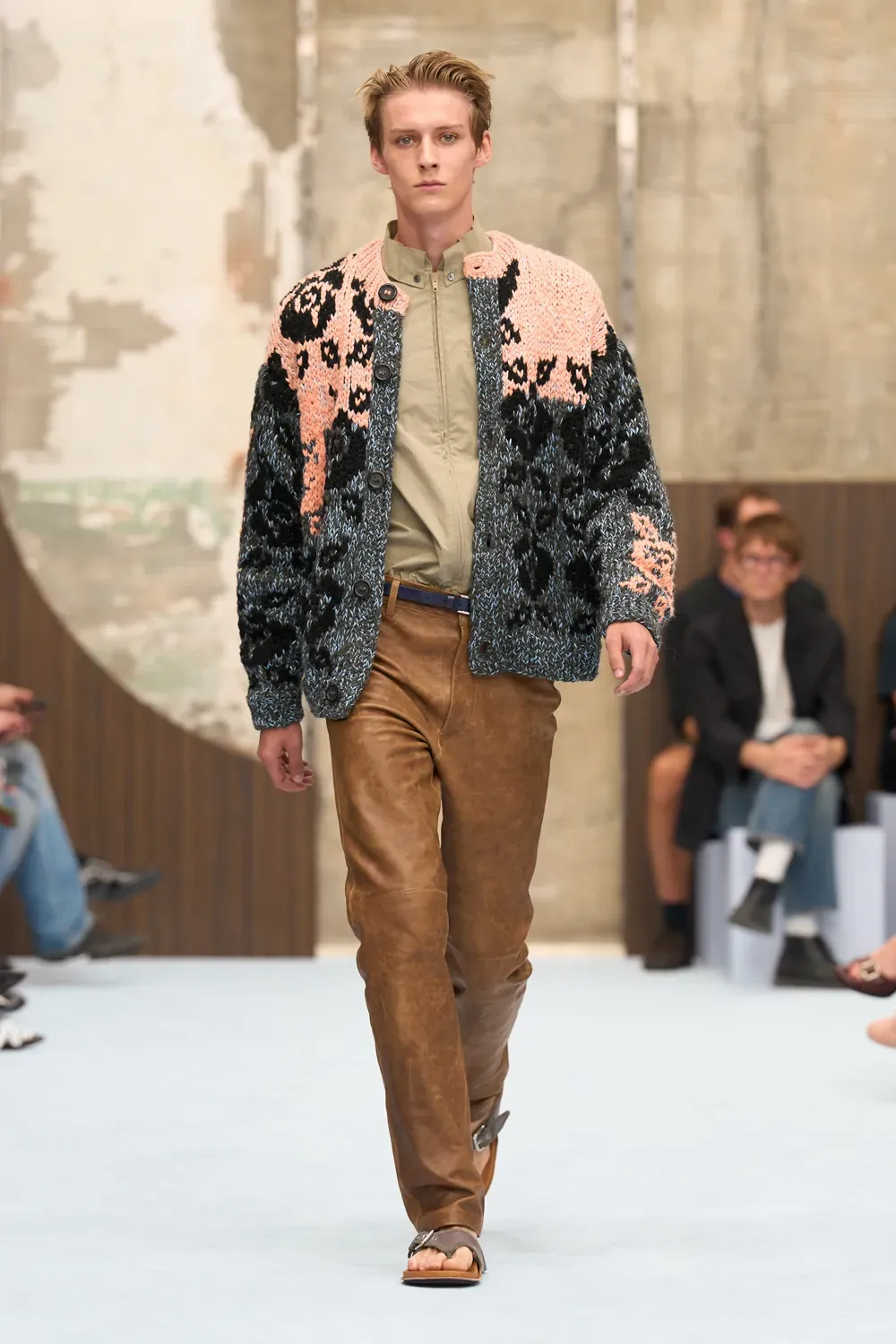
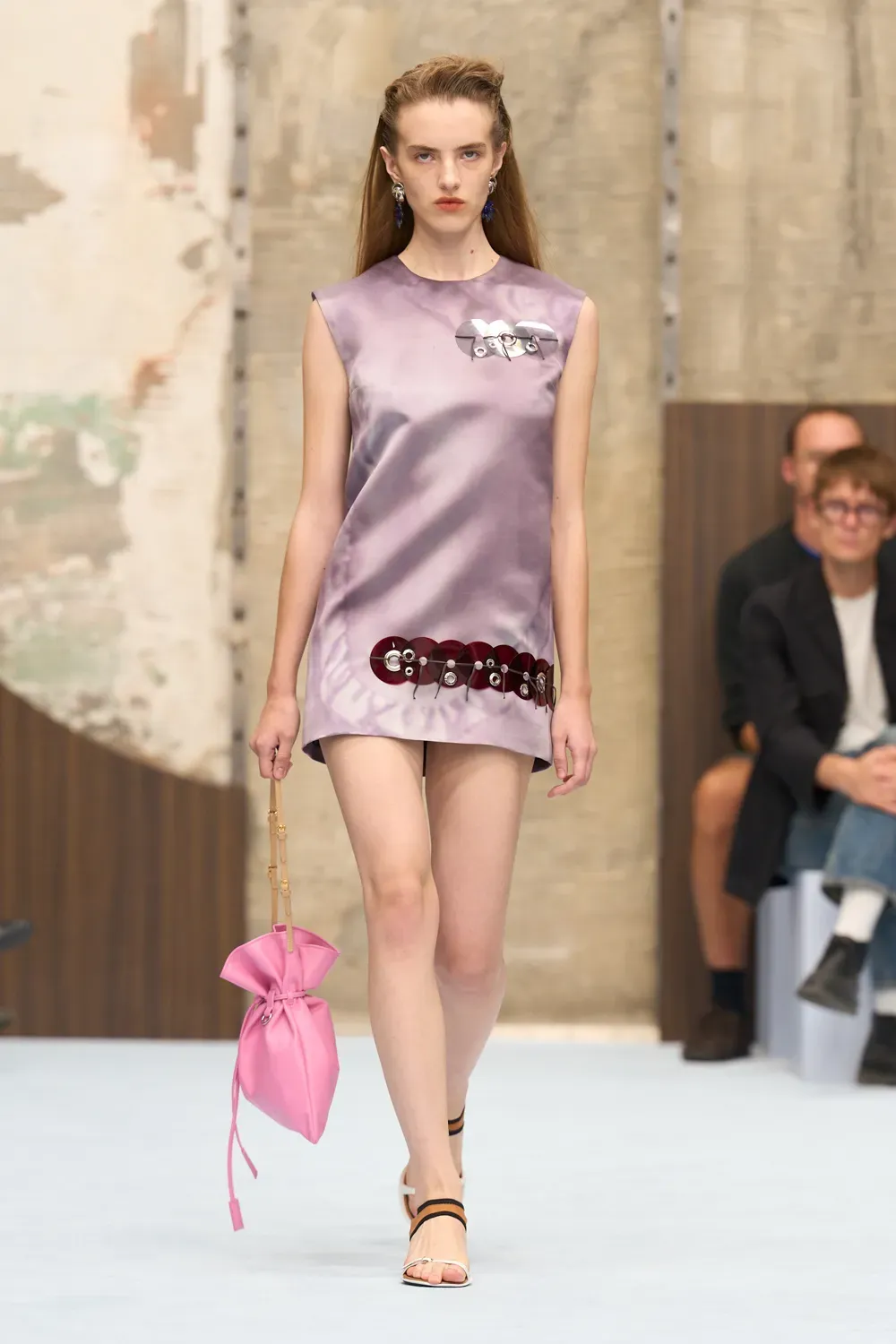

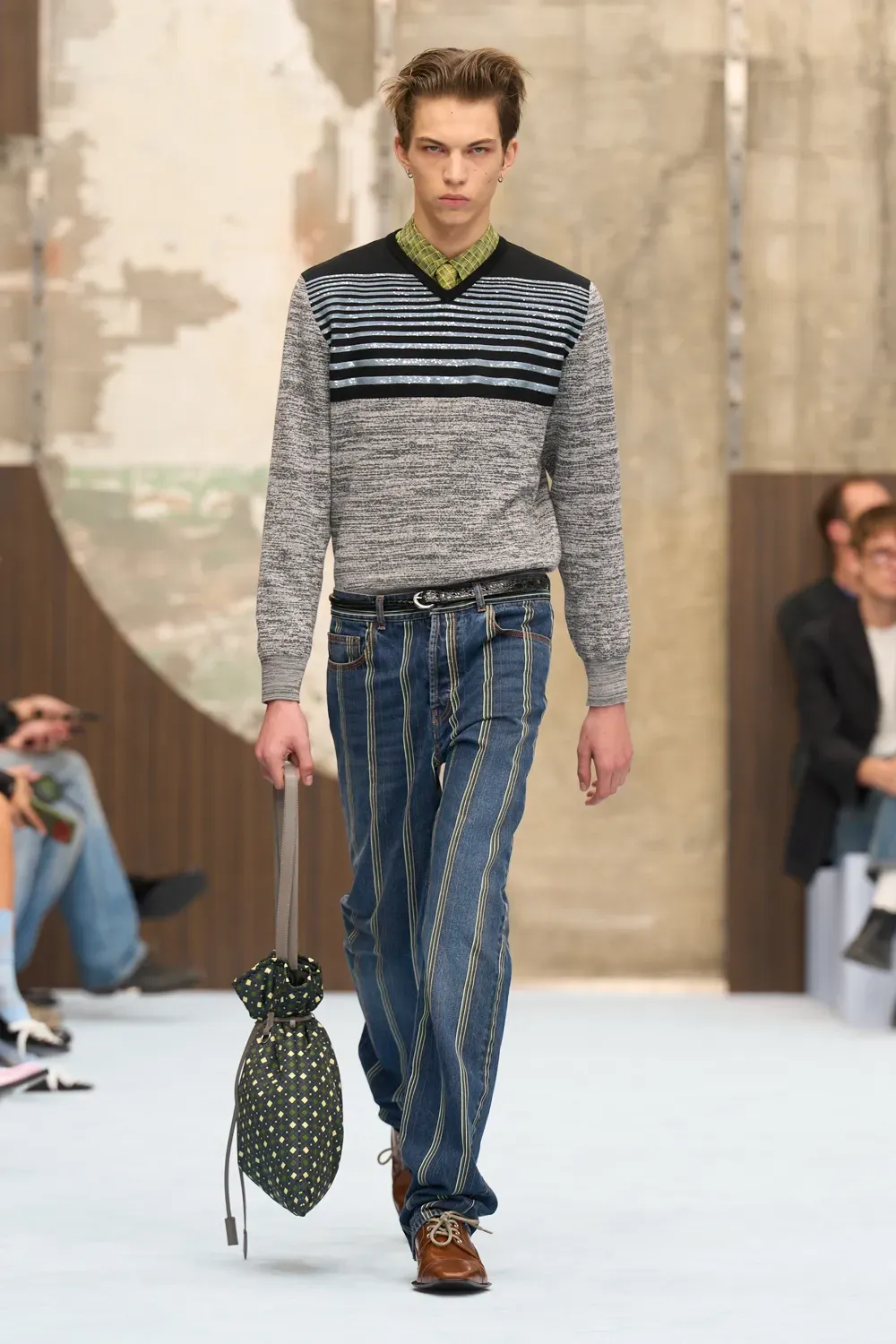


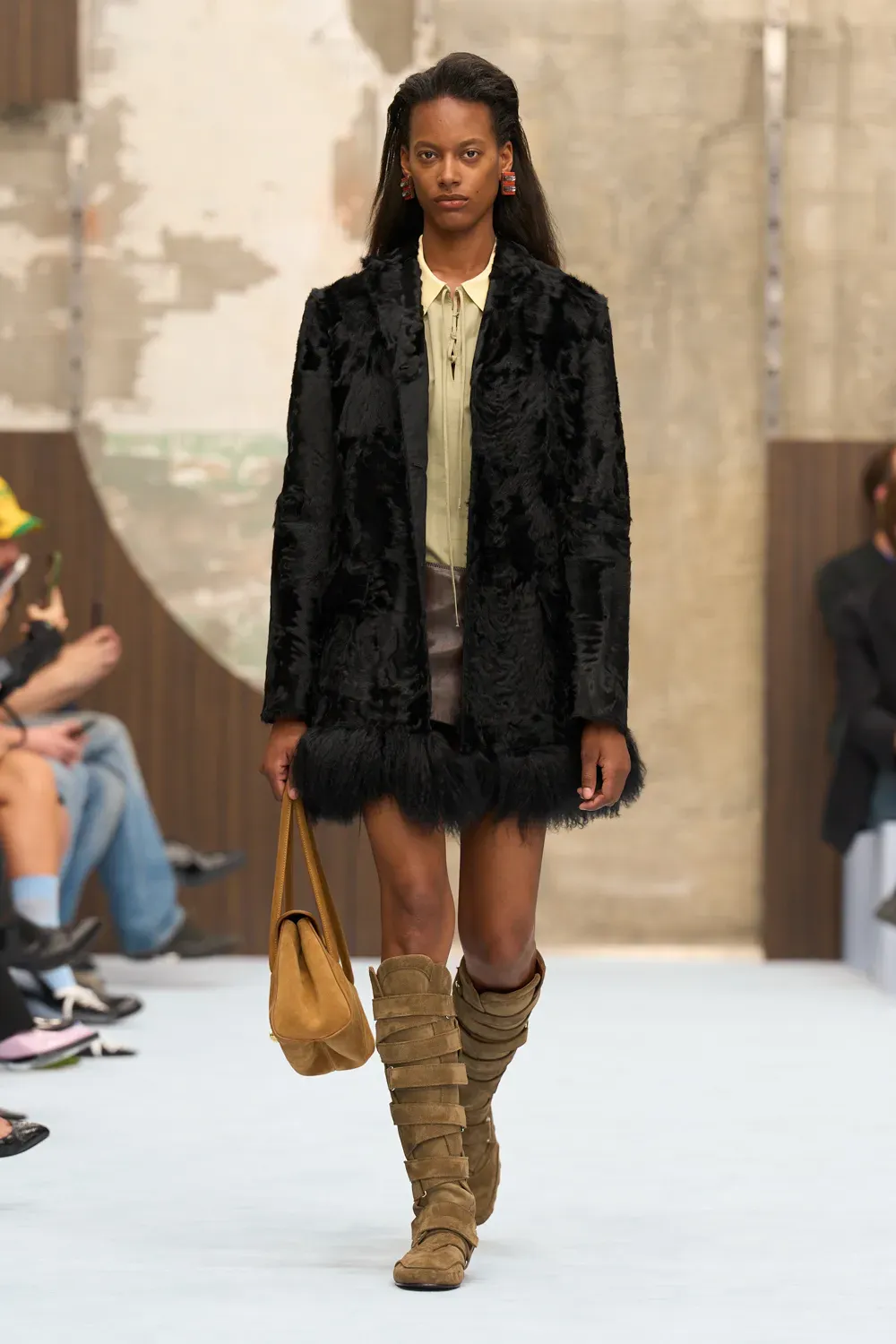


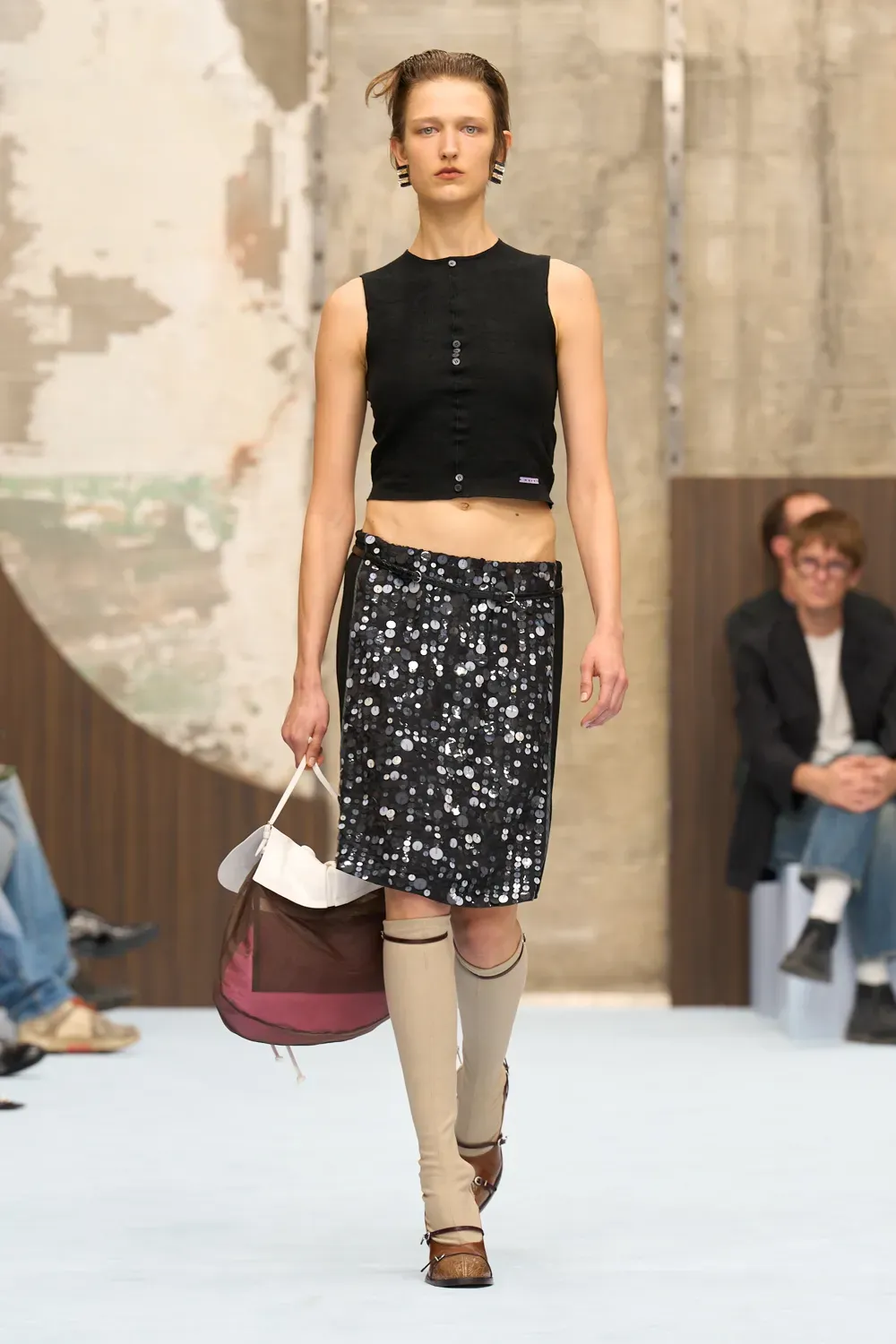

Spring Summer 2027 is the second attempt at that answer
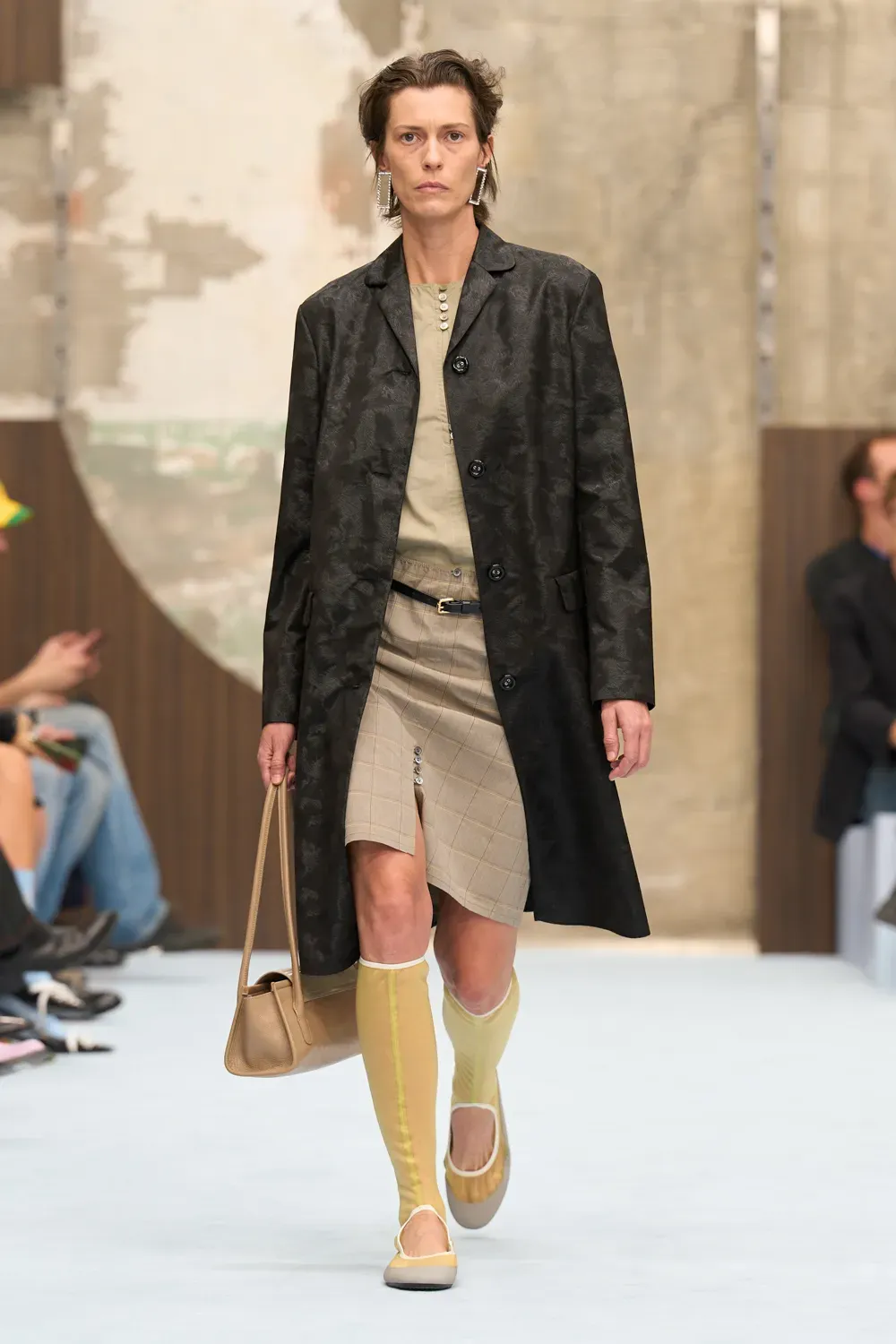
The collection is full of objects and ideas that appear to have come from different wardrobes and different decades.
Capri trousers.
Seventies A-line dresses.
Cardigans.
Pencil skirts.
Afghan coats.
Technical outerwear.
Knee socks.
Ballet shoes with exaggerated straps.
Sequins.
Stripes.
Tailoring.
Large earrings.
Oversized bags carrying several patterns at once.
Nothing is supposed to belong perfectly.
That is the point.
A woman can look as though she walked out of a seventies film, a Belgian art-school studio and an airport terminal at exactly the same time.
The references are familiar, but the combination is contemporary.
This is where the much-discussed idea of the Manic Pixie Dream Girl becomes useful, but only up to a point. The Penny Lane figure, the eccentric cinematic girl, the romantic misfit, the woman who appears to have assembled her wardrobe through instinct rather than rules: all of that is visible.
But Rogge’s woman is not really a character from a film.
She is what happens when someone has grown up with access to every film, every archive, every resale platform and every decade simultaneously.
She does not live in the seventies.
She has the seventies in her wardrobe.
There is a difference.



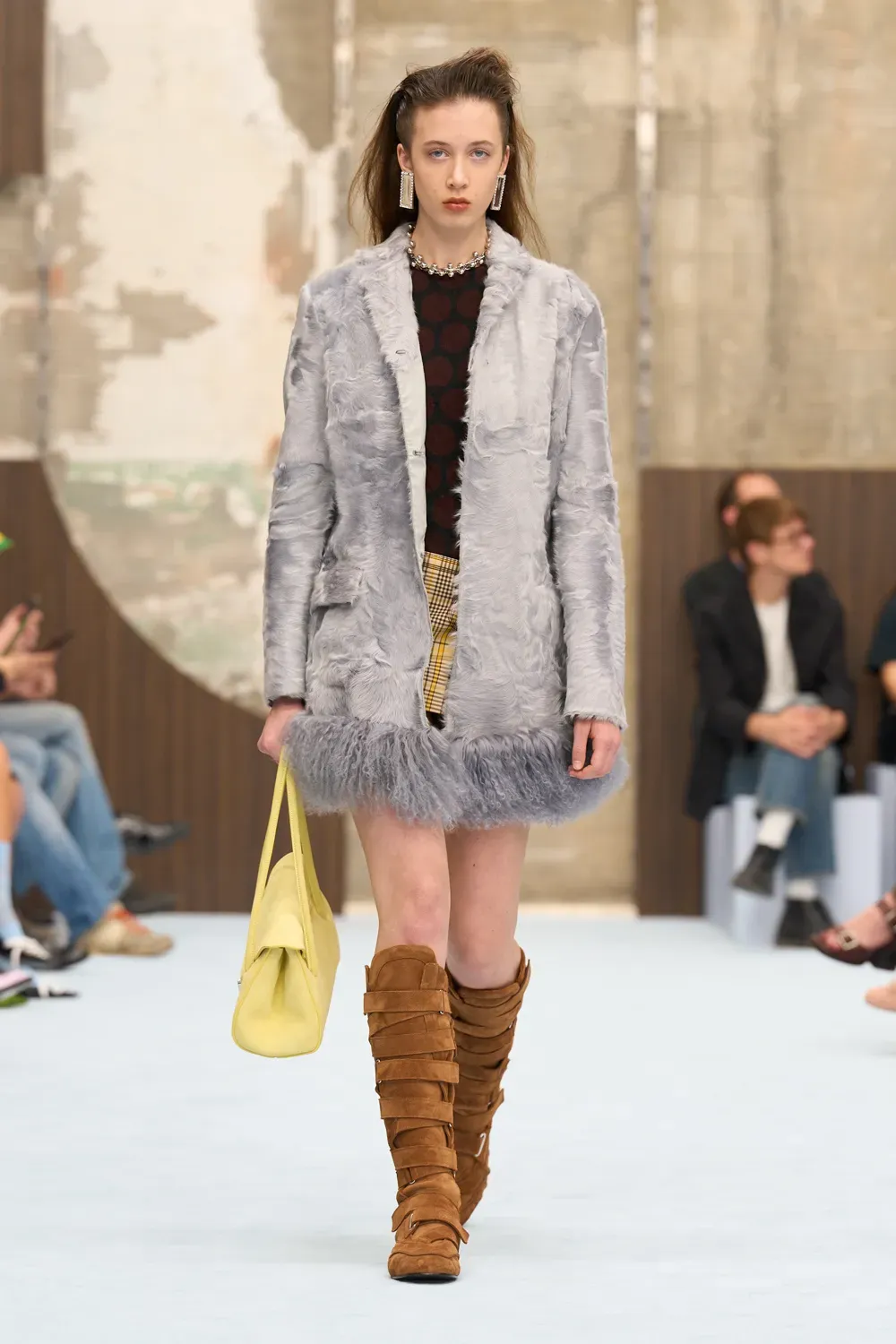




















The designer as conductor
Perhaps the most revealing thing Rogge has said about her role at Marni is that she does not see herself as the isolated genius traditionally associated with the creative director.
She describes herself instead as a conductor.
That idea says something about her clothes.
Rogge does not seem particularly interested in purity. She is interested in orchestration.
A good Marni look is not necessarily one extraordinary garment. It is the friction between several ordinary or extraordinary garments that makes the image work.
This is why her experience at Marc Jacobs and Dries Van Noten matters so much. She learned that a fashion house is not a single mind. It is a system of people, skills, interpretations, mistakes and negotiations.
Her creative direction therefore operates less like authorship and more like editing.
And editing is about deciding what stays.
And what disappears.
But does it seduce?
Here the collection deserves criticism.
The intellectual framework is convincing. The visual language is coherent. The relationship between Marni’s history and Rogge’s own vocabulary is increasingly clear.
But fashion is not an academic argument.
Clothes have to seduce.
One of the weaknesses of Spring Summer 2027 is that the intelligence of the construction can sometimes become more visible than the desire behind it. The dissonant colours, awkward proportions, deliberate interruptions and anti-polished styling are all recognisably Rogge, but they can occasionally feel like a demonstration of taste rather than an irresistible proposition.
The collection knows why it is strange.
The question is whether it always makes you want to be strange with it.
This is where the comparison with the great Marni years becomes useful. Castiglioni’s clothes could be intellectually sophisticated while remaining deeply desirable. Their awkwardness did not cancel seduction. It created it.
Rogge has the awkwardness.
She is still working on the seduction.
That is not a dismissal. It is probably the most interesting challenge of her tenure.
The commercial question hiding inside the artistic one
There is another issue that cannot be ignored.
Marni belongs to a large fashion group. Its future cannot exist exclusively inside runway criticism. The house needs bags, shoes, accessories and clothes that people actually want to buy.
Spring Summer 2027 understands this.
The oversized bags, mixed patterns, suede boots, straps, hardware and footwear have an immediacy that some of the more conceptual clothing deliberately avoids.
But this creates another tension.
How do you make something commercially desirable without smoothing away the very weirdness that made Marni desirable in the first place?
This is the real contemporary luxury problem.
Not how to become more exclusive.
How to remain distinctive when everyone has access to the same references.
Marni after the algorithm
There is also something sociological happening here.
Marni was born before fashion was consumed as an endless stream of images. Castiglioni could create a visual language slowly, allowing people to recognise it through repetition.
Rogge is designing in a culture where references are immediately flattened.
A seventies dress, a nineties shoe, a Japanese knit, an archive Marni print and a TikTok microtrend can exist on the same screen within seconds.
The danger for a house like Marni is obvious.
If everything is available, nothing is specific.
Rogge’s answer is not to invent something completely unprecedented. It is to make combinations that feel sufficiently personal that the references stop being the story.
That may be the real meaning of her bricolage.
Not recycling.
Recontextualising.
Taking something that already exists and giving it a different social life.
So who gets to define Marni now?
Not Consuelo Castiglioni alone.
Not Francesco Risso.
Not Meryll Rogge either.
The answer is probably more complicated.
Marni is now a negotiation between its founder’s original intelligence, the mythology accumulated over three decades, the transformations introduced by Risso, Rogge’s own Belgian and New York education, the commercial ambitions of the house and a new generation that did not necessarily experience Marni in its original cultural context.
That makes Rogge’s job almost anthropological.
She has inherited a culture.
She has to decide which parts are still alive.
Spring Summer 2027 is therefore less a declaration than an experiment.
It asks whether Marni can be strange again without becoming obscure. Whether it can be desirable without becoming polished. Whether it can speak to younger consumers without turning youth into a marketing strategy. Whether an archive can be used without becoming nostalgia. And whether a creative director can create something new without pretending that history does not exist.
The answer, for now, is incomplete.
And that is precisely why the collection is worth looking at.
Meryll Rogge has not reinvented Marni.
Not yet.
She has done something more useful.
She has started taking it apart.
And perhaps that is the only honest way to find out what is still holding it together.