


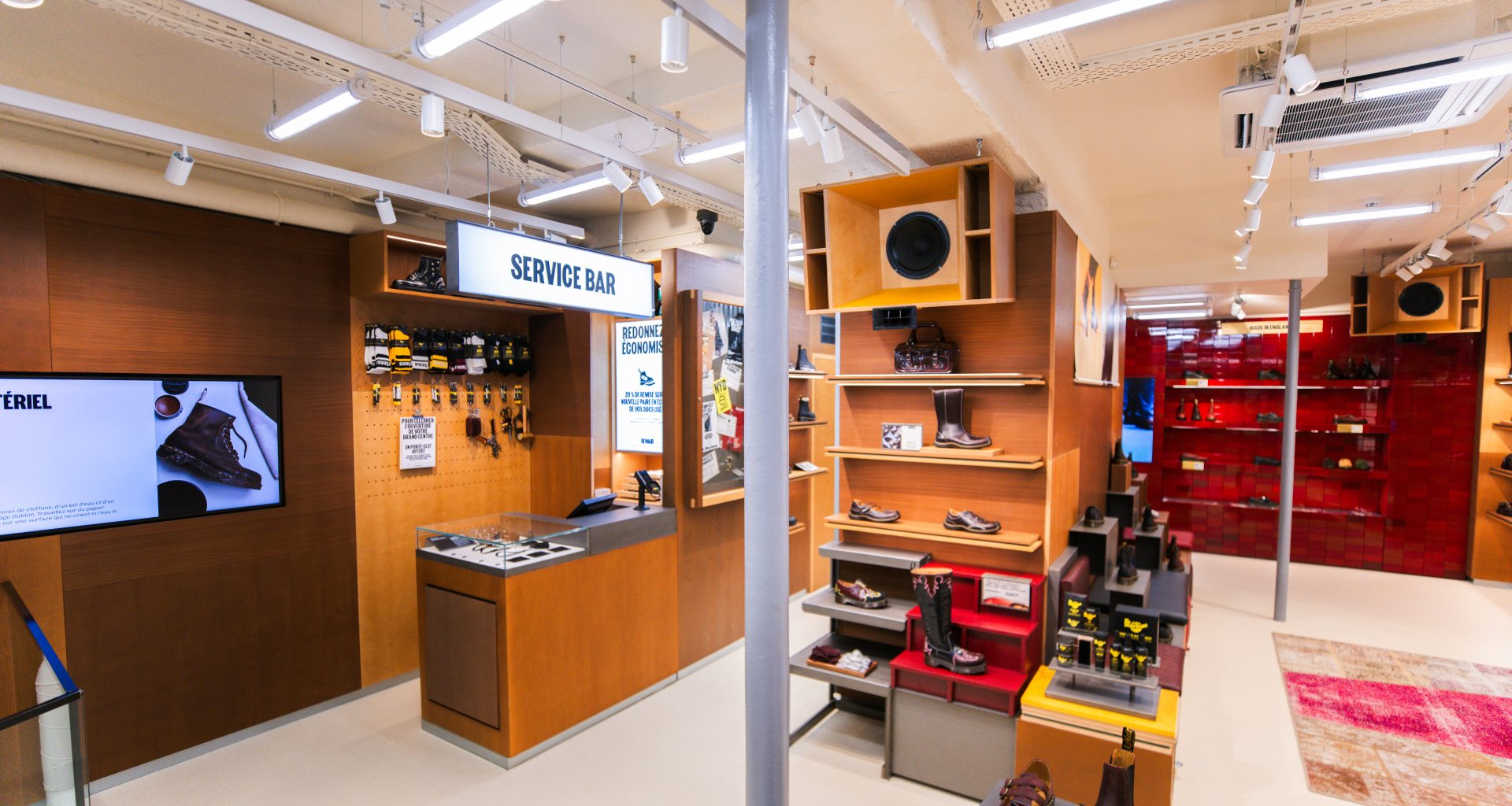
What happens when fashion remembers that a shoe is made by people, not just produced by a supply chain? In Paris, Dr. Martens makes craftsmanship part of the conversation again.
Fashion loves a good origin story.
It loves heritage, too, preferably packaged in a campaign, stamped with a logo and sold at a premium. But between the mythology of craftsmanship and the reality of making a shoe, something has gone missing: the human being behind the product.
On October 15, at Dr. Martens’ new Brand Centre in Le Marais, Paris, that distance felt unusually small.
The evening began inside the brand’s new retail destination at 6 Rue Sainte-Croix de la Bretonnerie, before moving to dinner at Joli, just around the corner. The setting changed; the conversation didn’t. Beyond the boots, the yellow stitching and the familiar subcultural codes, the real subject was what gives a product its value long after the hype has moved on: the hands, knowledge and people involved in making it.
And then came a detail that made the whole thing click.
Inside the shoes we received at the end of the evening was the name of the person who had carried out the final quality check. Not an anonymous factory reference. Not a vague promise of authenticity. A human name, attached to a finished product.
In an industry increasingly obsessed with speed, scale and the next disposable obsession, that small gesture said more than another thousand words about heritage ever could.
The Craft Is the Flex
Dr. Martens has never needed to invent an identity from scratch. Born in England, the brand’s 1460 boot first rolled off the production line on April 1, 1960. Its journey from practical footwear to a symbol of working-class identity, music and subcultural resistance is well documented. Generations of wearers have made the boot their own, turning a functional object into a statement of individuality.
But heritage is not a lifetime membership to cultural relevance. It is something a brand has to keep earning.
The new Le Marais Brand Centre signals a shift in how Dr. Martens wants people to experience its world. Part of a broader four-tier retail strategy, the space belongs to a new generation of stores designed to move beyond the basic transaction. Product storytelling, customisation, care services, repair, circular initiatives and collaborations with local creatives all contribute to a more expansive idea of retail.
The ambition is to make the store a destination rather than a checkout point. Yet the most compelling part of the experience goes beyond spatial design or premium merchandising. It is the opportunity to reconnect the object with the labour that brings it into existence.
Craftsmanship is often treated as fashion’s favourite decorative adjective. It appears in press releases, justifies price increases and gives industrial production a reassuring human gloss. The word becomes almost meaningless when nobody can explain what it actually represents.
A name inside a shoe changes the conversation. It creates a direct line between the person who checks the product and the person who wears it. It makes the manufacturing process feel less abstract, reminding us that quality is not an automatic feature of a brand’s reputation. It is the result of human attention, expertise and responsibility.
That is the real flex. Not pretending that production is effortless, but acknowledging the people whose work makes the finished product possible.
Against the Logic of Disposable Fashion
The modern footwear industry operates under enormous pressure to deliver more, faster. New drops, collaborations, trend cycles and constant product refreshes compete for attention in a market where yesterday’s must-have can become tomorrow’s resale listing. The consumer sees the finished object; the manufacturing process often remains somewhere offstage.
This separation has consequences. When the people behind a product disappear from the story, craftsmanship becomes harder to recognise, production becomes easier to take for granted, and value is increasingly confused with visibility.
Dr. Martens offers a different point of entry. Alongside its wider production network, the company continues to maintain its Made in England footwear, manufactured at its original Northamptonshire factory. Its heritage is not simply a visual language to reproduce; it is also a relationship with techniques, materials and manufacturing knowledge that cannot be reduced to a marketing slogan.
The distinction matters. A product does not become handmade simply because a campaign says so, and not every Dr. Martens shoe should be understood as entirely handmade. The significance lies in making craftsmanship tangible and giving the people involved in production a visible place in the brand’s story.
The name inside our shoes was a modest detail, not a solution to every question about modern manufacturing. But it was precisely its modesty that made it powerful. It gave a face, or at least a name, to a process that fashion usually presents as an immaculate result.
There is something almost radical about that level of specificity. In a culture that turns everything into content, the human detail becomes the thing worth paying attention to.
Le Marais, Beyond the Shop Window

Le Marais is a fitting place for this next chapter. Its independent fashion scene, galleries, creative studios and network of makers make it a natural meeting point for a brand whose identity has always been shaped by the people who wear it, challenge it and reinterpret it.
The new Brand Centre is designed to reflect that environment. Its modular interiors, product-focused displays and dedicated spaces for storytelling create room for seasonal launches, craft services and cultural programming. Customisation, care and repair extend the relationship with a product beyond the moment of purchase, while future collaborations with local talent offer opportunities to connect the brand with the community around it.
The business logic is clear: a richer retail experience can build engagement, strengthen brand desire and give consumers more reasons to return. But there is a more interesting possibility here. A store can become a place where a brand explains not only what it sells, but what it believes a product should be worth.
That distinction is increasingly important. Premium retail cannot rely on atmosphere alone. Beautiful interiors and carefully arranged products may attract attention, but substance is what gives people a reason to care. The challenge for Dr. Martens is to make the promise of craftsmanship consistent across its stores, services and products, rather than leaving it as a compelling detail in a single evening’s conversation.
At Joli, over dinner and conversations that continued beyond the store visit, the discussion returned to the same point: the value of footwear lies in more than its silhouette, its cultural associations or its position in the market. It also lies in the people who make it possible.
The shoes we received at the end of the evening carried that idea with them. Their maker’s name was not an accessory, a collaboration or a limited-edition gimmick. It was a reminder that even the most recognisable object has a human story behind it.
The Name Inside the Shoe
Dr. Martens knows that its products already carry decades of cultural meaning. The challenge is to make that history relevant without turning it into nostalgia.
The Le Marais Brand Centre is one expression of that ambition: a retail space built around product, services, creativity and community. Yet the most memorable takeaway was not the store’s architecture or the promise of another brand experience. It was the name inside a shoe.
Fashion spends a great deal of energy making products desirable. It spends considerably less time making the people responsible for them visible. That imbalance deserves scrutiny, particularly as the language of authenticity becomes more common and its meaning becomes easier to dilute.
Craftsmanship is not a retro fantasy, nor is it an aesthetic filter. It is work. It is knowledge passed between people, decisions made at every stage of production, and attention paid when nobody is watching. It is also a form of value that deserves to be recognised rather than hidden behind a finished product.
The next generation of premium footwear will not be defined by price alone, or by how convincingly a brand performs its own heritage. It will be defined by the substance behind the story.
At Dr. Martens, that substance has a name.
And sometimes, the most powerful brand statement is the one you find inside the shoe.