
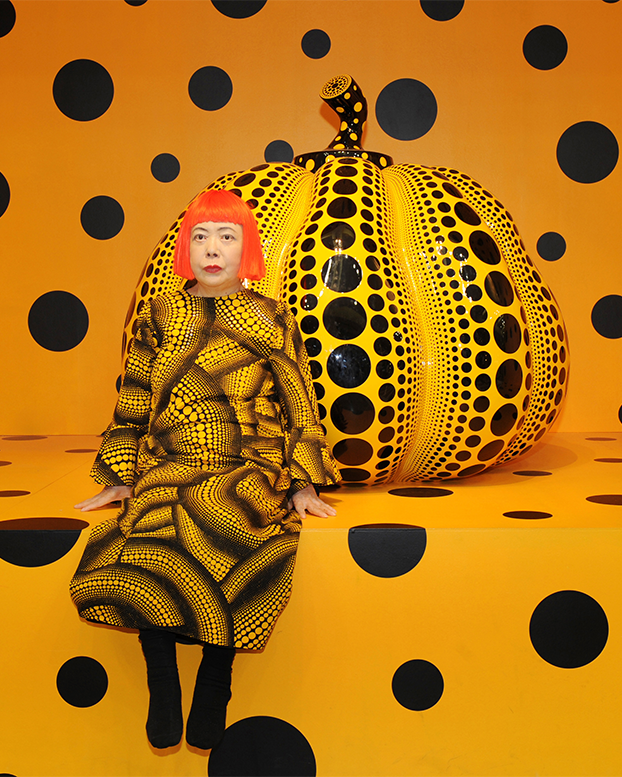
Few artists have understood the porous border between the intimate and the universal quite like Yayoi Kusama. What began as a deeply personal confrontation with hallucination, repetition and the fear of disappearance became one of the most radical visual languages of the last century.
Kusama did not simply make paintings, sculptures or installations. She constructed an alternative reality, one in which the boundaries of the body could dissolve, a room could become infinite, and a single dot could contain an entire cosmos.
From her early years in postwar Japan to the radical New York art scene of the 1960s, she persistently placed herself outside the categories available to her. Woman, Japanese, outsider, provocateur, obsessive, visionary: none of these identities could quite contain her. She kept moving beyond them.
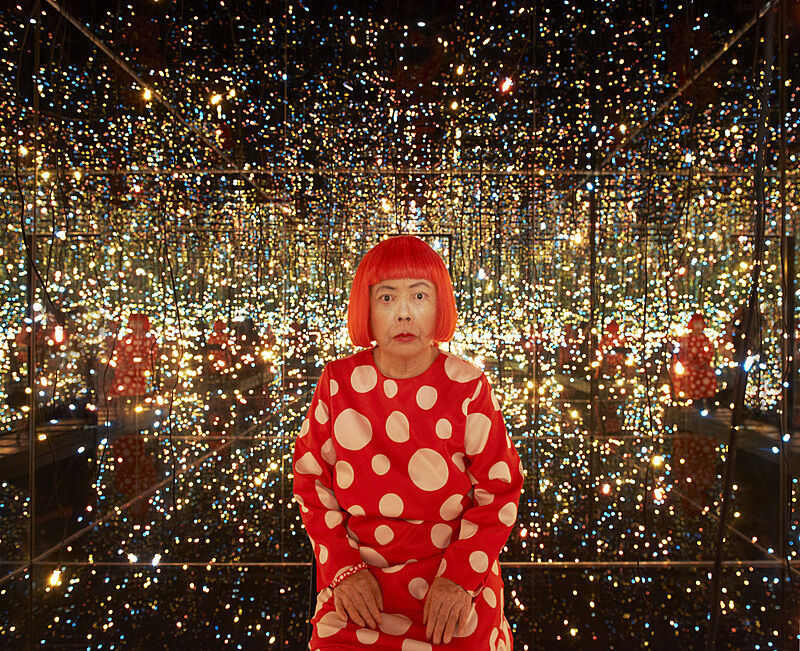
Her Infinity Nets, mirrored environments, naked happenings, soft sculptures, pumpkins and endless fields of polka dots were never merely signatures. They were different manifestations of the same desire: to escape the limits of the individual and disappear into something immeasurably larger.
And perhaps this is why Kusama eventually became more than an artist. She became a cultural universe of her own, moving effortlessly between avant-garde art, fashion, performance and popular culture without ever entirely belonging to any of them.
Yayoi Kusama died in Tokyo on August 14, aged 97. Until her final days, she continued to paint.
There is something fitting about that.
For an artist who spent a lifetime confronting infinity, there was never really a final canvas.
Only another dot.