Six years, two authors, one house – and a question that still has no final answer
When Raf Simons joined Prada in 2020, the fashion industry was offered something it almost never gets: not a succession, not a takeover, not a new designer arriving to erase the previous one, but an experiment.
Two designers. Equal creative responsibility. Equal decision-making power. One house.
Miuccia Prada and Raf Simons were supposed to work together rather than one after the other, challenging the very idea that a fashion house needs a single authorial voice. Prada itself described the arrangement as a challenge to the “singularity of creative authorship”.
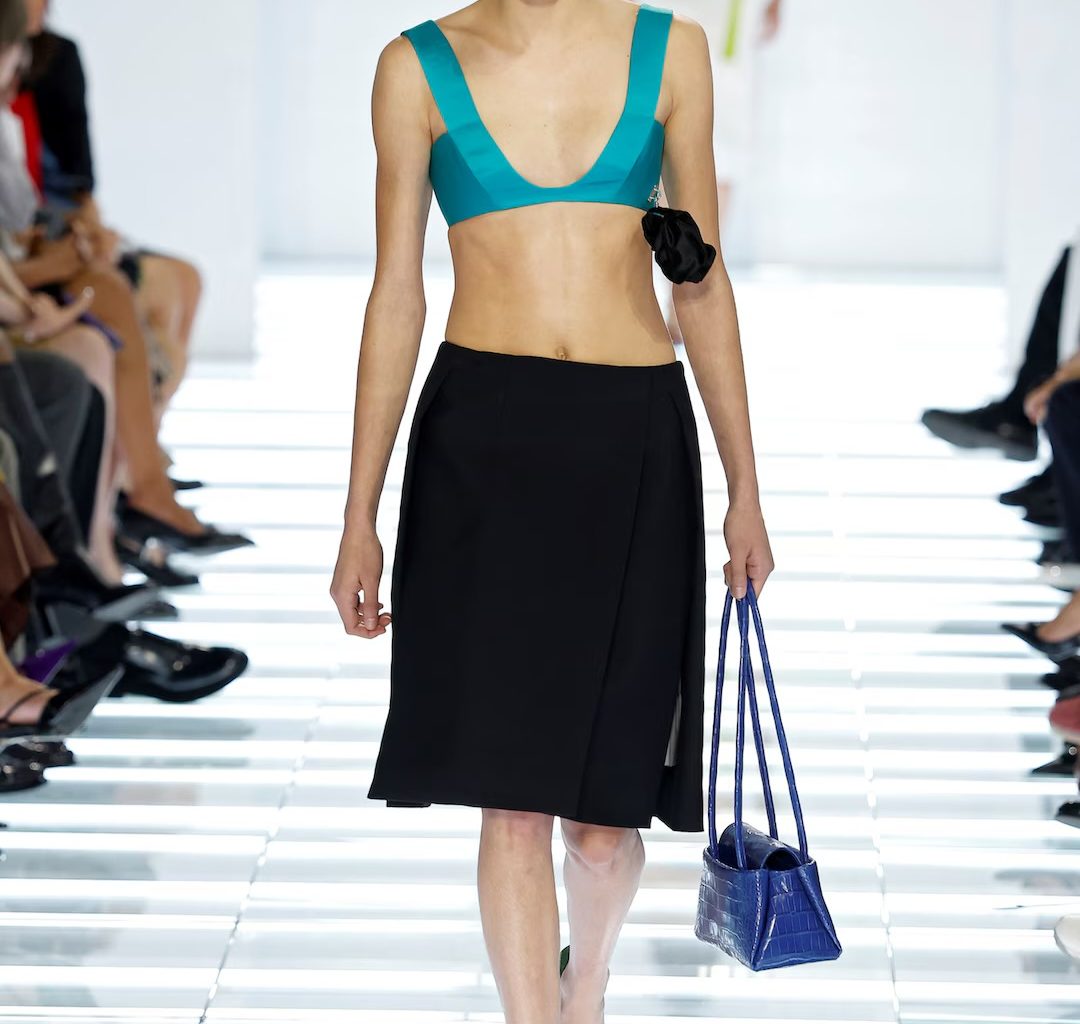
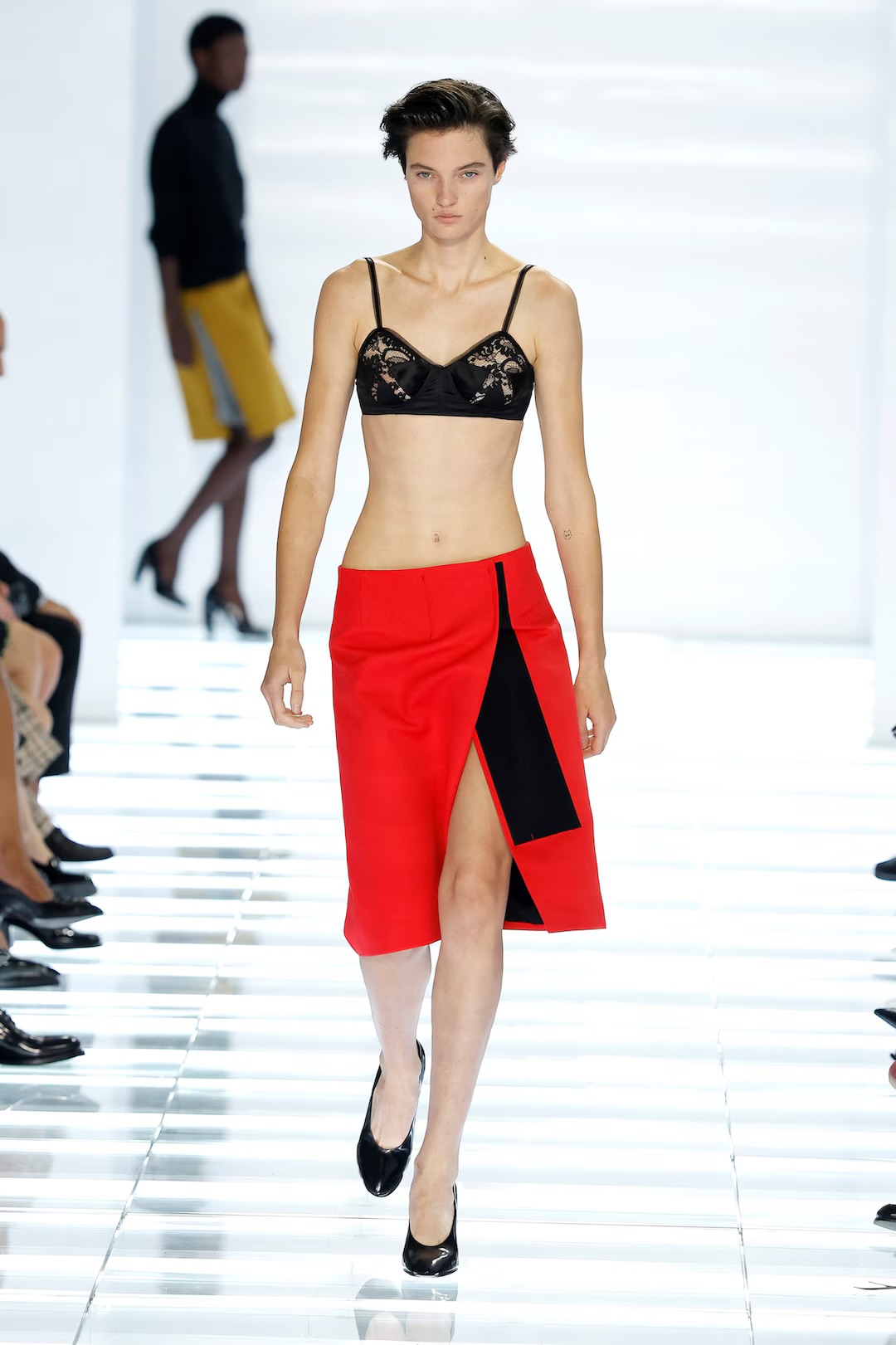
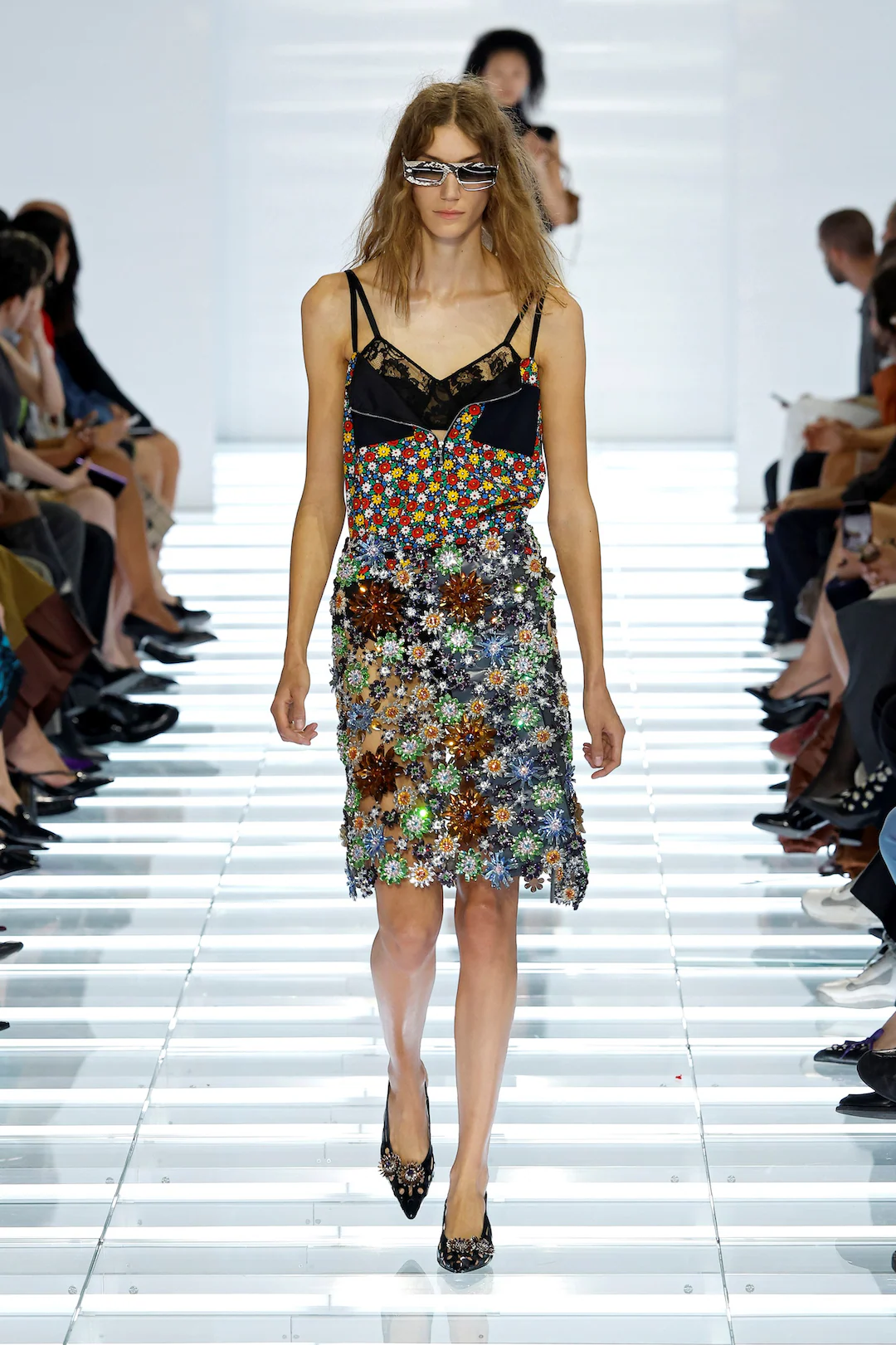
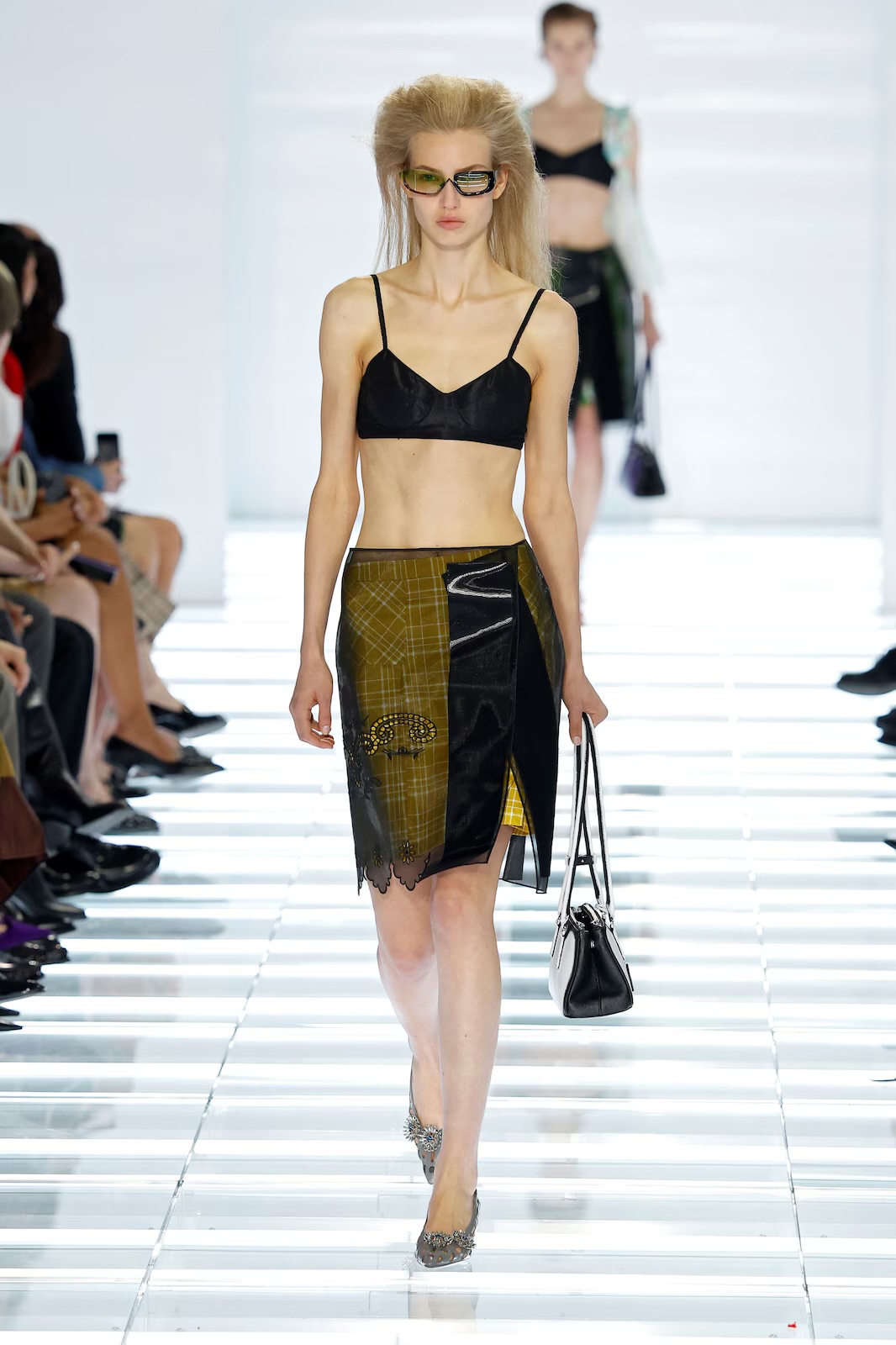
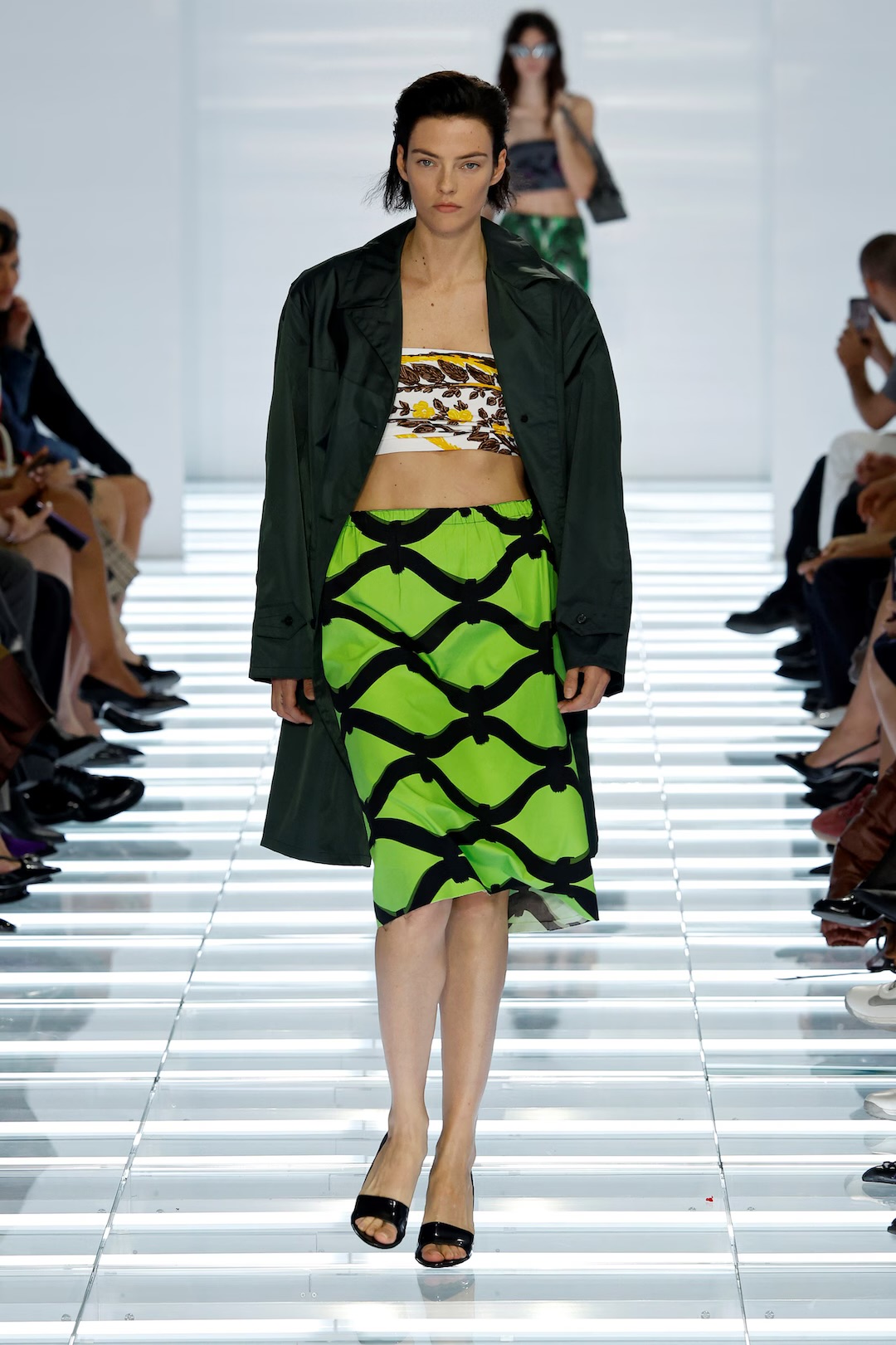
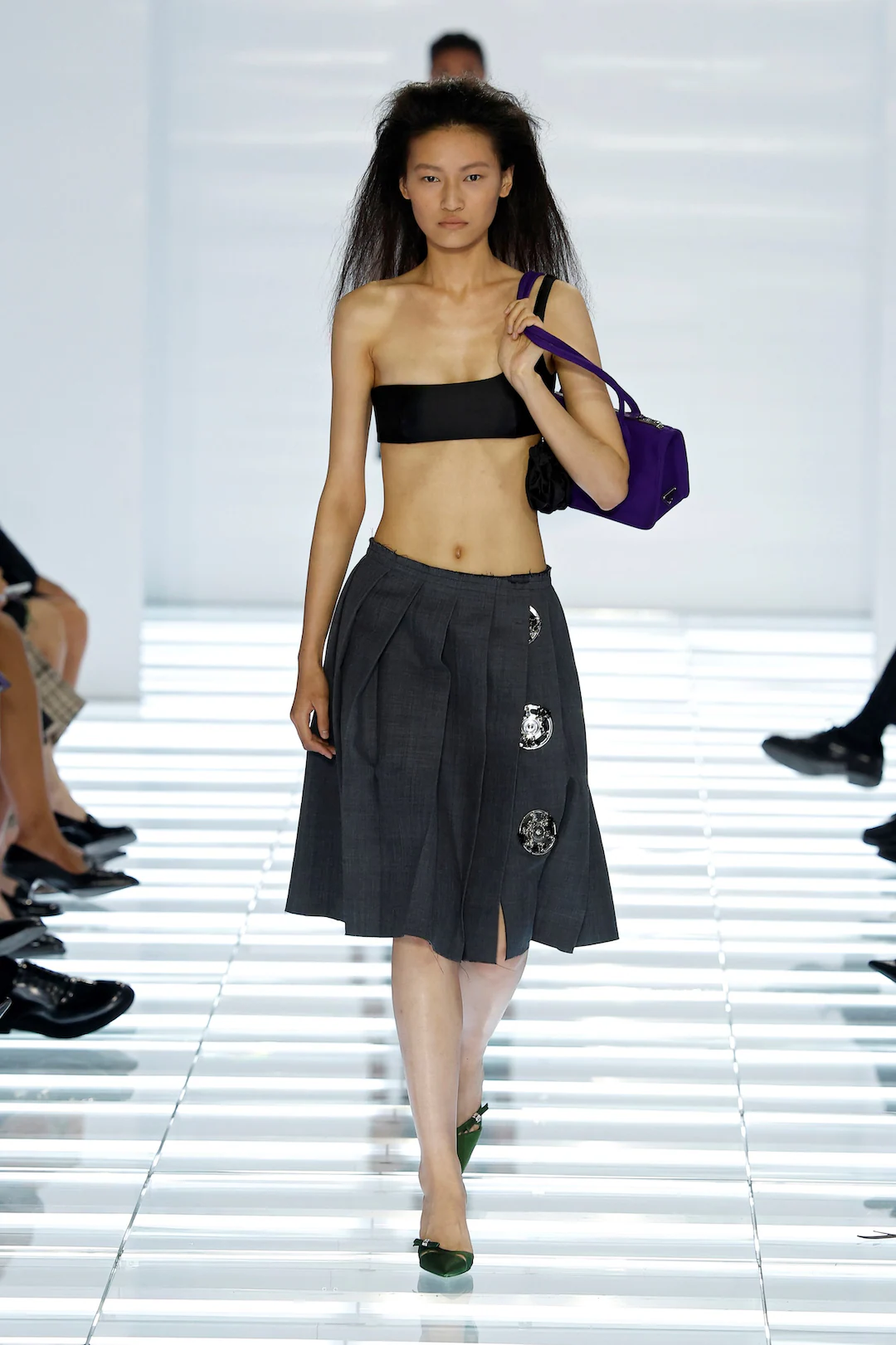
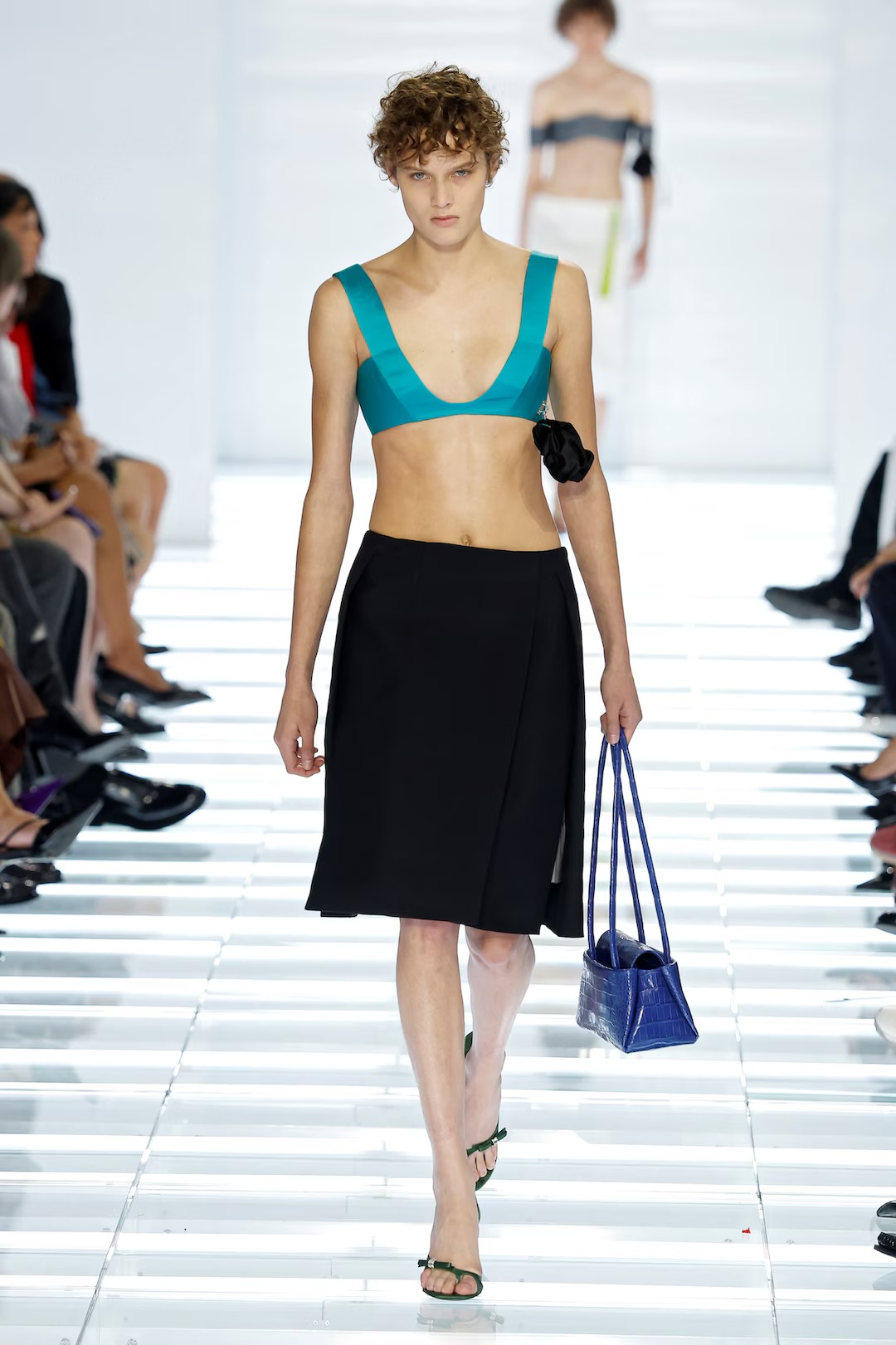
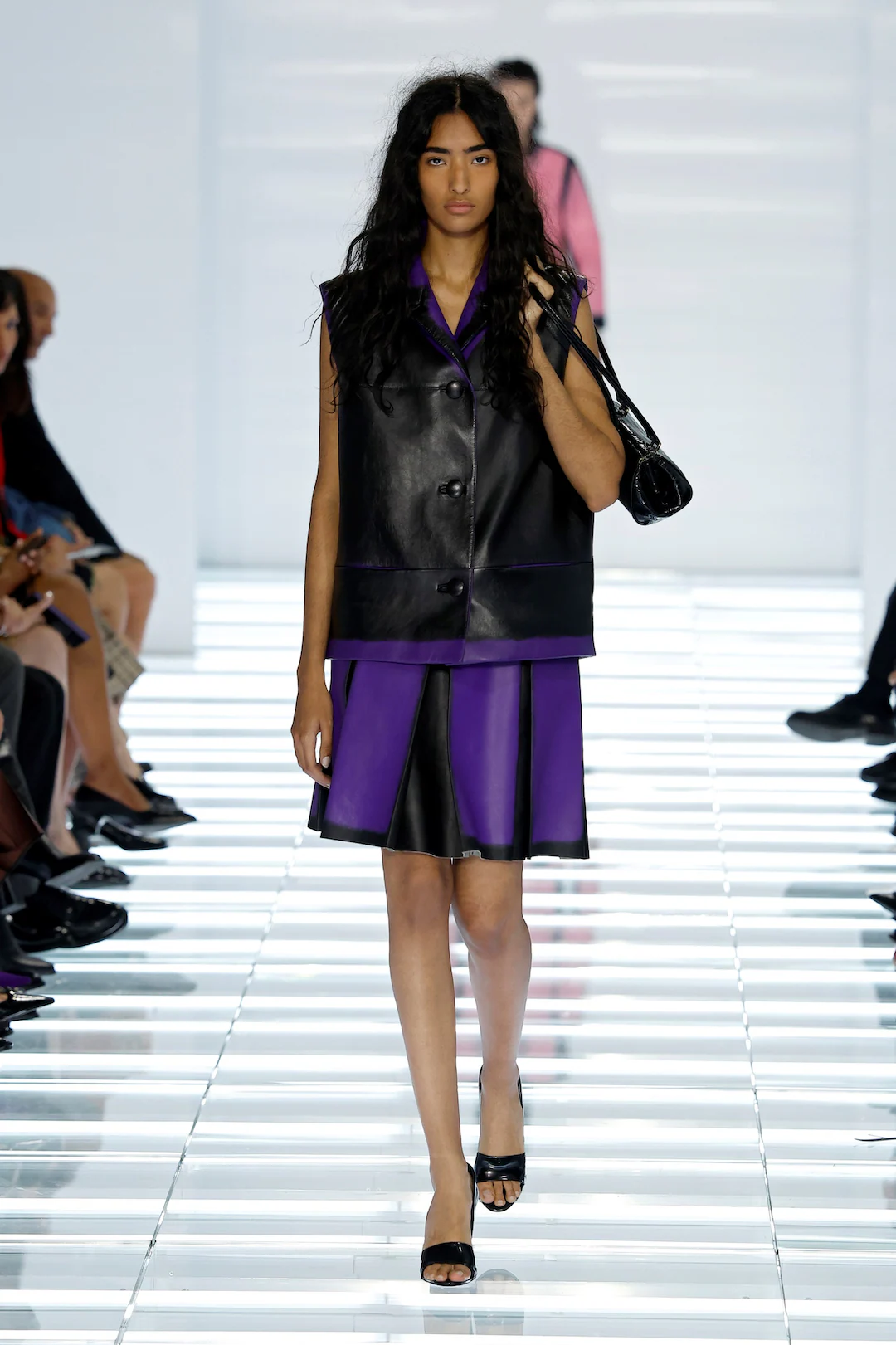
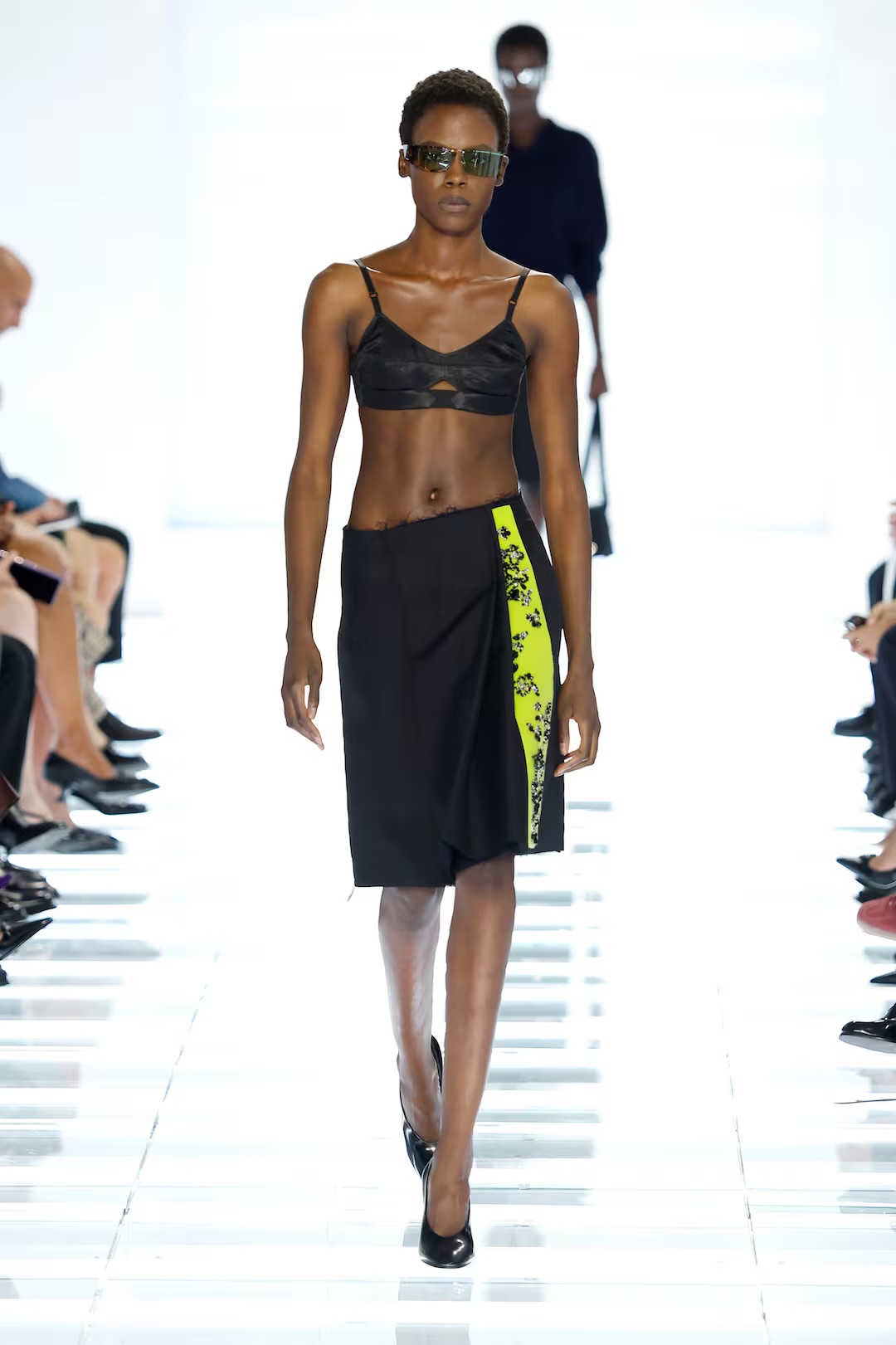
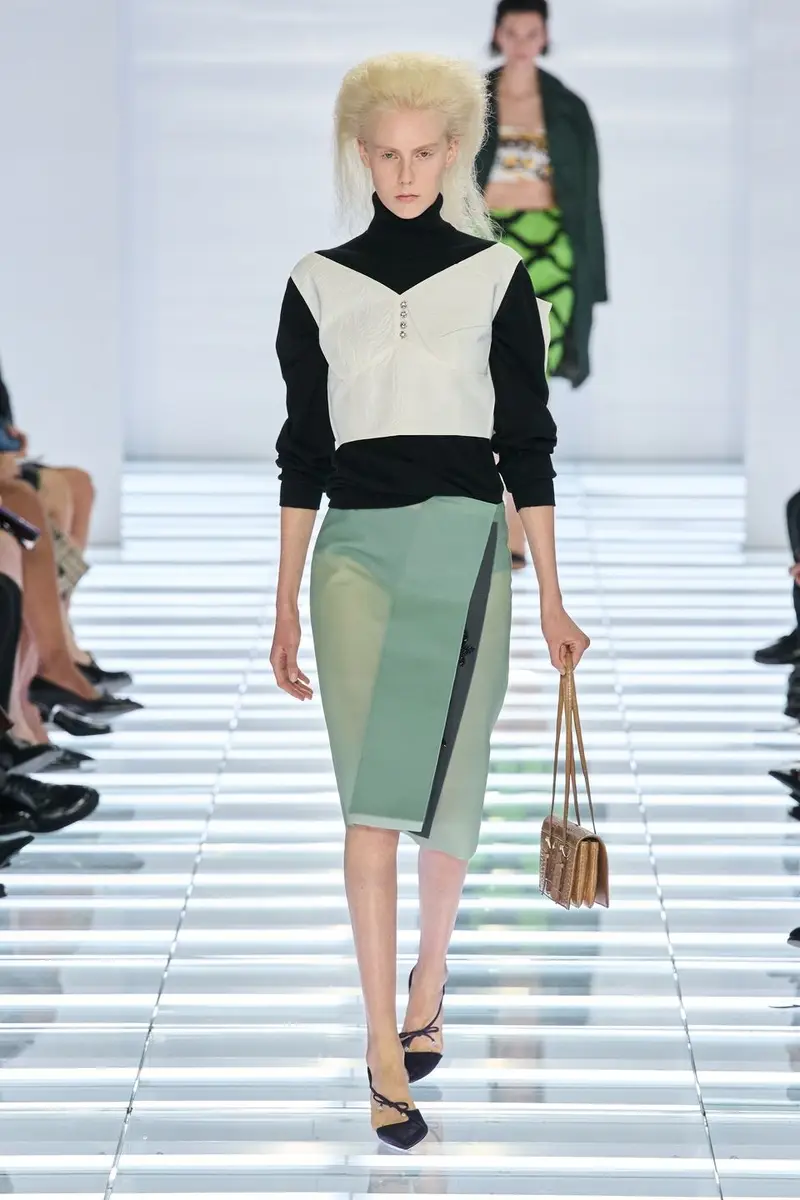
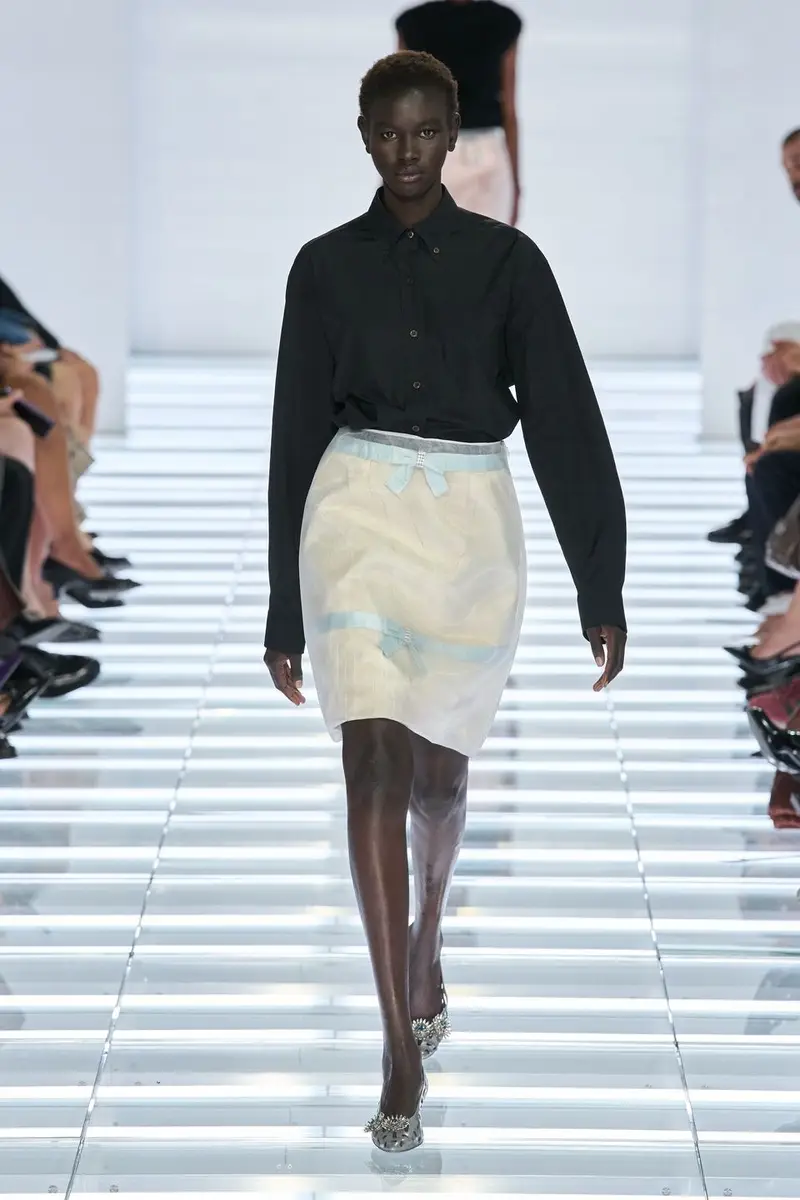
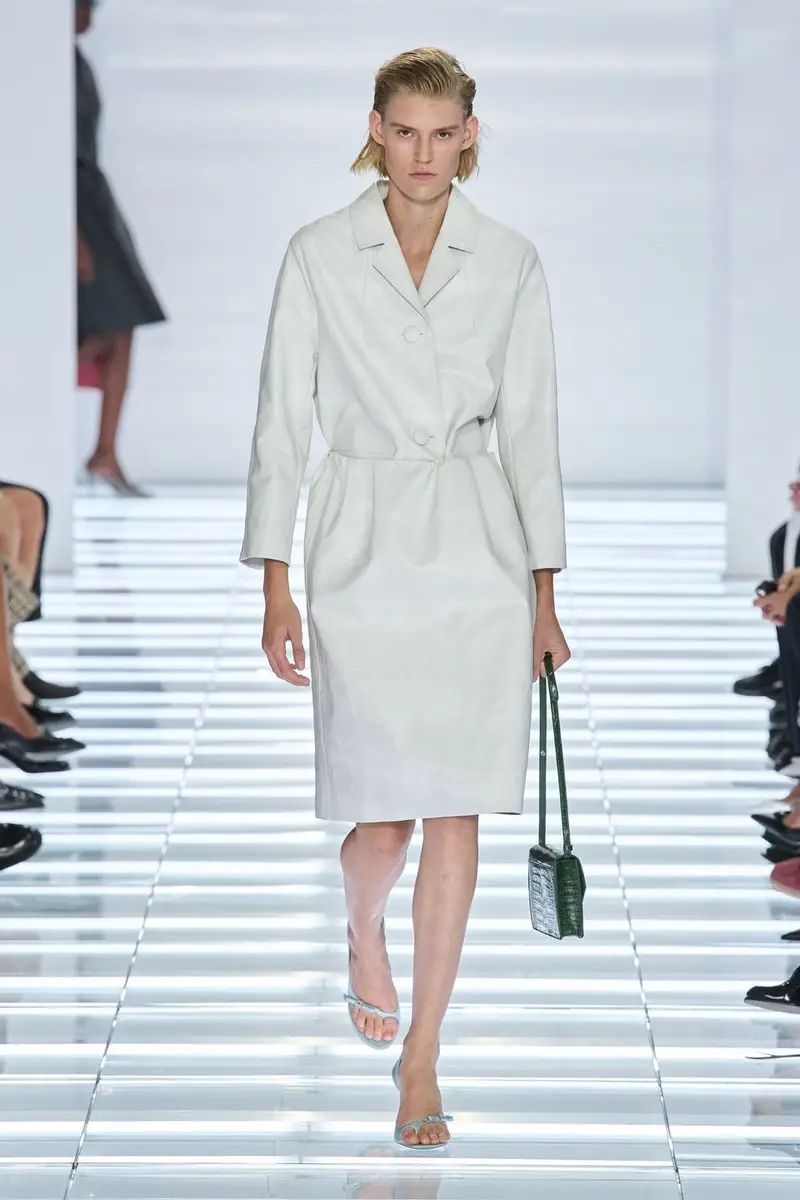
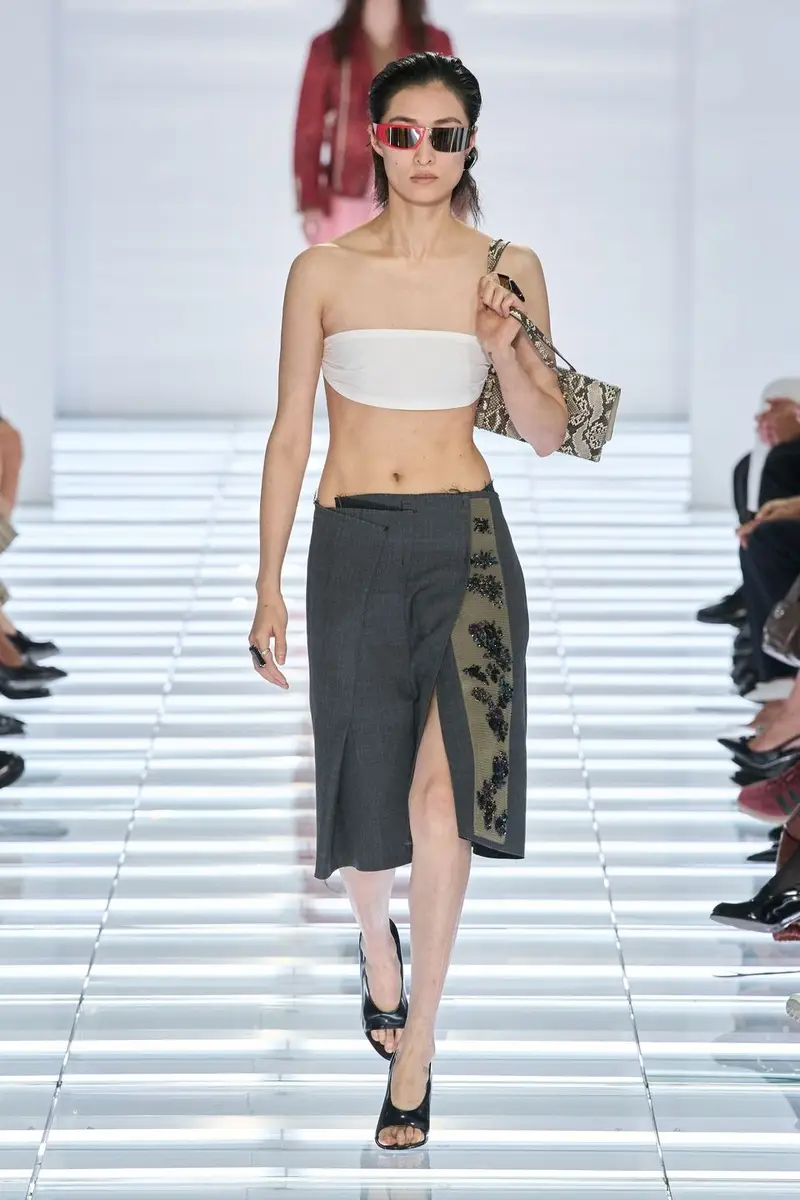
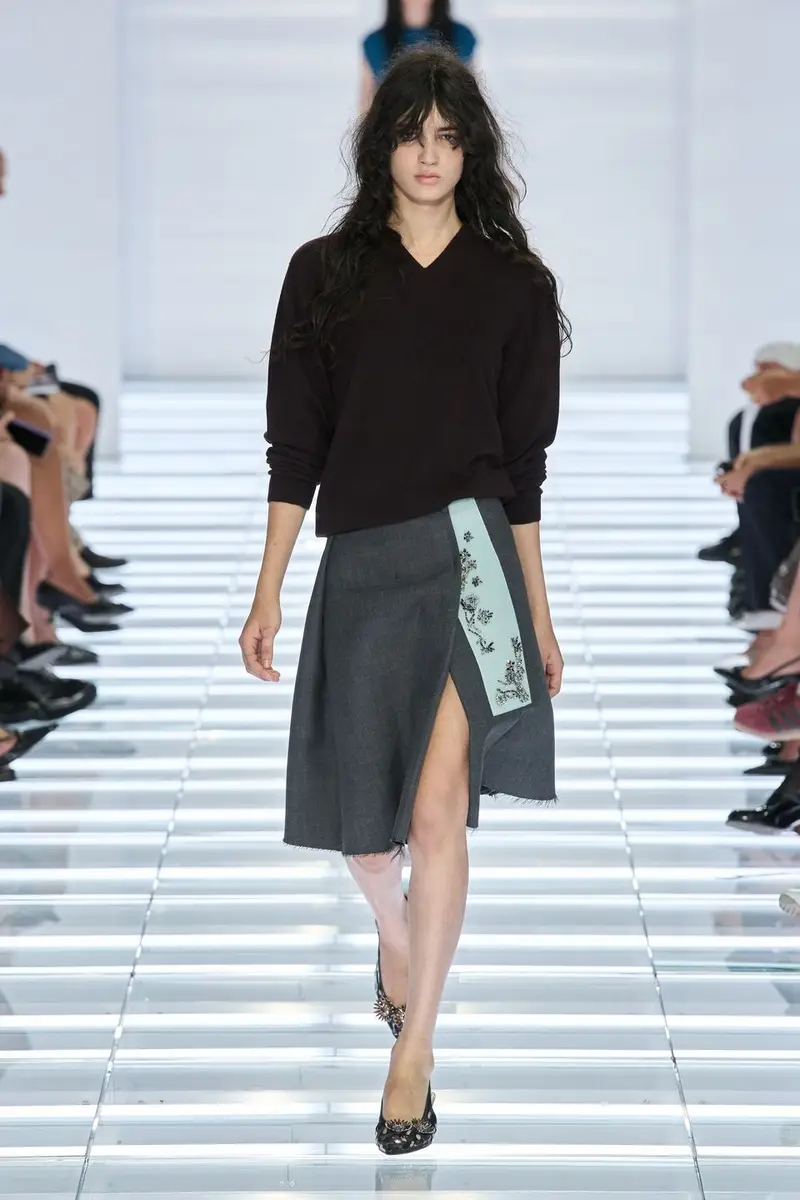
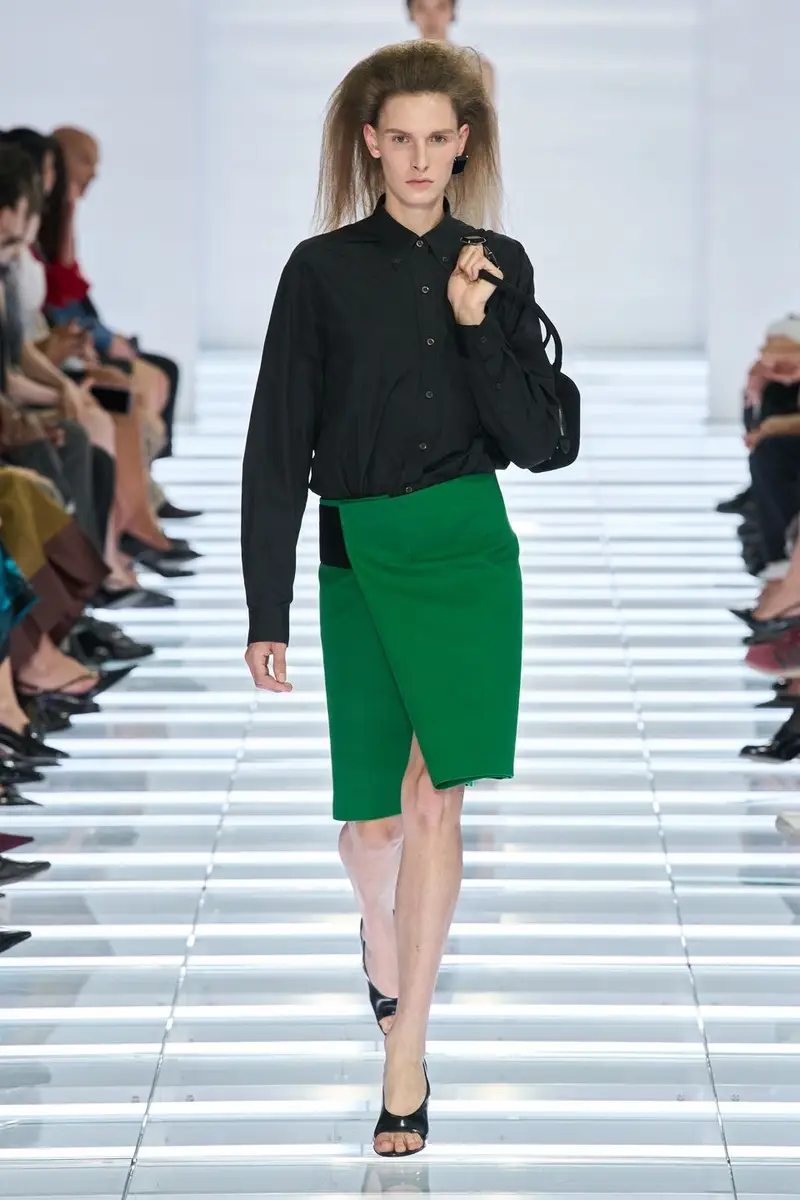
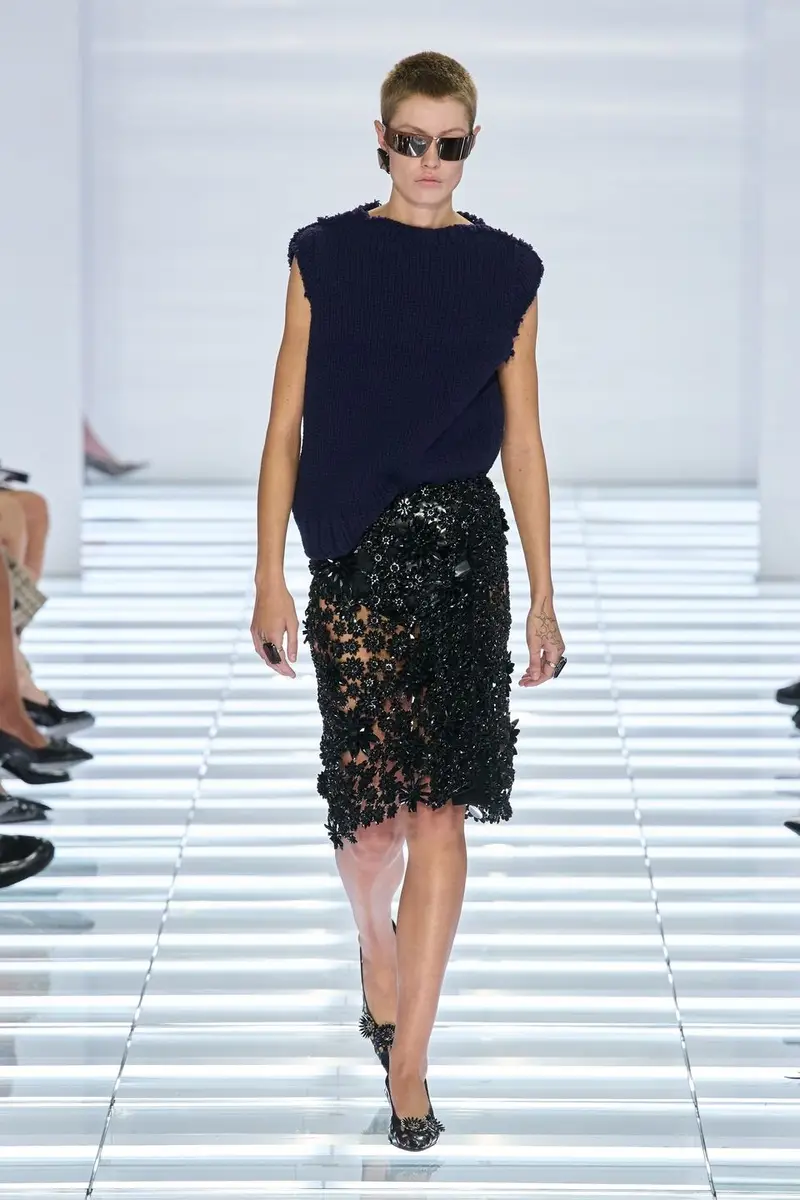
Six years later, Prada has opened Milan Fashion Week with a collection in which there is not a single pair of trousers and not a single dress. All 63 looks revolve around one garment: the skirt.
That sounds like simplicity.
It is not.
And perhaps that is exactly where the Prada experiment becomes interesting.
BEFORE RAF
Before Simons arrived, Prada was already one of the rare fashion houses whose identity could not be reduced to a logo, a silhouette or a single product.
The story began in Milan in 1913, when Mario Prada opened the family’s first store in the Galleria Vittorio Emanuele II. But the Prada the fashion world came to know was largely constructed after Miuccia Prada entered the family business in the late 1970s, alongside the entrepreneurial force of Patrizio Bertelli.
Miuccia’s revolution was not simply about making clothes.
It was about changing what clothes could mean.
Nylon could become luxury. Something deliberately plain could become desirable. An awkward colour could be more modern than a beautiful one. A uniform could contain more psychological information than a fantasy dress. Intellectualism could become glamour without announcing itself as glamour.
Prada’s great trick was contradiction.
Pretty and ugly. Feminine and severe. Expensive and deliberately ordinary. Intellectual and commercial. Historical and futuristic.
Miuccia’s clothes often appeared to be arguing with themselves.
That tension became the house’s most recognisable signature.
By the 1990s, Prada was no longer simply a successful Italian fashion brand. It had become a way of thinking about fashion.
Miu Miu arrived in 1993 as another laboratory for Miuccia’s ideas, while Fondazione Prada, also established in 1993, made the relationship between fashion, art and culture part of the company’s institutional DNA.
Prada did not just sell an image.
It constructed an intellectual universe around clothing.
THEN CAME RAF
Raf Simons came from somewhere else entirely.
He studied industrial design in Belgium before entering fashion, launched his own menswear label in 1995, and built a language around youth, music, adolescence, subculture, uniforms, alienation and desire. His work was never simply about making a jacket or a pair of trousers. It was about creating an emotional world around them.
Then came Jil Sander, Dior and Calvin Klein.
At Jil Sander, Simons worked inside one of modern fashion’s great systems of reduction. At Dior, he translated his intellectual and architectural sensibility into one of fashion’s most historically loaded houses. At Calvin Klein, he confronted the mythology of an American brand through his own cultural references.
His vocabulary was different from Miuccia’s.
Where Prada had often looked at society from the inside – observing its contradictions, habits and uniforms – Raf had spent much of his career looking at youth culture from the outside, finding emotion in outsiders, music scenes, subcultures and the psychological intensity of adolescence.
Miuccia Prada had made fashion intellectual.
Raf Simons had made intellect emotional.
The attraction was obvious.
The risk was equally obvious.
What happens when two people who have spent decades building highly individual languages are asked to speak at the same time?
THE EXPERIMENT
On 23 February 2020, Prada announced that Raf Simons would become co-creative director alongside Miuccia Prada.
The first collection designed by the pair would be Spring/Summer 2021.
The arrangement was deliberately unusual: equal responsibility for creative input and decision-making across the creative facets of the Prada label. The company explicitly framed the move as a challenge to the idea of singular creative authorship.
This was not presented as a succession plan.
It was presented as a new model.
At the time, the fashion industry was already questioning the cult of the single creative director. Luxury houses had become increasingly dependent on individual designers as celebrities, authors and commercial engines. Prada proposed something structurally different: what if the future of a fashion house did not belong to one person?
The timing was almost surreal.
The announcement arrived just as the world was about to shut down.
The first Prada collection by the pair would be shown in September 2020, during a fashion system already radically transformed by the pandemic.
The experiment began under conditions nobody could have designed.
MIUCCIA VERSUS RAF
It is tempting to turn the story into a duel.
Miuccia versus Raf.
Milan versus Antwerp.
Society versus subculture.
Irony versus emotion.
Woman versus man.
Past versus future.
But that would be too easy; and, more importantly, it would miss what makes Prada interesting.
Because their differences were never absolute.
Raf had already worked at Jil Sander, a house that was part of the Prada Group when he joined it. Miuccia had always been fascinated by youth, music, architecture, art and the changing psychology of society.
Both designers have built careers around ideas rather than decorative excess.
Both distrust fashion when fashion becomes too obvious.
Both have repeatedly used uniforms, repetition, proportion and familiar garments as vehicles for more complicated cultural questions.
Their languages were different.
Their obsessions were not.
That is why Prada could make sense as the meeting point.
SIX YEARS OF DIALOGUE
The first Prada collections created by the pair did not produce a clean fusion.
They produced friction.
And that friction was part of the point.
The partnership was never supposed to turn Raf into Miuccia or Miuccia into Raf. Its premise was that the conversation itself could become creative material.
That meant moments of recognition.
A Prada shirt still looked like Prada.
A Raf silhouette could still feel like Raf.
But over time, the borders became harder to identify.
The question shifted from “Who designed this?” to something more complicated:
What does Prada look like when authorship becomes collective?
The answer has not been one fixed aesthetic.
Instead, the partnership has repeatedly returned to a set of Prada/Simons obsessions: the body, uniforms, sexuality, reduction, ugliness, beauty, everyday clothing, youth, repetition and the strange emotional charge of ordinary objects.
Sometimes the dialogue has appeared seamless.
Sometimes the tension has remained visible.
And that is precisely why six years later the partnership is still worth investigating.
SPRING/SUMMER 2027: THE TEST
Then comes Spring/Summer 2027.
If the past six years were an experiment, Milan is where the experiment becomes visible again.
And Prada begins with an unusually severe proposition: one garment, one wardrobe, one idea.
No trousers.
No dresses.
Just skirts.
Sixty-three looks built around the same fundamental object.
It is an almost obsessive restriction — but the collection does not look restricted.
That is the paradox.
The skirt becomes a kind of laboratory.
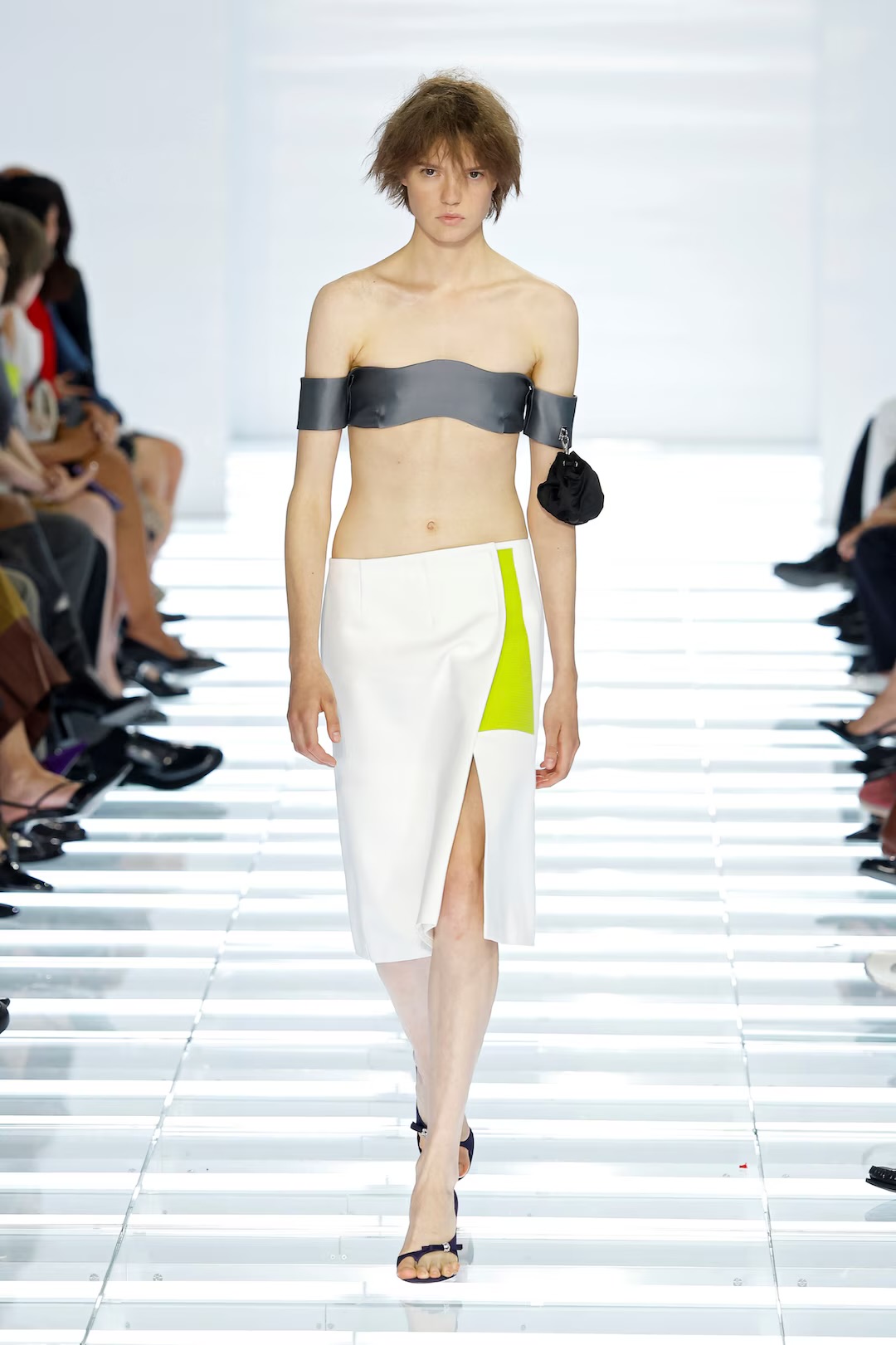
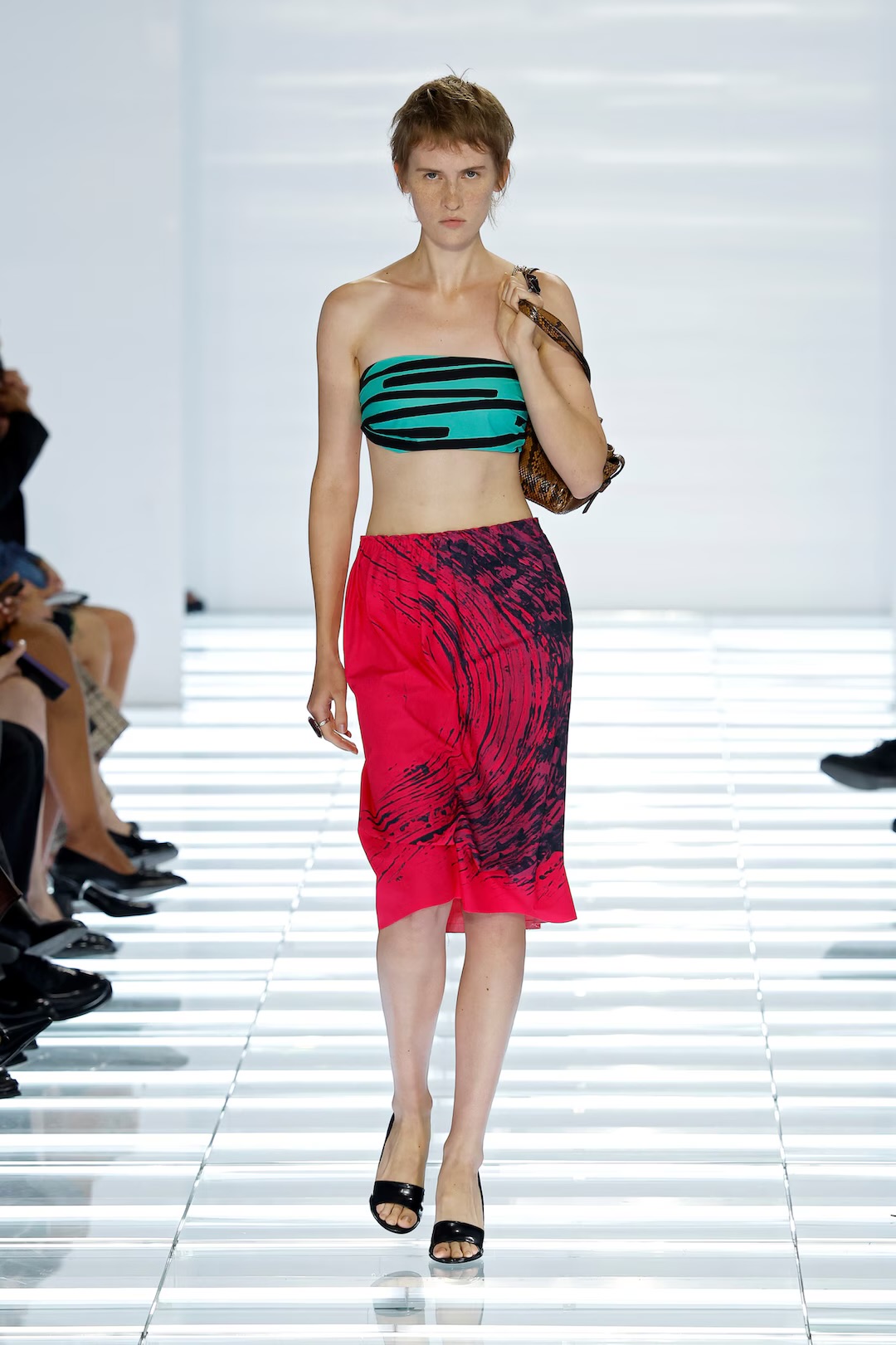
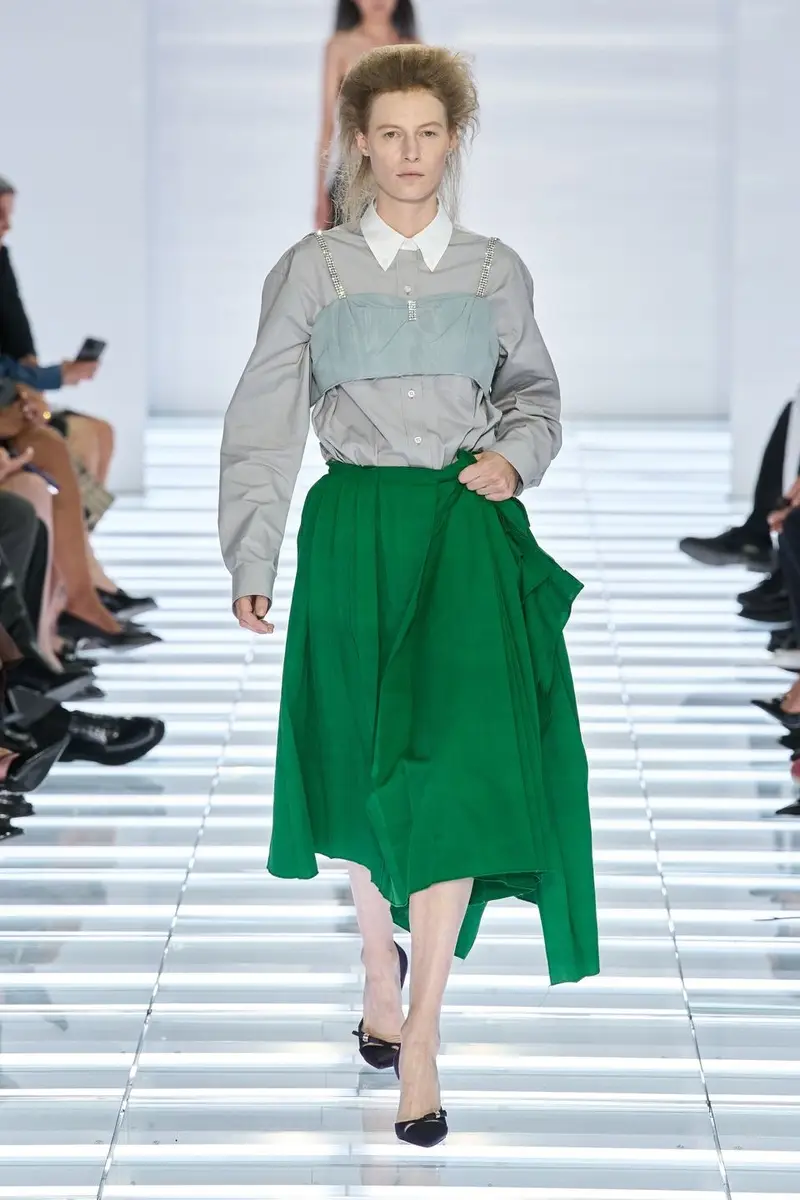
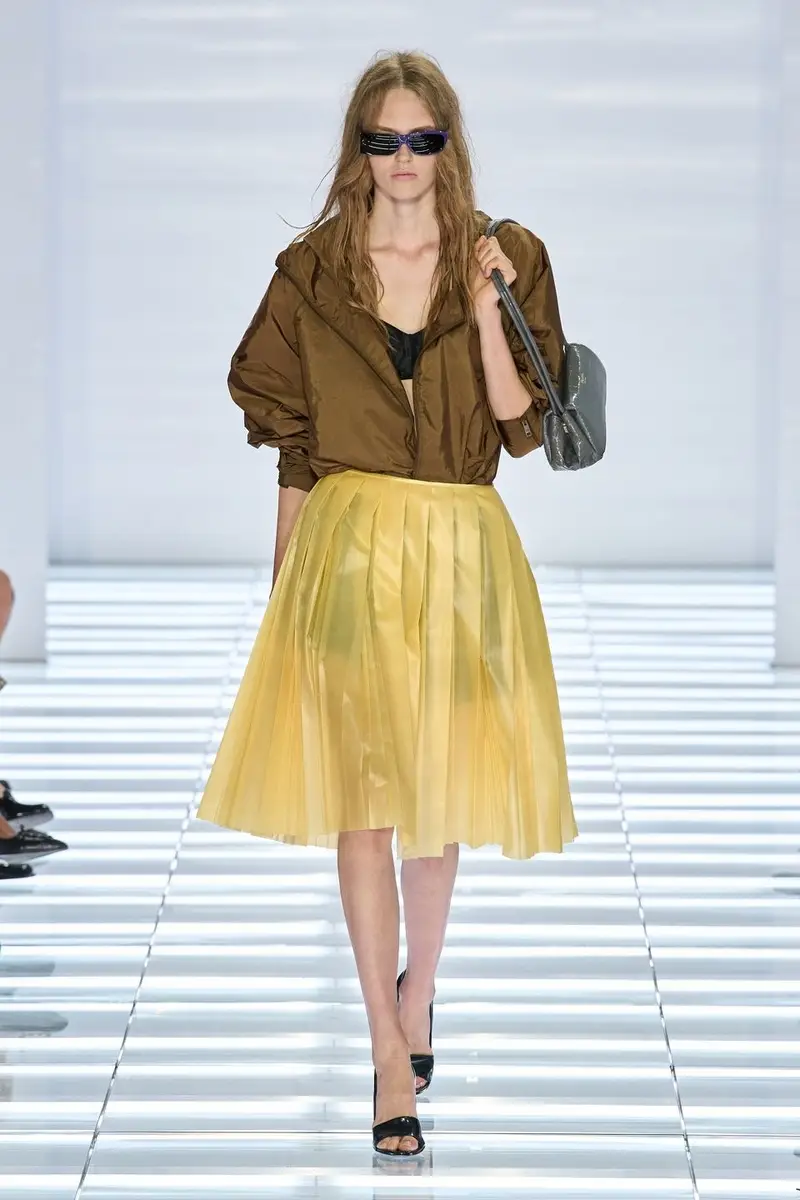
There are short skirts and long skirts, pleated skirts and wrapped constructions, transparent layers, leather, nylon, florals, sequins and crystal embellishment. Some are paired with cropped tops or bralettes; others sit against utilitarian outerwear, shirts or more severe tailoring. Legs become part of the silhouette. Skin becomes another material. The body is repeatedly revealed, interrupted and reconstructed by layers of fabric.
The result is not one version of femininity.
It is many.
And that distinction matters.
Because the collection is not simply saying that skirts are back. It is asking how many different identities can be extracted from the same garment.
Dazed immediately identified the skirt as the defining proposition of the show, while the Guardian described the 63 looks as an unusually concentrated exploration of the garment. The skirt becomes simultaneously sexual, practical, formal, awkward, glamorous and ordinary.
That multiplicity is quintessentially Prada.
THE SKIRT AS A PRADA DEVICE
There is something almost scientific about the construction of the collection.
Take one object.
Remove everything else.
Change its length.
Change its material.
Change its surface.
Change the body wearing it.
Change the context.
Repeat.
Suddenly the object becomes a language.
This is where SS27 connects directly to the menswear collection shown earlier in the season.
For menswear, Prada and Simons introduced “Clarity” as a central idea: reduction, concentration, repetition, decision. The wardrobe was stripped towards essential garments, with a particularly narrow silhouette and an emphasis on the universal quality of jeans and familiar clothes.
Womenswear follows the same intellectual structure but reaches a completely different visual destination.
Menswear says: reduce the wardrobe.
Womenswear says: reduce the wardrobe to the skirt.
But once reduced, the skirt becomes almost infinitely variable.
So perhaps the two collections are not contradictory at all.
They are two versions of the same experiment.
How much can you remove before an object becomes more expressive, rather than less?
THE BODY RETURNS
The body is crucial here.
Prada has always understood that clothing is never just about clothing. It is about what society asks the body to become.
The SS27 skirt exposes legs, waistlines, stomachs and shoulders, but the effect is not simply sexual.
It is also about construction.
Where does a skirt begin?
Where does the body end?
What happens when a bralette becomes part of a uniform?
What happens when crystals turn a utilitarian silhouette into something glamorous?
What happens when something deliberately revealing is worn with something deliberately ordinary?
Again, Prada refuses the clean answer.
The collection can be read as sexy, awkward, sophisticated, funny, nostalgic or provocative; sometimes within the same look.
This is where Miuccia’s historical language becomes impossible to separate from Raf’s influence.
The body has always mattered to Simons too, but often through the psychology of youth, desire and exposure.
At Prada, that emotional intensity meets Miuccia’s interest in the social meaning of clothes.
The result is not simply sexiness.
It is the idea of sexiness being examined.
THE STRANGE RETURN OF PRADA
Then there is the archive.
Vogue Singapore’s reading of SS27 points directly towards Prada’s own history, identifying references and constructions that echo different moments of the house’s past, from the 1990s through the early 2000s.
This is not straightforward nostalgia.
But it is unmistakably self-aware.
The collection contains Prada memories: familiar proportions, recognisable materials, prints, embellishment, utilitarian details and silhouettes that feel as though they have travelled through different chapters of the house before arriving in Milan in 2026.
And that creates one of the most interesting questions around the collection.
What happens when Prada becomes its own reference?
For decades, Prada was famous for looking forward.
Now the house possesses one of the most recognisable archives in contemporary fashion.
The danger of an established vocabulary is that reinvention can begin to look like quotation.
Vogue Singapore captures precisely this tension, suggesting that Prada has, over recent seasons, appeared increasingly willing to work within its own established universe.
That does not automatically make the work nostalgic.
It may mean something else.
Perhaps the house has reached the point where its own history has become raw material.
THE PRADA PARADOX
This is where SS27 becomes particularly revealing in the context of Raf Simons.
Raf built his reputation by creating new emotional worlds from existing cultural symbols: school uniforms, military references, music, youth imagery, industrial garments.
Miuccia built Prada by doing something remarkably similar with fashion itself.
Take something familiar.
Change its context.
Make it strange.
Make it desirable.
Make people look at it differently.
Six years into their collaboration, those methods have begun to overlap.
The archive is no longer simply Miuccia’s territory.
The idea of quotation is not foreign to Raf.
And the result is a Prada collection that can simultaneously look backwards and forwards.
That may be the real meaning of the partnership.
Not fusion.
Translation.
DID RAF CHANGE PRADA?
This is the question that has followed the partnership since 2020.
But it may be the wrong question.
Raf did not arrive at Prada to replace Miuccia.
Miuccia did not become less Miuccia because Raf arrived.
The more interesting possibility is that the two have gradually changed the conditions in which each designer operates.
Raf entered one of fashion’s most intellectually established houses.
Miuccia opened that house’s authorship to another designer whose own mythology was already fully formed.
The result is neither a clean Rafification of Prada nor a complete absorption of Raf into Prada.
It is something more ambiguous.
And ambiguity, historically, has been Prada’s strongest territory.
THE PRICE OF RECOGNISABILITY
There is, however, another side to the story.
If the first challenge of the Prada–Simons experiment was learning how to collaborate, the next may be learning how to escape their own combined vocabulary.
Because after six years, Prada does not have an identity problem.
It has almost the opposite problem.
It has too much identity.
The house can reference itself and still look unmistakably Prada.
It can strip away design and still look Prada.
It can make a skirt the centre of 63 looks and still communicate the house instantly.
That is an extraordinary strength.
But it can also become a creative trap.
When everyone knows what Prada looks like, how radical can Prada still be?
SIX YEARS LATER
The original 2020 proposition was radical because it challenged the idea of singular authorship.
Six years later, the experiment is no longer new.
That changes the question.
We no longer need to ask whether Miuccia Prada and Raf Simons can work together.
They clearly have.
The more difficult question is what their collaboration has actually produced.
Has it created a third language?
Has Raf changed the way Prada thinks?
Has Prada changed the way Raf designs?
Or have two exceptionally recognisable authors simply become better at speaking through the same house?
Spring/Summer 2027 does not give us a definitive answer.
And perhaps it shouldn’t.
Instead, it gives us a fascinating contradiction.
A collection built around one garment, but containing dozens of identities.
A season built on clarity, but expressed through contradiction.
A house looking backwards while insisting on reinvention.
A partnership founded on two voices, increasingly capable of sounding like one.
And a creative experiment that, six years later, is still refusing to tell us exactly what it became.
Maybe that is the most Prada thing about it.
Two authors. One house. Six years later, the question remains: did Raf change Prada – did Prada absorb Raf – or did the two finally create something that neither could have made alone?