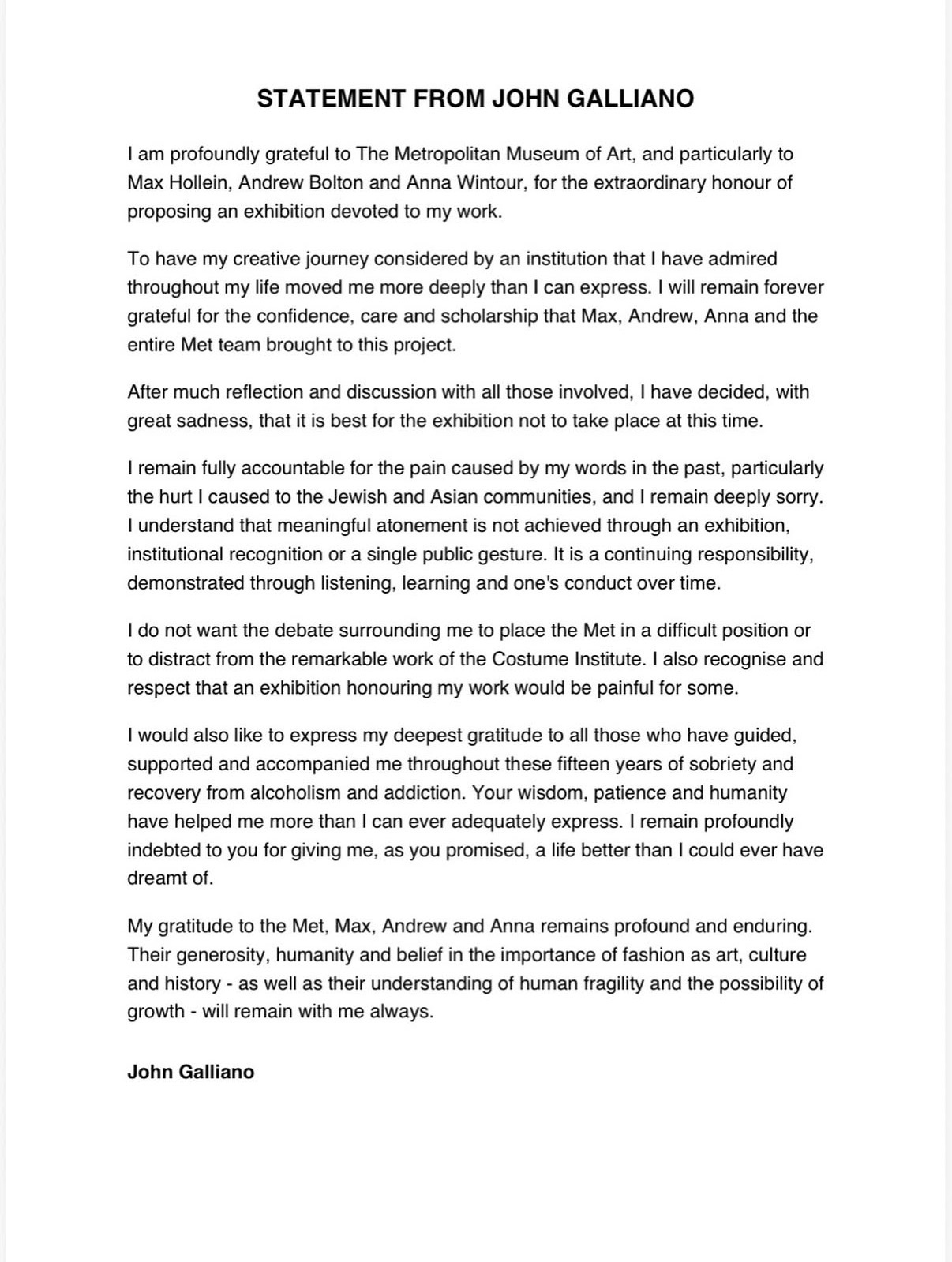


On August 31, Galliano made an announcement that caught many off guard. He said that the Metropolitan Museum of Art’s planned exhibition, John Galliano: Horizons, which was supposed to be about his career and scheduled for 2027 at the Costume Institute, will not be happening for now.

What Happens When an Artist Refuses His Own Retrospective?
This decision is striking, especially considering the amount of work that usually goes into creating such an exhibition. Galliano’s career has been long and notable, and an exhibition like this would have been a great way to showcase his work and achievements. However, it seems that for now, this project is being put on hold.
The exhibition was announced just a month before, and the Met said it was the first big museum show to look at all of Galliano’s work. It was going to cover everything from his time as a student at Central Saint Martins to his work at Givenchy, Dior, and Maison Margiela, and it would also talk about what happened in 2011 that made his career come to a stop. This retrospective was a big deal, and it was going to give people a chance to see the whole range of Galliano’s designs, from his early days as a student to his time at the top of the fashion world. The Met wanted to explore all of Galliano’s work, and that included the good and the bad, so the show was going to be really honest about what happened in 2011.
However, Galliano’s statement is pretty careful not to make his withdrawal seem like a protest or a defeat, or even a rejection of the Met for that matter. Actually, when he talks about the institution, he’s really appreciative of it.
He starts by saying how thankful he is to The Metropolitan Museum of Art, and he specifically wants to thank Max Hollein, Andrew Bolton, and Anna Wintour. He feels really honored that they are letting him have an exhibition all about his work, which he thinks is a huge privilege.
Then comes the reversal.
“After much reflection and discussion with all those involved, I have decided, with great sadness, that it is best for the exhibition to not take place at this time.”
What’s key here is that final part–“at this time”. It’s crucial because Galliano isn’t saying his work can never be in the Met, he’s just deciding if this specific exhibition should happen right now. And the interesting thing is, he’s being really open about why he’s making this choice.
The problem is not the exhibition but what the exhibition could mean.
The Horizons exhibition wasn’t meant to just gloss over John Galliano’s past mistakes. Instead, the museum wanted to directly confront the issues surrounding his antisemitic, racist, and anti-Asian behavior back in 2010 and 2011. They also planned to address his struggles with addiction and how he’s since owned up to his actions. This approach was supposed to be a key part of the exhibition, rather than just sweeping his controversies under the rug. By doing so, the museum aimed to provide a more nuanced and honest look at Galliano’s career, one that acknowledges both his accomplishments and his flaws.
The exhibition’s theme and the controversy it sparked were explored in detail here: John Galliano Takes Over the Met Gala 2027—and Sparks Controversy.
So, the real challenge was actually going to be once you were inside the exhibit.
Galliano’s statement suggests that, eventually, the difficulty became bigger than what could be contained inside the galleries.
He says he is fully to blame for the hurt his words caused in the past. He is talking about the pain he caused to the Jewish and Asian communities.
Galliano says something really important when he notes that saying sorry and making things right isn’t just about putting on a show or getting recognized by institutions or making one big public move.
It is an unusual thing for the subject of a major museum retrospective to say.
A museum exhibition is basically a way of picking and choosing what’s important. It shows us what’s worth keeping and putting into the history books. The Costume Institute is really good at taking fashion and making it a part of history. When a designer gets a big retrospective exhibition there, it’s not just about showing off their clothes, it’s about seriously looking at their work as a major part of the fashion world. This means their designs are considered a key part of the fashion story, and that’s a big deal. The exhibition is like a stamp of approval, saying this person’s work is significant and deserves to be remembered. It’s a way of saying their clothes are not just beautiful or trendy, but also historically important. By putting their work in a museum, we’re acknowledging that it’s a part of our cultural heritage, and that’s something to be proud of.
Galliano appears to recognize that distinction.
An exhibition could investigate his past. It could display his most influential collections. It could provide historical context. It could even allow viewers to hold his creative achievements and his misconduct in their minds simultaneously.
It wasn’t able to make things right on its own. And perhaps that is where the proposed Horizons became uncomfortable.
The Metropolitan Museum of Art was ready to face the criticism head-on. However, Galliano chose not to burden the museum with it.
There is another revealing sentence in his statement:
“I do not want the debate surrounding me to place the Met in a difficult position or to distract from the remarkable work of the Costume Institute”
Again, he does not blame the museum.
The fact that the controversy over Horizons had started to spread beyond just fashion criticism is really important. People were upset about the decision to honor Galliano, and this upset wasn’t just coming from the fashion world–Jewish leaders and New York officials were also speaking out against it. The timing of the 2027 Met Gala was also being questioned, and it seemed like the Met was trying to figure out how to deal with all the pressure that was building up. As the situation continued to unfold, it was clear that the Met had a tough decision to make, and whatever they chose to do would likely have significant consequences. The controversy had sparked a much bigger conversation, one that went beyond just the fashion industry and into the broader cultural and social landscape.
However, Galliano’s statement doesn’t try to address any of those issues. Actually, he removes himself from the equation.
This could be the part of his decision that really matters in the end. If the Met had gone ahead with the exhibition, people would have definitely talked about it, but they would have also discussed something else. They would have wondered if the museum was right to give Galliano a chance to show his work, considering what he had done in the past. They would have asked if the fact that he had a successful career after that changed how we think about what he did. They would have debated whether the importance of his art outweighs his personal mistakes. And they would have questioned whether looking back at a problematic history is the same as celebrating it.
And so, the clothes would have been there, but so would the argument.
Galliano says he does not want that argument to overwhelm the Costume Institute’s work. And then he makes another acknowledgment that is easy to overlook: he recognizes that “an exhibition honouring my work would be painful for some.”
He might have made the case that the exhibition was meant to face his past head-on. He could have argued that not having the exhibition would prevent people from getting a more nuanced understanding of his work. But instead, he acknowledges that just having an exhibition with his name on it could be hurtful in itself. This shows he’s thinking about how his actions affects others, and that’s a significant consideration. By accepting this possibility, he’s taking a step back to think about the potential impact of the exhibition, rather than just pushing forward with it. It’s a complex issue, and he’s trying to approach it in a thoughtful way.
That still doesn’t answer the bigger question–should the Met have suggested it in the first place?
So what does John Galliano: Horizons leave behind?
In May 2027, you won’t find a gallery that tries to make sense of the amazing and the unacceptable all at once. There won’t be any signs on the walls that tell you what to think about Galliano’s career. And no museum will get to decide what’s more important–the clothes he made or the person he is. It’s not up to them to weigh those things against each other. The story of Galliano’s career will be left open to interpretation, without any one place or exhibit trying to sum it all up.
Galliano’s decision to step back doesn’t mean his impact on the fashion world is gone. His collections are still important. But at the same time, it’s also important to remember the hurt he caused, and that’s not something that can be easily forgotten. His influence is still felt, but so is the pain he inflicted, and both of these things need to be acknowledged.
It just won’t settle for having one place, like a museum or an exhibit, where the feelings of two different groups of people come together in a neat and tidy way.
Galliano’s career was all about changing things up–taking old ideas and making them new again, pushing familiar shapes to be more dramatic. He would take things from the past and twist them into something fresh. But when it comes to changing himself, that’s a different story. You can’t just put a new version of yourself on display, take a picture, and then store it away like a finished product. Personal transformation is a process, for him that journey has been 15 years long, and it’s still ongoing.
It seems like the Met is not going to revisit Horizons anytime soon. Galliano’s statement kind of leaves the door open for it to happen in the future, but for now, it’s not going to happen. So, there won’t be a big retrospective or a final look at his career, and things will just be left as they are, without a sense of closure.
For a designer whose work has always been concerned with creating fantasy, perhaps the most consequential thing Galliano has done here is refuse to turn his own life into one.