Your friend has a DJ controller. Your favourite fashion girl has a DJ set. Someone is DJing from their kitchen on TikTok. Your algorithm is full of people mixing house music while doing their skincare.
So when did DJing stop being something you did at a club and become something you apparently have to have a personality for?
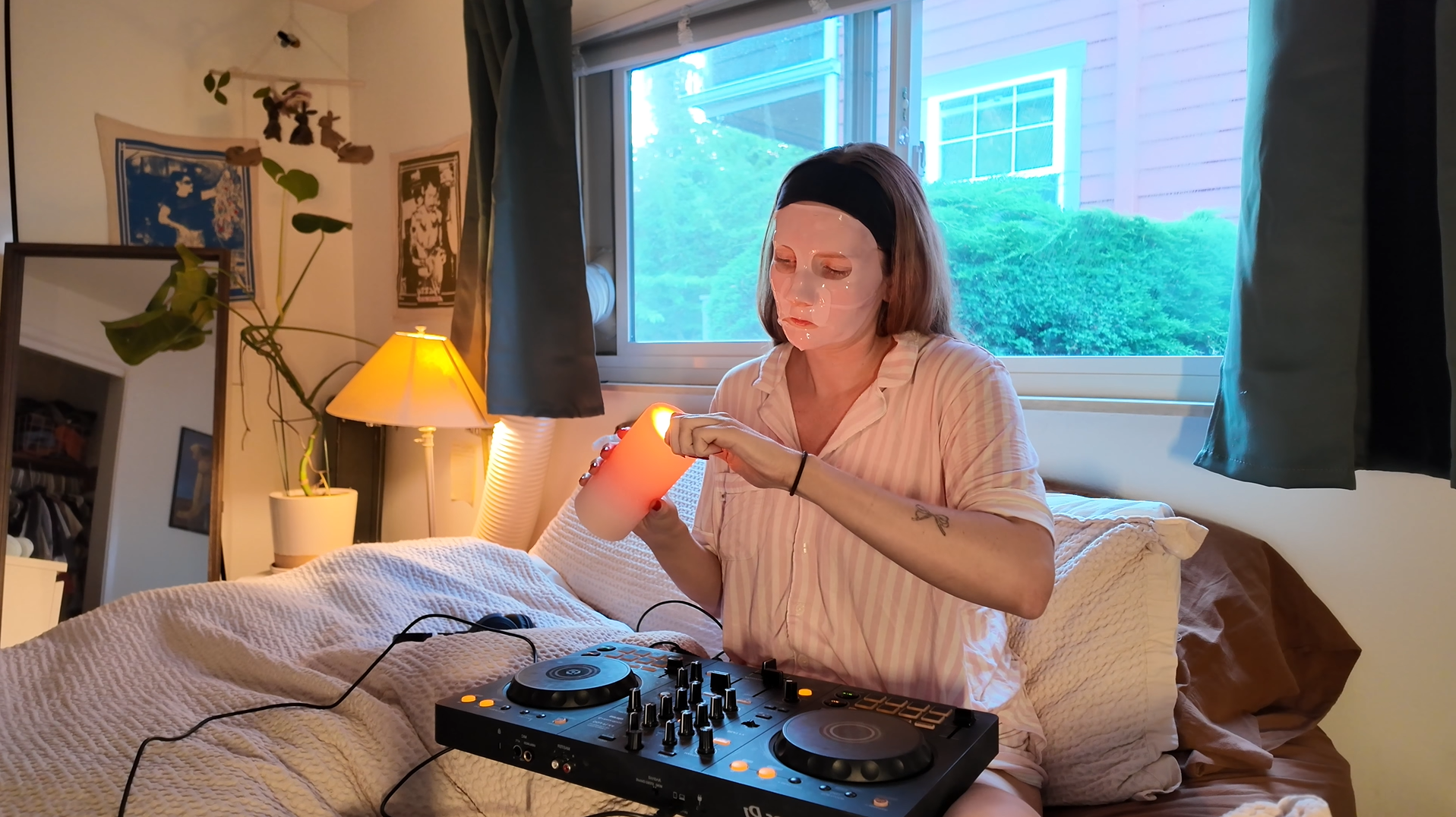
ethereal beats from bed while doing a Medicube facemask (please sponsor me) – dj kisscam
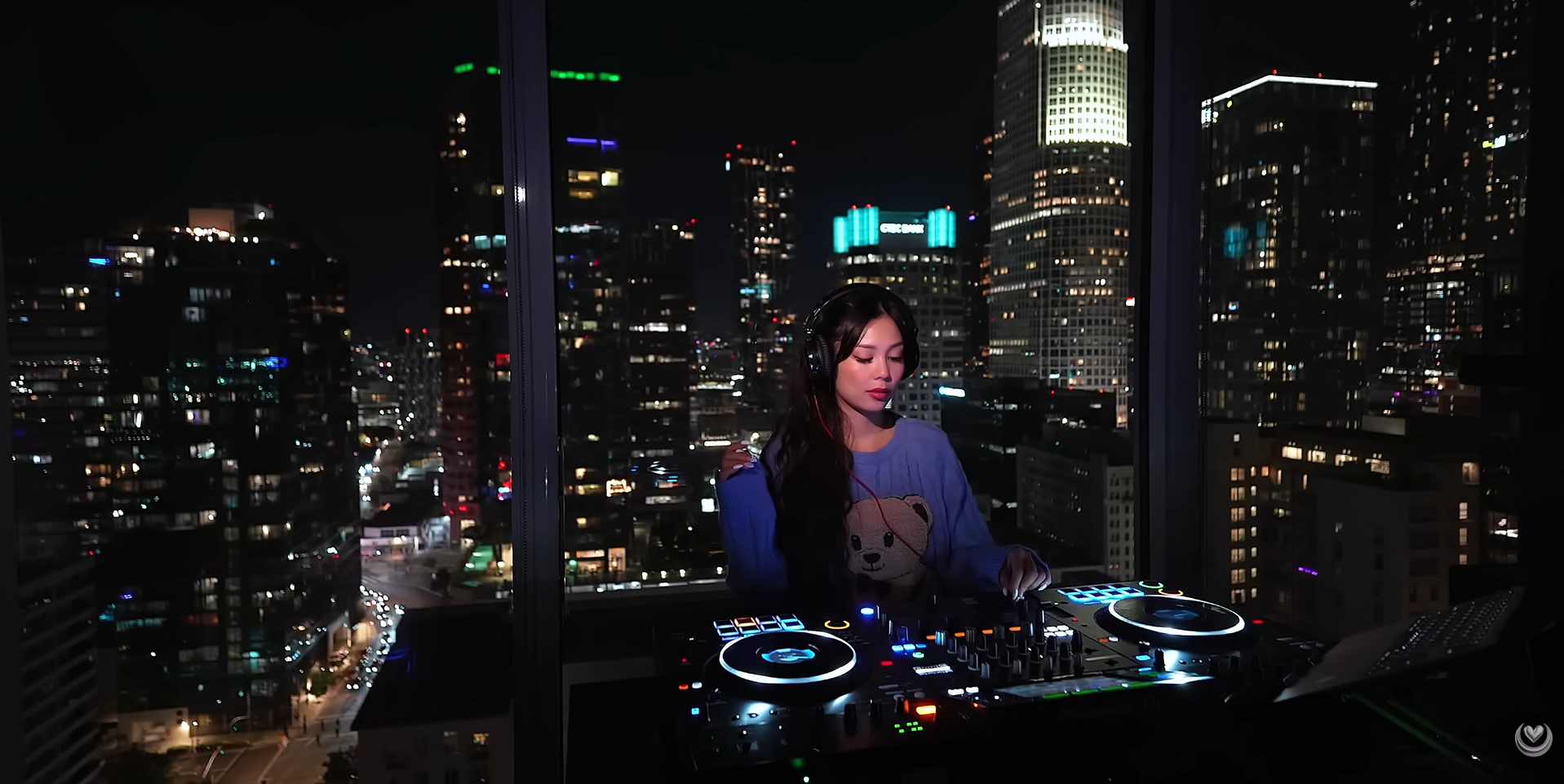
People watch bedroom sets, living-room sets, kitchen sets, rooftop sets – and the visual environment becomes part of the music. We are basically watching the experience of being a DJ.
Sometimes we even get oddly specific about what we want to listen to: deep house music for coding, a get ready with me while I DJ, “Soho New York golden hour – jazz house mix.” The DJ set has started adapting to our lives, rather than waiting for us to enter a club.
On live sets, visuals matter more and more, too. But they don’t necessarily have to be professional. Throw in a silly TikTok reference, like a spinning cat, and people might appreciate it just as much – if you’ve found your audience.
Because obviously, technical skill matters. Smooth transitions matter. Music selection matters. But the skill of curation is becoming just as important.
Around four years ago, James Hype filmed a DJ set on the street outside a London venue. He posted it to Instagram, and, as he later recalled, only three people showed up. Last year, he returned to the same place – this time for a sold-out event that he described as the biggest thing he and his team had ever taken on.
Four years. Three people. Then sold out.
In his Instagram post, Hype described it as the result of a team working on a vision for a year. But there is something else happening here: the journey itself became part of the story. We don’t just see the finished DJ anymore. We see the grind, the crowd, the setup, the clips, the failure and eventually the payoff.
Boiler Room helped make this kind of visibility possible. What started in London in 2010 as a weekly streamed showcase for underground artists turned the person behind the decks into part of the spectacle. You weren’t just listening anymore – you were watching the room, the crowd, the clothes, the person playing.
With coverage from outlets including the BBC, Boiler Room eventually expanded internationally, becoming a platform that helped bring artists including Fred again.., Sammy Virji and Sara Landry to wider audiences.
Yousuke Yukimatsu offers an even stranger version of the fantasy. In 2016, he was diagnosed with brain cancer and shortly decided to leave his construction job and become a full-time DJ. Nine years later, he appeared in one of Boiler Room’s most viral recent sets.
How many people watching Boiler Room from their bedroom are imagining exactly the same escape?
Maybe the DJ controller sitting at home isn’t just there for the weekend. Maybe it’s there to debrief after a long day, play with an idea, and quietly think: fuck it, I’m gonna become a DJ.
And then there is the other side of it: FOMO.
Four hundred people get the experience. Four million people get the FYP.
Selling a limited, intimate experience and then letting the internet watch it unfold the next day sounds almost diabolical – but it works. Charli XCX understood this around the beginning of BRAT, appearing at smaller, limited events and making people desperate to be there, while every clip online made the upcoming album feel even bigger.
The same thing is happening with DJs. The event is no longer only the event. The anticipation, the exclusivity, the clothes, the room, the clips and the person behind the decks are all part of what we’re buying into.
Maybe that’s why everyone suddenly wants to be a DJ.
Not because everyone secretly thinks they can make the perfect transition between two house tracks – although, let’s be honest, some of us absolutely do.
The DJ booth has become a stage, a fashion moment, a content studio, a social life and, for some, a possible escape route.