

If Pierpaolo Piccioli were to leave, who is Balenciaga really looking for?
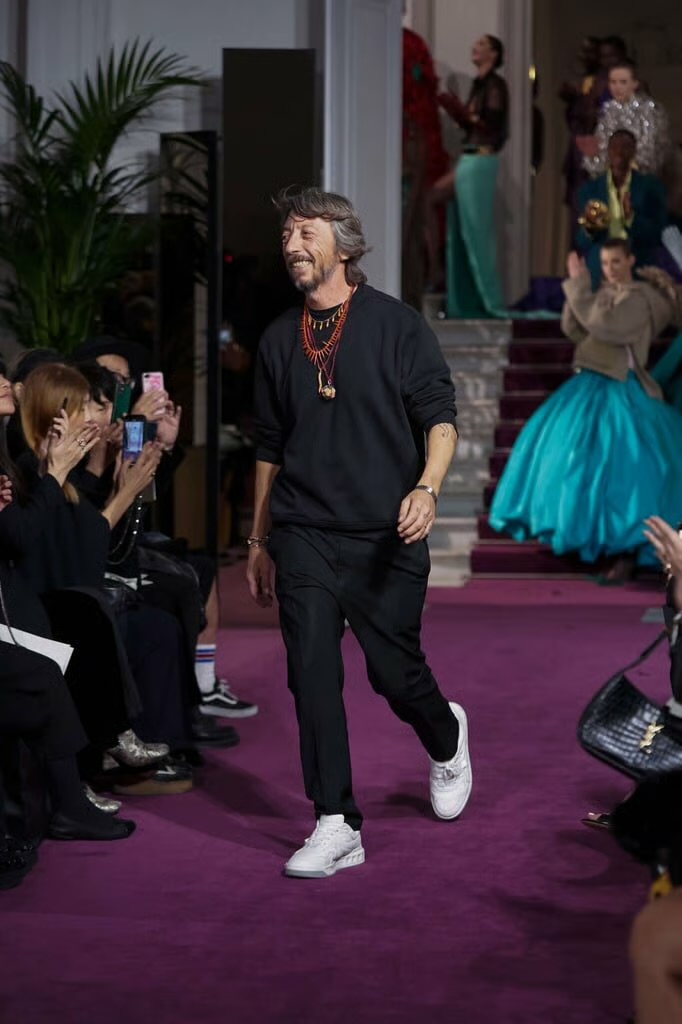
An alleged early exit exposes a larger question facing luxury today: how much time can a creative director afford to reinvent a fashion house before the business demands a different future?
What happens when a fashion house runs out of time before its creative director has had the chance to define it?
According to an exclusive published by Astrid Wendlandt in Miss Tweed on September 22, Pierpaolo Piccioli could be leaving Balenciaga after barely a year at the helm. Citing industry sources, the report suggests that an announcement could follow the house’s October 1 show in Paris, with disappointing menswear sales and couture expectations reportedly falling short of Kering CEO Luca de Meo’s ambitions among the reasons behind the potential split. Neither Kering nor Balenciaga has officially confirmed the departure, and the commercial claims remain unverified.
One year. A handful of collections. A couture debut. And, potentially, the end of a creative partnership that was supposed to open a new chapter in one of fashion’s most historically charged houses.
If the report proves accurate, the question will extend far beyond Piccioli’s future. Was he the wrong designer for Balenciaga? Was Balenciaga the wrong environment for Piccioli? Or has the luxury industry reached a point where a creative vision is expected to justify its existence before it has had time to become a language, let alone a business?
The distinction matters. Because a creative director can fail to meet commercial expectations without necessarily failing as a designer. Equally, a historically coherent vision can struggle to translate into a commercially viable proposition. Fashion has always lived between these two realities. What feels different now is how little time appears to separate them.
Balenciaga may not simply be looking for another designer. It may be looking for a faster answer to a question it has not yet resolved.
The house Demna built, the house Piccioli inherited
To understand what may be happening, we need to return to the identity Balenciaga had constructed before Piccioli arrived.
Under Demna, the house became a cultural machine. Its power extended beyond the runway, transforming sneakers, hoodies, oversized tailoring, accessories and everyday objects into luxury signifiers. Balenciaga did not simply sell clothes. It sold an attitude, a visual language and a particular understanding of contemporary culture.
Streetwear, celebrity, music, internet culture and fashion were not separate territories. They became part of a single commercial and cultural ecosystem.
The success of that system was particularly visible in menswear. The male wardrobe became one of the house’s most recognizable expressions, connecting luxury to a younger consumer whose relationship with fashion was shaped as much by cultural affiliation as by traditional ideas of craftsmanship.
Demna’s departure therefore left more than a creative vacancy. It left behind an established relationship between product, audience and desire.
Piccioli was appointed on May 19, 2025, with Kering presenting his arrival as a new chapter for Balenciaga, grounded in the legacy of Cristóbal Balenciaga and the designer’s experience in haute couture. The brief was not simply to reproduce the past, but to develop the house’s identity while building on its existing achievements.
The appointment made historical and creative sense. Piccioli had spent years refining a sophisticated language of couture, colour, volume and emotional expression. His experience offered an opportunity to reconnect Balenciaga with the architectural intelligence of its founder, whose approach to the body remains one of the defining achievements of twentieth-century fashion.
But a compelling creative rationale is not the same thing as a commercially seamless transition.
Demna had made Balenciaga desirable through a contemporary cultural vocabulary. Piccioli was asked to develop a different relationship with its heritage, one in which construction, craftsmanship and the authority of the garment could become central again.
The question was never whether Balenciaga could return to couture. It was whether couture could become the foundation of a new, contemporary and commercially sustainable Balenciaga.
Was Piccioli the wrong choice?
It is tempting to read the reported departure as a verdict on Piccioli’s suitability. That would be premature.
The more interesting question is whether the expectations attached to his appointment were ever fully compatible.
What did Kering actually want from him? A designer capable of restoring the house’s historical identity? A commercial turnaround? A new generation of luxury customers? A more refined product proposition? Or a creative personality who could preserve the cultural relevance established under Demna while moving the house in a different direction?
These objectives are not mutually exclusive. But they require different priorities, different investments and, crucially, different amounts of time.
Piccioli’s first collection for Balenciaga, presented in October 2025, introduced his interpretation of the house. His haute couture debut followed in July 2026. By the time the departure rumors emerged, he had barely completed a year in the role.
A creative director needs time to establish a visual language, communicate it to consumers, develop a coherent product offer and allow that offer to move through the commercial cycle. A runway collection is not an immediate retail result. Products require development, production, distribution and time on the selling floor before their performance can be meaningfully assessed.
There is no public evidence establishing precisely how much of Balenciaga’s 2025 or first-half 2026 performance can be attributed to Piccioli’s collections. Nor is there sufficient information to determine how much of the reported menswear decline, if accurate, reflects creative decisions rather than pricing, distribution, market conditions or products developed before his arrival.
The possibility of a premature departure therefore raises a difficult question: can a new creative direction be judged fairly before the business has fully experienced it?
The answer is not necessarily that Piccioli should have been given more time. A luxury group has commercial responsibilities, and a creative appointment must ultimately work within the realities of the business. But the distinction between a commercially unsuccessful strategy and an insufficiently developed one is precisely where the real debate begins.
Kering wants growth. But what kind of Balenciaga will deliver it?
The financial context cannot be ignored.
Kering’s 2025 results reflected a group under significant pressure, with declining revenue and operating profitability. Under Luca de Meo, the company has placed renewed emphasis on financial discipline, operational efficiency, clearer brand strategies and a return to sustainable growth. Its first-half 2026 results showed an improvement in comparable group revenue, while the Fashion & Leather Goods division continued to face a more difficult environment.
Balenciaga is part of that equation.
The house is not an isolated creative laboratory. It is a global business with substantial retail operations, product development costs, manufacturing commitments, marketing investments and expectations around profitability.
Kering needs its creative houses to generate cultural relevance, but also to translate that relevance into products people want to buy at prices that sustain the business.
The distinction between those two objectives is becoming increasingly consequential.
A spectacular runway can create visibility without generating sufficient demand. A commercially successful accessory can sustain revenue without necessarily advancing the creative identity of a house. A couture collection can reinforce prestige while remaining too narrow to support the scale of a global luxury business.
Balenciaga must make these elements work together.
The first-half 2026 communication from Kering identified the house’s creative transition as an ongoing challenge and highlighted leather goods as an area of strength. The group has not published standalone Balenciaga revenue figures or a breakdown of menswear performance that would allow the claims surrounding Piccioli’s departure to be independently verified.
That absence is important. It prevents us from turning an industry rumour into a financial conclusion.
But it also sharpens the strategic question: is Kering trying to restore the commercial model that made Balenciaga successful under Demna, or is it attempting to build a different model altogether?
Because the two approaches lead to different creative decisions.
If the priority is to restore the existing business, the emphasis may fall on recognizable products, accessories, menswear and a stronger connection with the customers already buying Balenciaga.
If the ambition is to reposition the house, the priority may be a more substantial transformation of its image, product and customer base, with the understanding that the commercial effects could take longer to materialize.
The difficulty is that Kering may need both simultaneously.
The menswear problem is also a cultural problem
The allegation concerning menswear is particularly revealing, even if its financial details remain unverified.
Balenciaga’s menswear under Demna was not simply a successful category. It was one of the ways the house communicated with contemporary culture.
The sneakers, oversized proportions, outerwear and sportswear established a recognizable relationship between the brand and a generation of consumers for whom fashion was inseparable from music, celebrity, digital culture and personal identity.
If that relationship has weakened, the problem cannot necessarily be solved by introducing a new collection of products.
A new creative director must give the customer a reason to remain interested.
Piccioli’s approach offers a different proposition: the authority of construction, the sophistication of silhouette, the relationship between body and garment, and a more direct engagement with Balenciaga’s couture heritage.
These are legitimate sources of contemporary desirability. But they do not automatically replace the cultural mechanisms through which the previous generation of Balenciaga products became desirable.
The challenge is not to choose between couture and streetwear. It is to develop a language in which the two can coexist without appearing to belong to different brands.
A house that abandons its existing audience too quickly risks losing the commercial foundations of its identity. A house that refuses to evolve risks becoming a museum of its own recent success.
The real test is whether Balenciaga can change what it means to its customer without losing the customer in the process.
And if menswear is indeed underperforming, the question should be broader than whether Piccioli’s aesthetic is selling. Is the house still speaking to the audience it spent a decade cultivating? Has that audience changed? Or has the market itself moved beyond some of the codes that once made Balenciaga indispensable?
These are questions of brand strategy as much as creative direction.
Who is Balenciaga looking for?
If Piccioli were to leave, the obvious question would be who comes next.
At the time of writing, no successor has been credibly confirmed. Any discussion of names must therefore remain hypothetical. More importantly, the profile of the next creative director depends on what Kering believes needs to be fixed.
A designer who can reconnect Balenciaga with contemporary culture might bring a different set of priorities from one who can deepen its couture identity. Someone with a strong product sensibility might approach the business differently from a designer whose work is primarily driven by conceptual experimentation.
Several creative profiles offer useful ways of thinking about the possibilities, without implying that any of these designers is involved in discussions with Kering.
Hedi Slimane
Slimane remains the most obvious free agent if the question is commercial identity rather than couture.
Since leaving Celine in 2024, he has not been attached to another major fashion house, yet his influence has only become more visible. His vocabulary of menswear, denim, leather, tailoring, music, youth culture and image continues to circulate well beyond the brands he once led.
More importantly, Slimane has repeatedly demonstrated an ability to turn a highly personal creative language into a complete commercial ecosystem. At Celine, he expanded the house into new categories and helped transform it into a global megabrand.
But would Kering really want another designer capable of completely dominating Balenciaga’s cultural identity?
After Demna, that may be precisely the attraction. Or precisely the risk.
Julien Dossena
Dossena may be one of the cleanest possibilities on the table. After thirteen years at Rabanne, he is now independent, having left the house in June after transforming its historic chainmail and avant-garde codes into a contemporary, globally relevant proposition. His Rabanne chapter was not simply about aesthetics. He demonstrated an ability to take a highly recognisable heritage, modernise it without neutralising it, and turn cultural relevance into product.
There is another reason his name makes sense. Dossena knows Balenciaga. Before Rabanne, he spent four years at the house working under Nicolas Ghesquière.
Could Balenciaga need someone who understands its history from the inside, but is distant enough from both Demna and Piccioli to write a genuinely new chapter?
Dossena would be a very different kind of succession.
Riccardo Tisci
Tisci would represent another possible route: the designer as cultural architect.
His Givenchy years demonstrated an unusually powerful combination of couture, tailoring, celebrity, music and street culture. He turned the house into a cultural phenomenon rather than treating couture as an isolated category, while his later experience at Burberry exposed him to the demands of a much larger commercial machine.
He is also independent of a major fashion house today, making him a genuinely available name rather than a theoretical one.
The question would be whether Balenciaga wants to rebuild its cultural power through another highly recognisable personality, or whether Kering is looking for something quieter and more commercially controlled.
Tisci would bring culture back into the centre of the conversation.
Natacha Ramsay-Levi
Then there is a name that changes the equation entirely.
Ramsay-Levi is one of the few designers who could arrive at Balenciaga with an intimate understanding of its modern history. She joined the house in 2002 and spent more than a decade there, ultimately becoming design director under Nicolas Ghesquière before following him to Louis Vuitton. She later became creative director of Chloé, where she developed her own interpretation of the house’s femininity.
Today she is not attached to another major luxury maison. Her current work includes a creative-partner role with ECCO, but she is not occupying a traditional top creative-director position at a competing fashion house.
That makes her particularly intriguing.
Ramsay-Levi would not be an attempt to recreate Ghesquière. Nor would she represent a return to Demna. She could instead reconnect Balenciaga with the period when the house established itself as one of the defining forces of modern Parisian fashion, while bringing a distinctly female perspective to its next chapter.
Could the answer to Balenciaga’s identity crisis come from someone who already knows the house from the inside, but has had years to develop a language of her own?
That possibility is difficult to ignore.
The unknown
And then there is the option Kering cannot calculate on paper: giving Balenciaga to a designer who has not yet run a major luxury house.
The current emerging generation is already producing designers with unusually precise languages, combining tailoring, construction, experimentation and a sharper understanding of how fashion can function beyond the traditional luxury system. Marie Adam-Leenaerdt, for instance, won the 2026 ANDAM Grand Prix after working in the studios of Balenciaga and Givenchy, while a wider generation is emerging through the major European fashion prizes.
Putting one of them directly into Balenciaga would be an entirely different proposition. It would mean choosing potential over proven scale, giving an emerging voice the infrastructure of one of the industry’s most powerful houses and accepting that the result could be unpredictable.
But perhaps that is precisely the point.
After Demna and Piccioli, Kering could either continue looking for an established answer or decide that Balenciaga needs someone who has not yet been given the chance to define a global house.
The real question is not whether such a designer exists. It is how much risk Kering is willing to take.
Anthony Vaccarello?
Then comes the most unexpected possibility.
Anthony Vaccarello remains officially at Saint Laurent, where he has been creative director since 2016. The current rumours surrounding his future remain unconfirmed, making any move to Balenciaga entirely hypothetical.
Yet the logic is difficult to ignore. Vaccarello has spent a decade turning Saint Laurent into a highly controlled, instantly recognisable world, balancing house codes, image, product and global luxury without surrendering a singular creative identity.
If he were ever to become available, the question would not simply be whether he could design Balenciaga. It would be whether Kering would move one of its most established house-builders from Saint Laurent to solve a very different problem.
And that is where the speculation becomes interesting.
The challenge would be maintaining the house’s contemporary cultural relevance and commercial connection with the audience established under Demna.
These are not predictions, candidate rankings or reports of negotiations. They are different answers to the question of what Balenciaga might need.
And perhaps the most revealing possibility is that Kering may not be looking for a radical departure from Piccioli at all. It may be looking for someone capable of continuing the work already begun, but with a closer integration between creative direction, merchandising and commercial strategy.
If so, the problem would not necessarily be the language Piccioli introduced. It would be how that language was expected to perform.
The destination: a Balenciaga that can afford to be Balenciaga
Before choosing a successor, Kering would need to define the destination.
What should Balenciaga look like in three years? Which customer should it speak to? What role should menswear play? How much of its commercial identity should remain connected to the codes developed under Demna? And how should the heritage of Cristóbal Balenciaga translate into products that people want to buy today?
The destination cannot simply be a return to the past, nor a repetition of the previous decade.
Balenciaga needs a creative language that is recognisable without being nostalgic, commercially productive without becoming generic, and culturally relevant without depending entirely on the mechanics of online attention.
It needs a menswear proposition that can sustain demand, a leather goods business that continues to build on its strengths, and a couture identity that contributes to the value of the entire house rather than existing separately from its commercial reality.
Above all, it needs a strategy in which the creative director and the business are working towards the same definition of success.
This is where the reported situation becomes more than a story about Piccioli.
If a new creative director arrives, that person will inherit not only the archive and the ateliers, but also the unresolved tension between Balenciaga’s historical identity, its recent commercial success and Kering’s demand for a faster recovery.
The next appointment cannot eliminate that tension simply by introducing a new aesthetic.
How much time does fashion have left?
If Piccioli were to leave Balenciaga after barely a year, it would be tempting to describe the episode as another creative failure in an industry increasingly obsessed with the next appointment.
But that would miss the larger issue.
The luxury industry asks designers to reinvent historic houses, establish new cultural relevance, attract customers, support global retail networks and deliver profitable growth. It then evaluates their work against commercial expectations that may arrive before the creative transformation has fully reached the market.
There is a contradiction at the heart of this system. Fashion depends on change, but meaningful change requires continuity. A creative director needs enough freedom to challenge the identity of a house, yet that freedom becomes difficult to sustain when the existing business is under pressure.
Kering is entitled to demand results. Balenciaga cannot operate outside economic reality. And no creative director, however accomplished, is guaranteed a successful commercial outcome.
But if the house is searching for a new direction after only a year, the next appointment will face the same fundamental question.
How can a designer build something new when the business is already asking what it will deliver next season?
Perhaps Piccioli was not the right person for Balenciaga. Perhaps the project needed more time. Perhaps the house and its new creative director never shared the same understanding of what the future should look like.
The available evidence does not allow us to decide between those possibilities.
What it does reveal is a fashion system increasingly caught between the long time required to create desire and the short time allowed to demonstrate its commercial value.
If Pierpaolo Piccioli were to leave Balenciaga, the real question would not simply be who comes next. It would be whether the next designer is being appointed to build a new Balenciaga, or to solve a business problem before the house has decided what it wants to become.
Because the next creative director may be the right person.
But unless the destination is clear, and unless the time required to reach it is part of the strategy, even the right person could arrive at the wrong moment.