What happens to a muse when the designer becomes the myth?
There is something almost suspiciously beautiful about watching a Rick Owens woman walk across water.
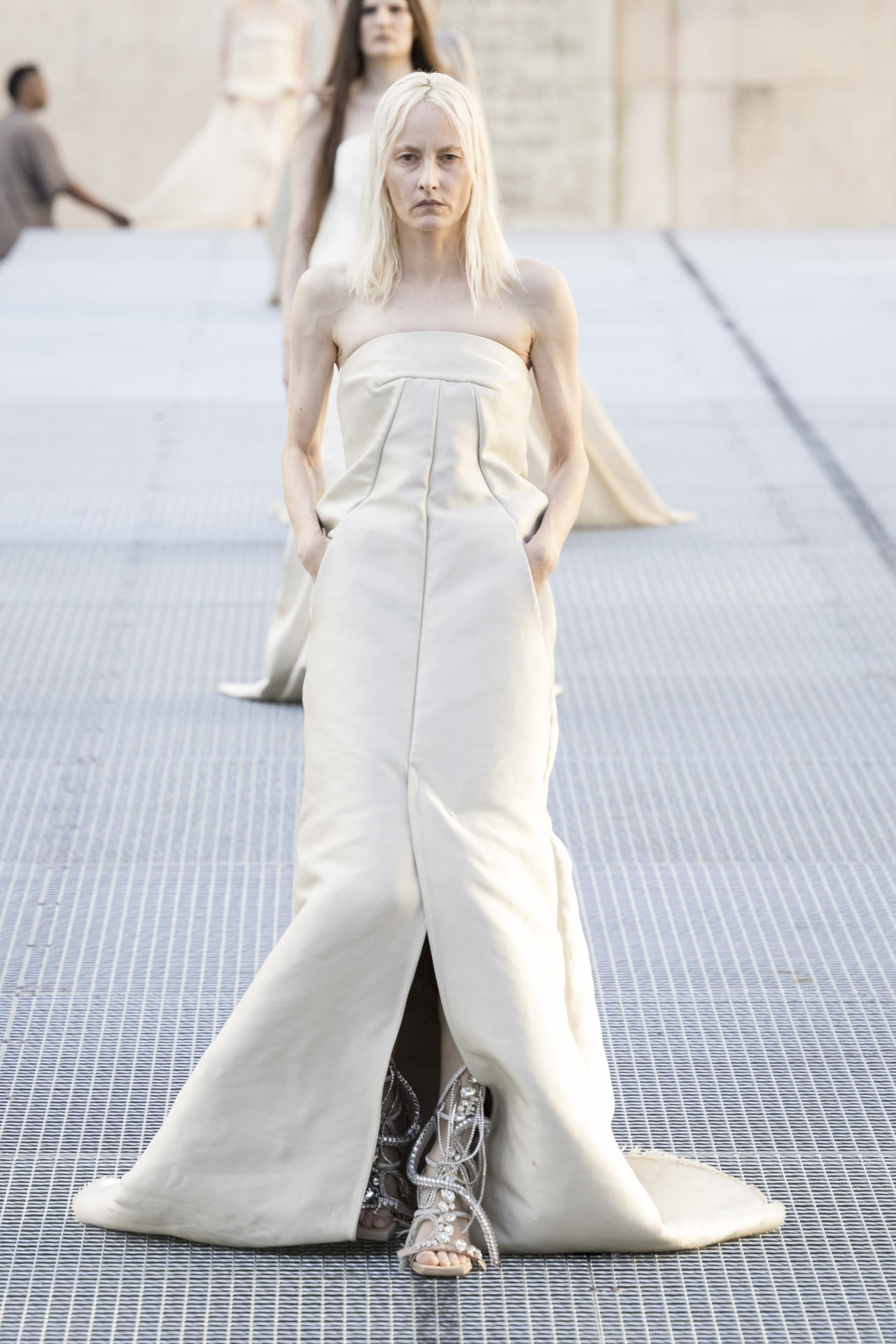
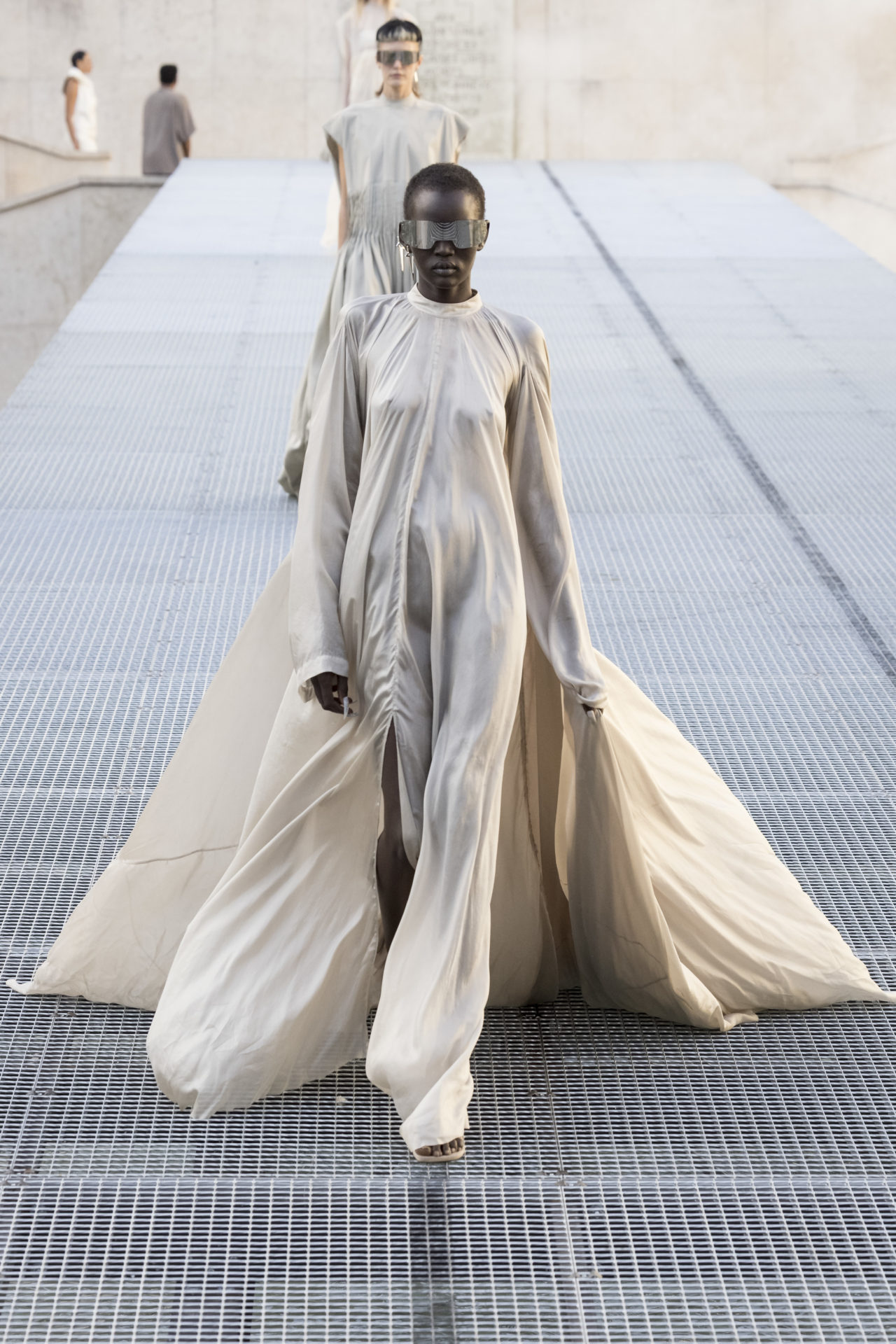
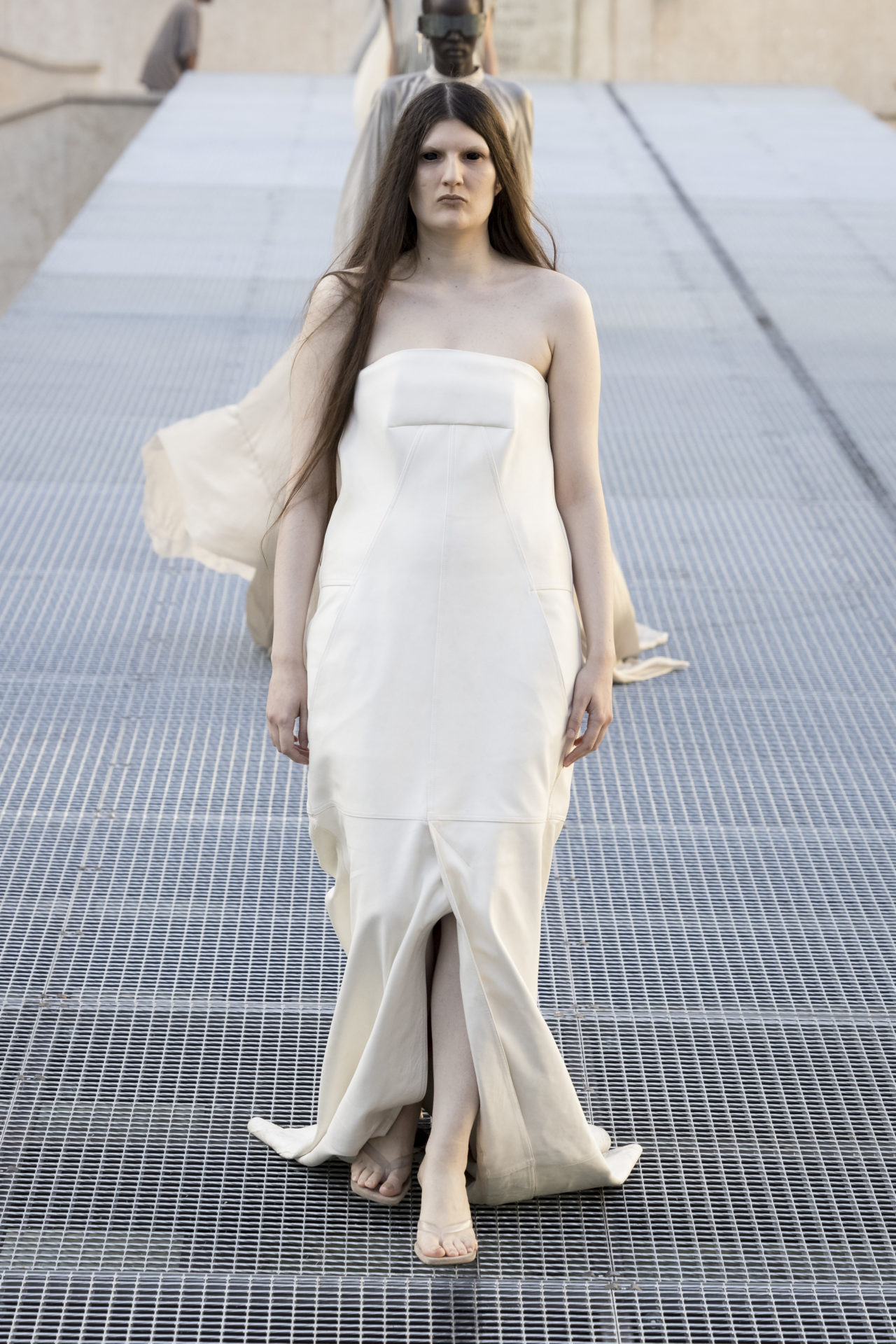
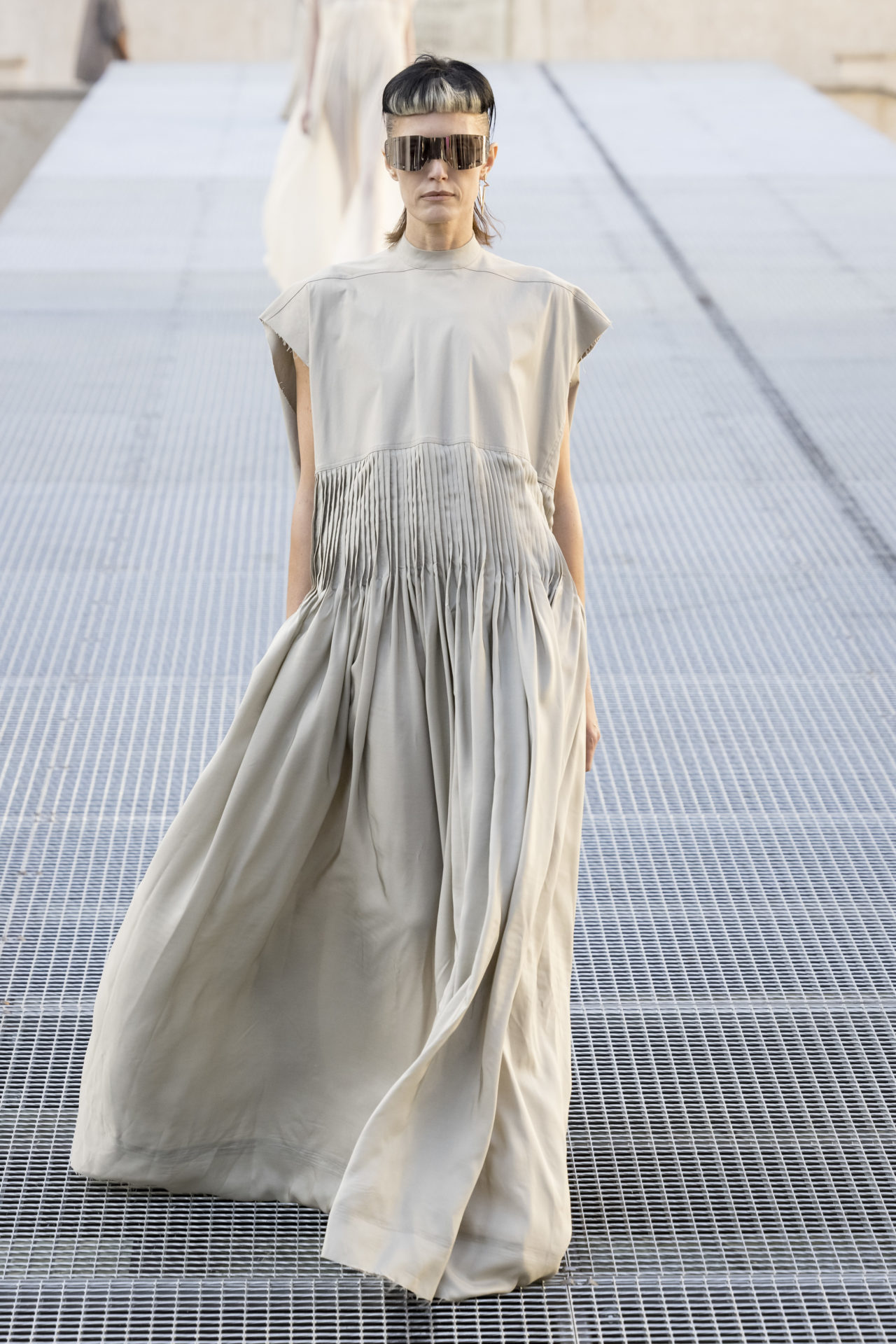
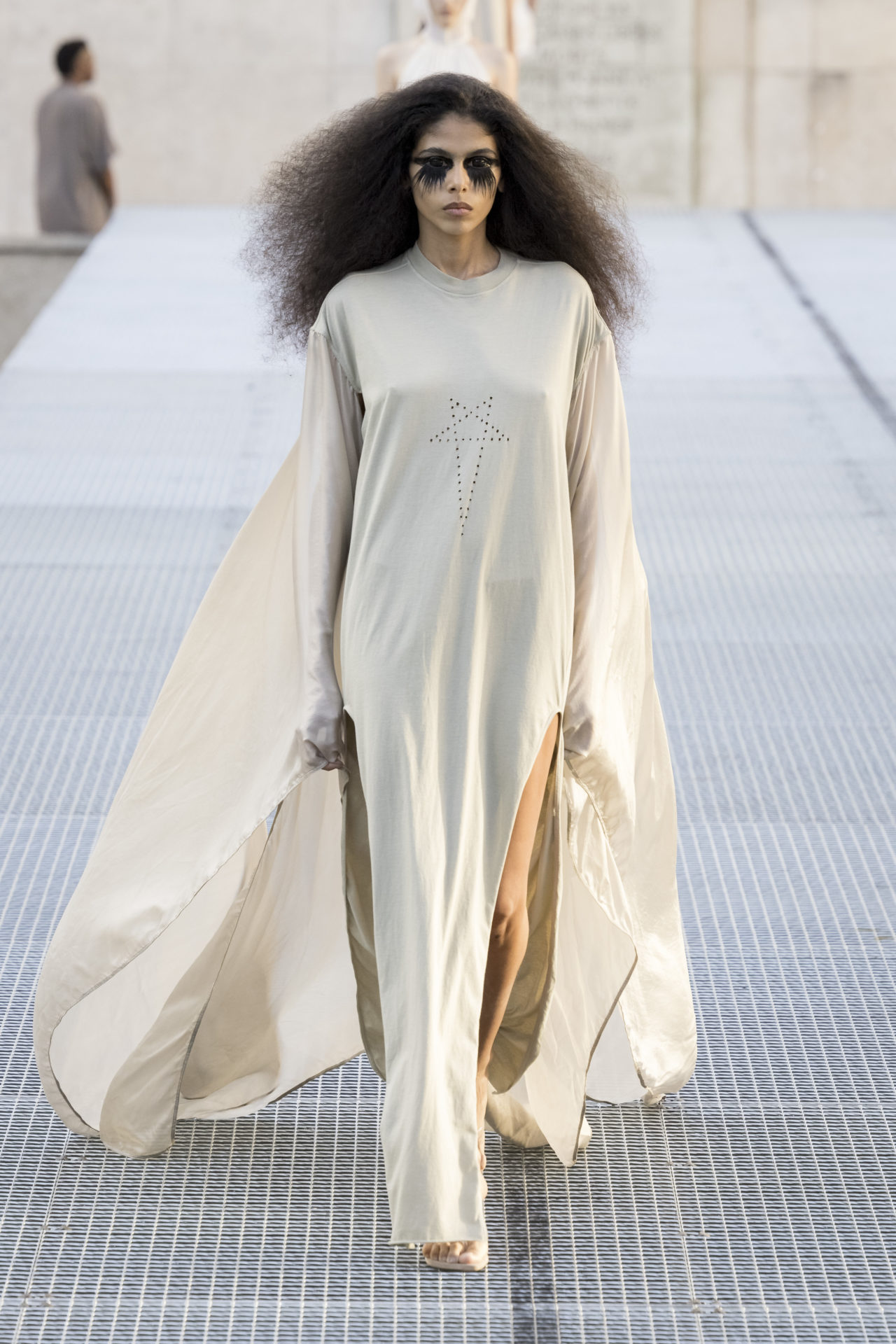
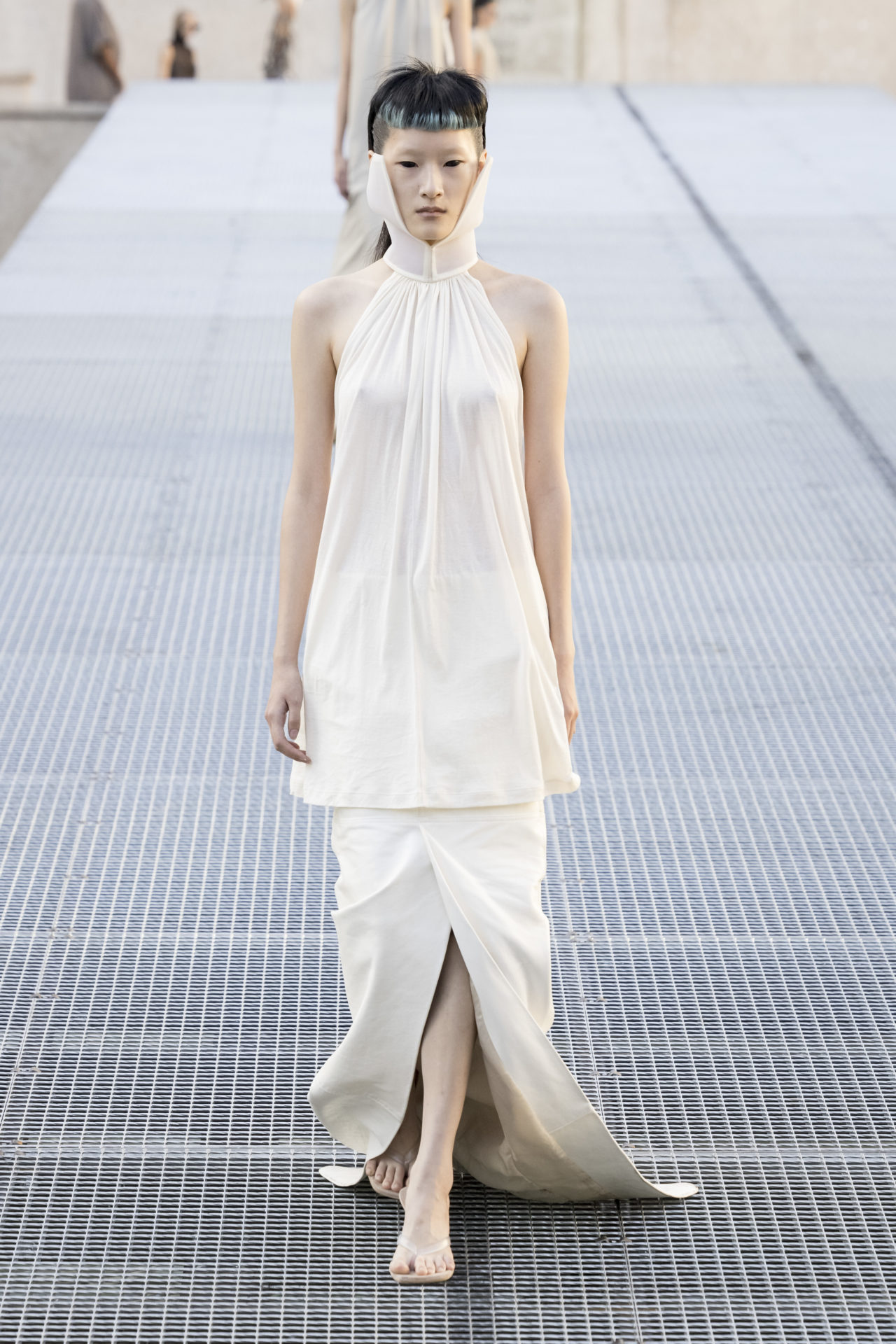
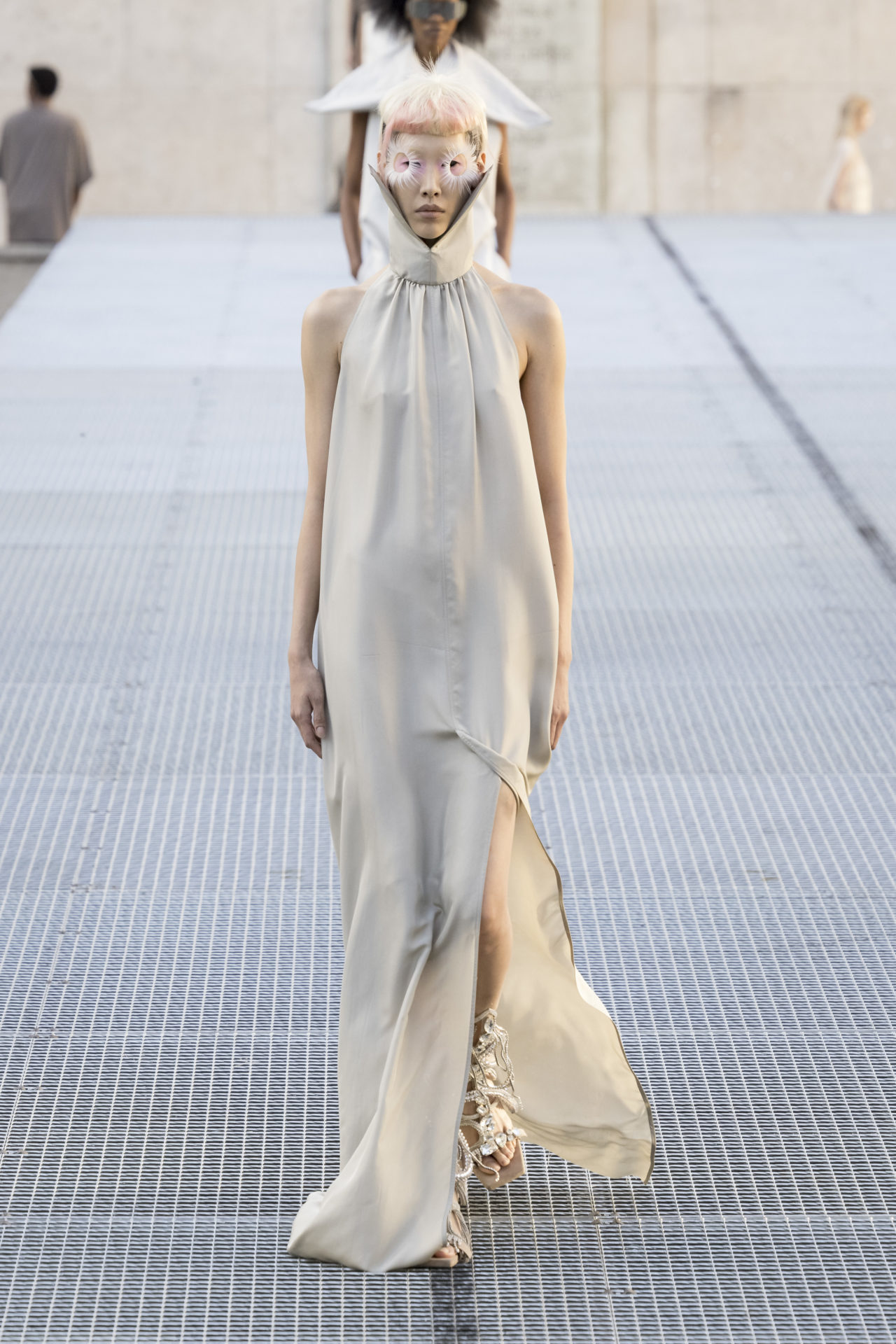
For Spring/Summer 2027, Owens placed his runway over the pool of the Palais de Tokyo, turning the show into something suspended between architecture, ritual and apparition. Water moved beneath the models while the clothes seemed to resist movement altogether: monumental, elongated, ceremonial, almost geological.
It was a precise contradiction.
Stone and water.
Weight and flight.
Rigidity and movement.
And somewhere between those opposites was the body.
For Spring/Summer 2027, Owens calls the collection Stone. But the collection is not really interested in stillness. It is interested in what happens when something apparently immovable begins to move.
That distinction is everything.
Because after three decades of building one of fashion’s most recognisable visual worlds, Rick Owens no longer needs to prove that he can create a silhouette.
The more difficult question is what he wants that silhouette to become now.
And perhaps that is where the muse enters the picture.
Who is the muse now?
THE WOMAN AS APPARITION
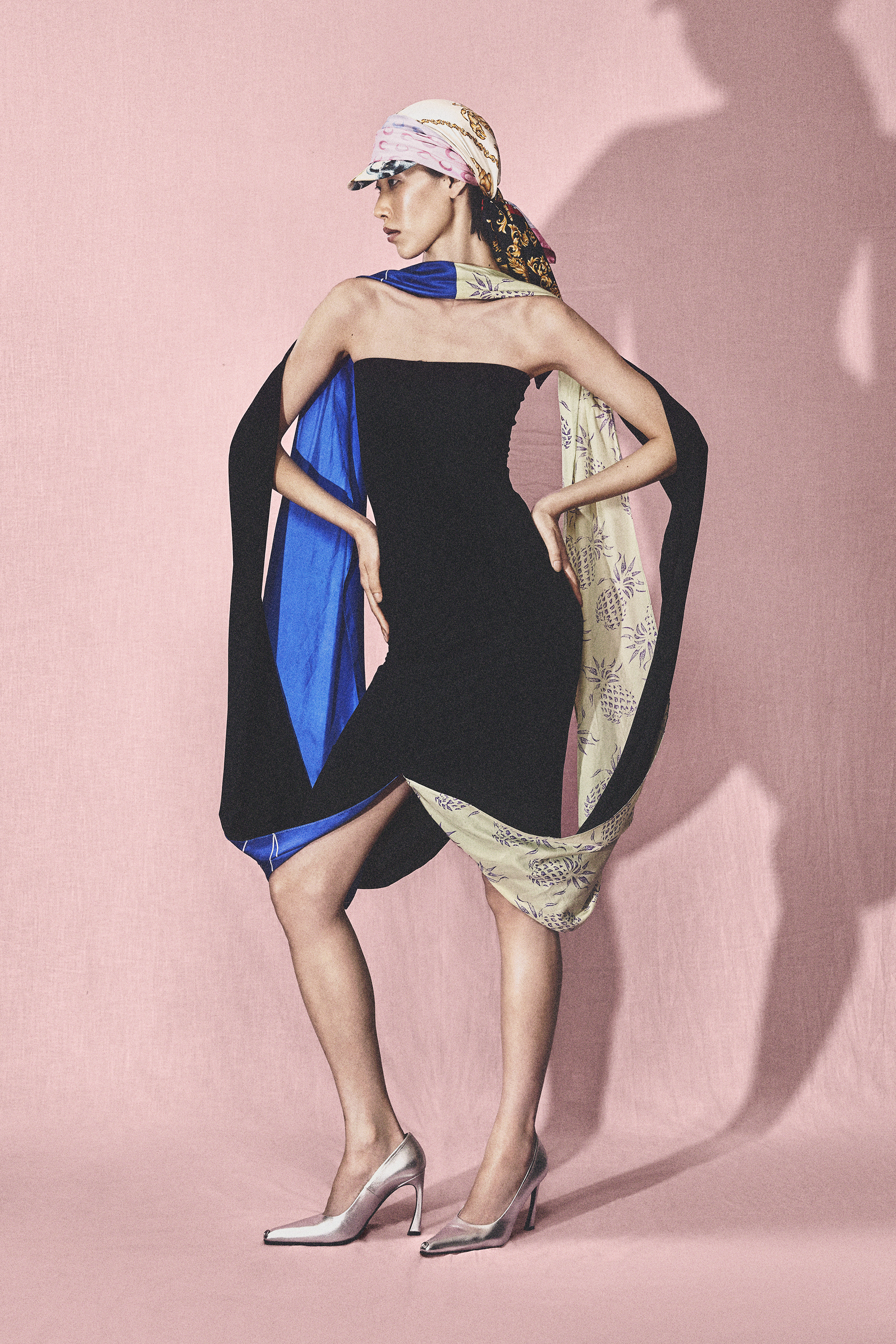
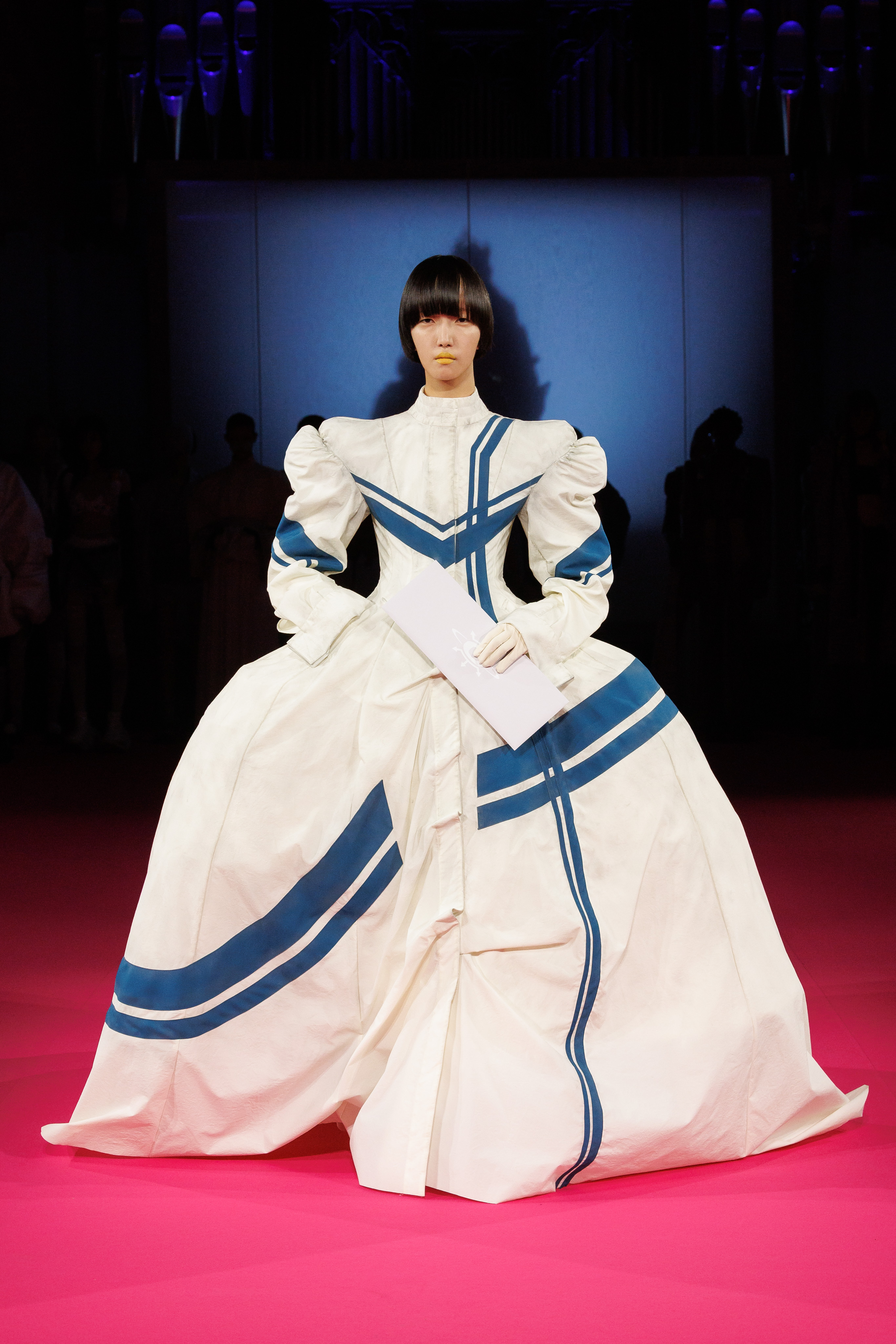
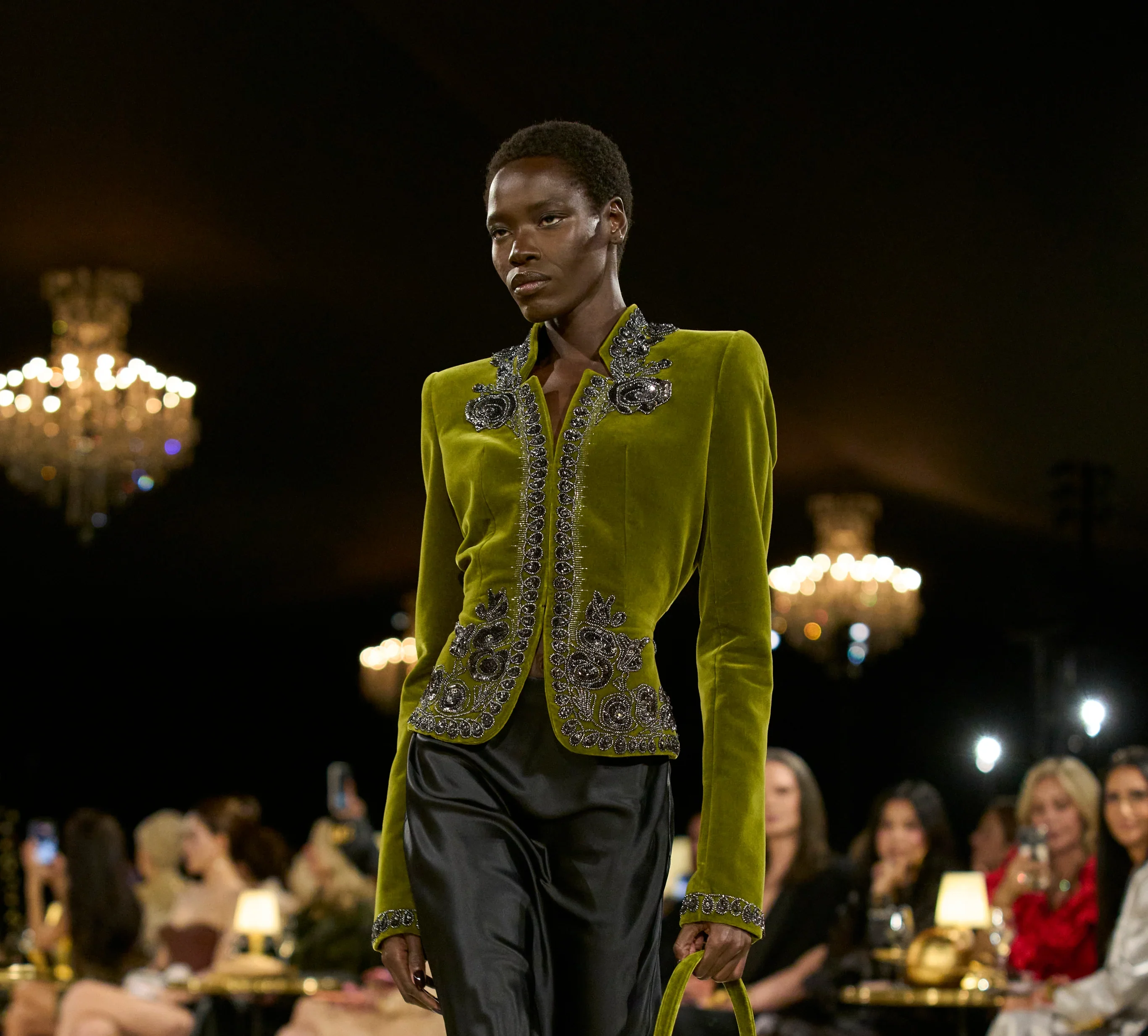
The women emerging onto the runway looked less like conventional fashion characters than figures from some private mythology: angels, witches, survivors, ceremonial beings.
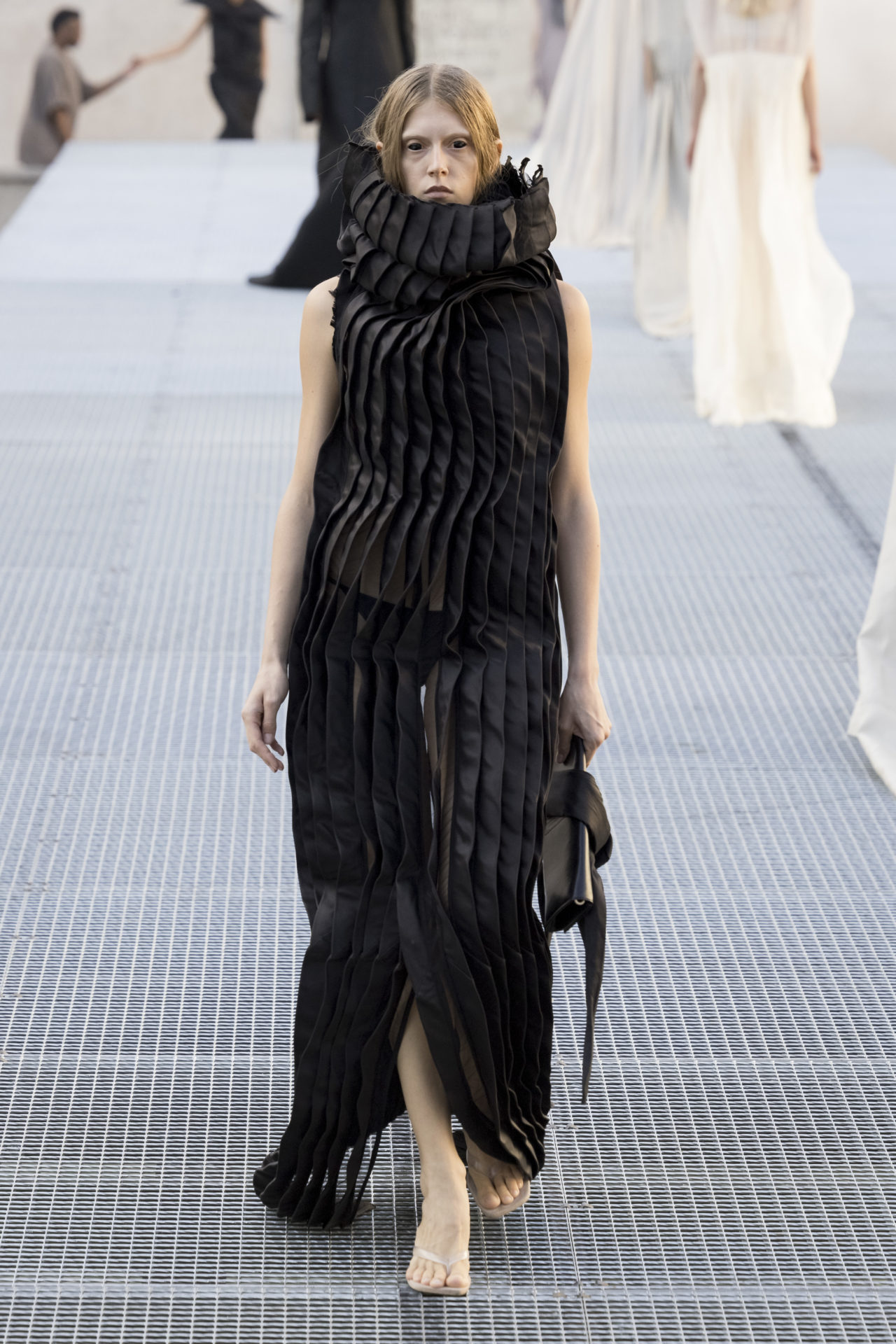
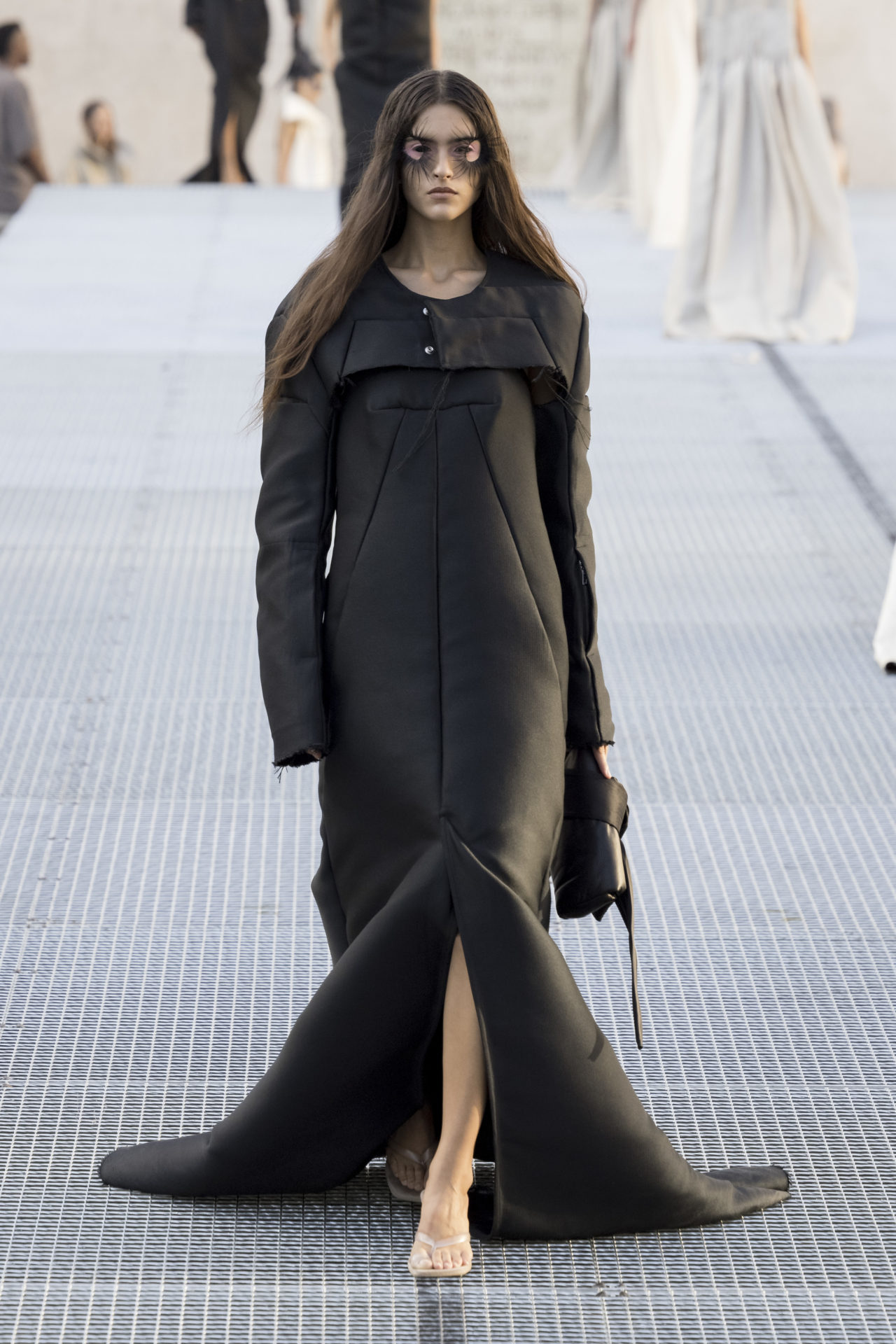
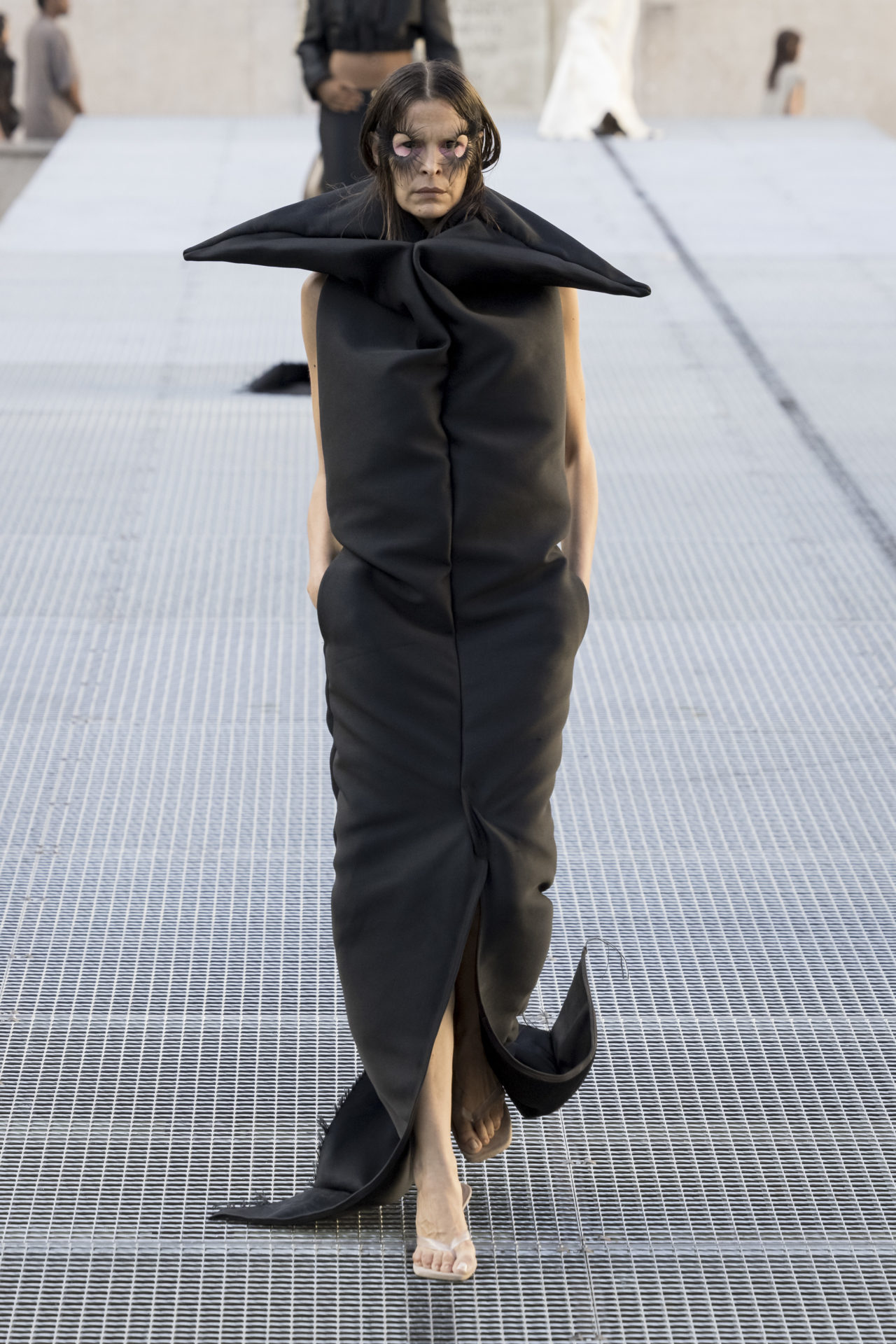
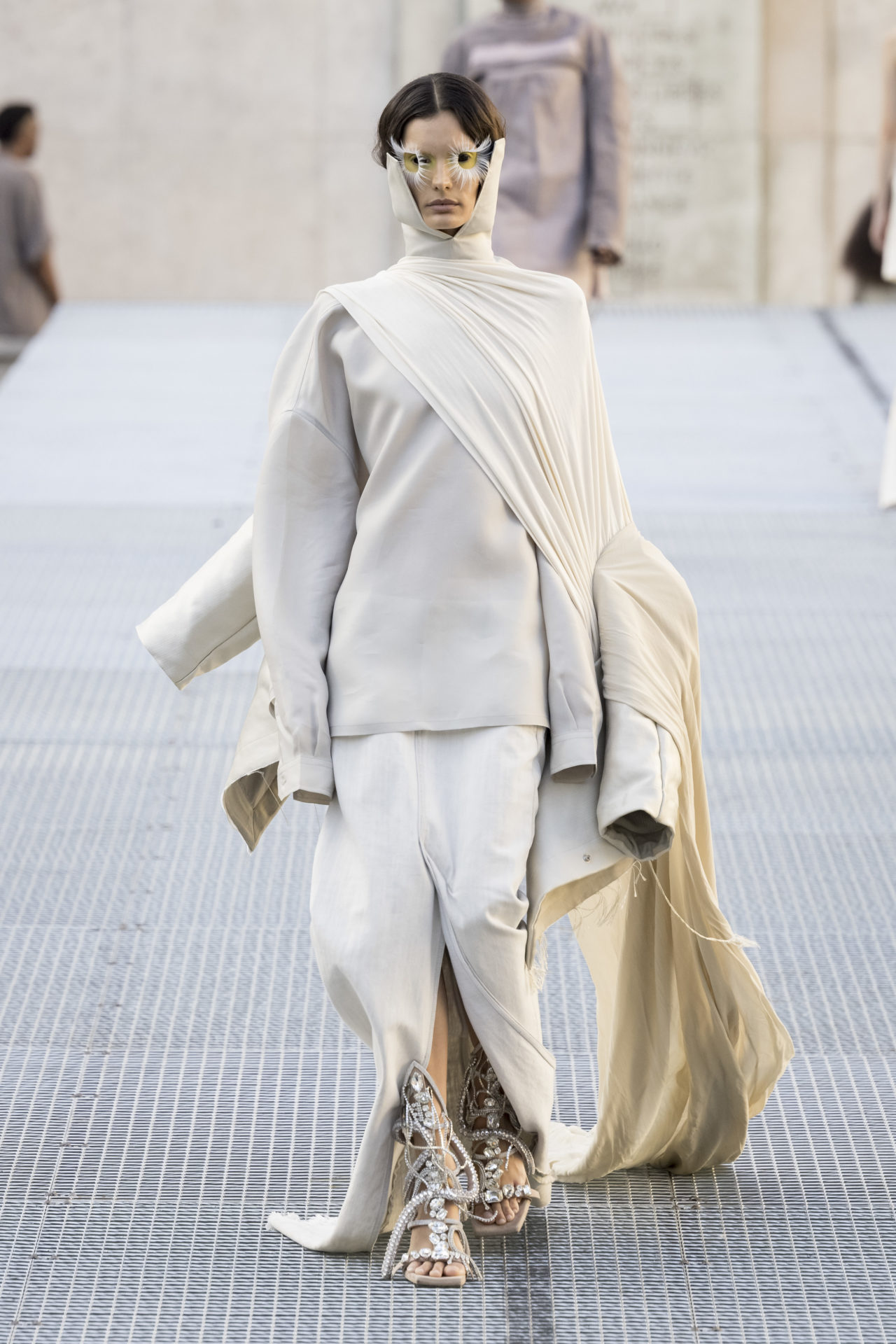
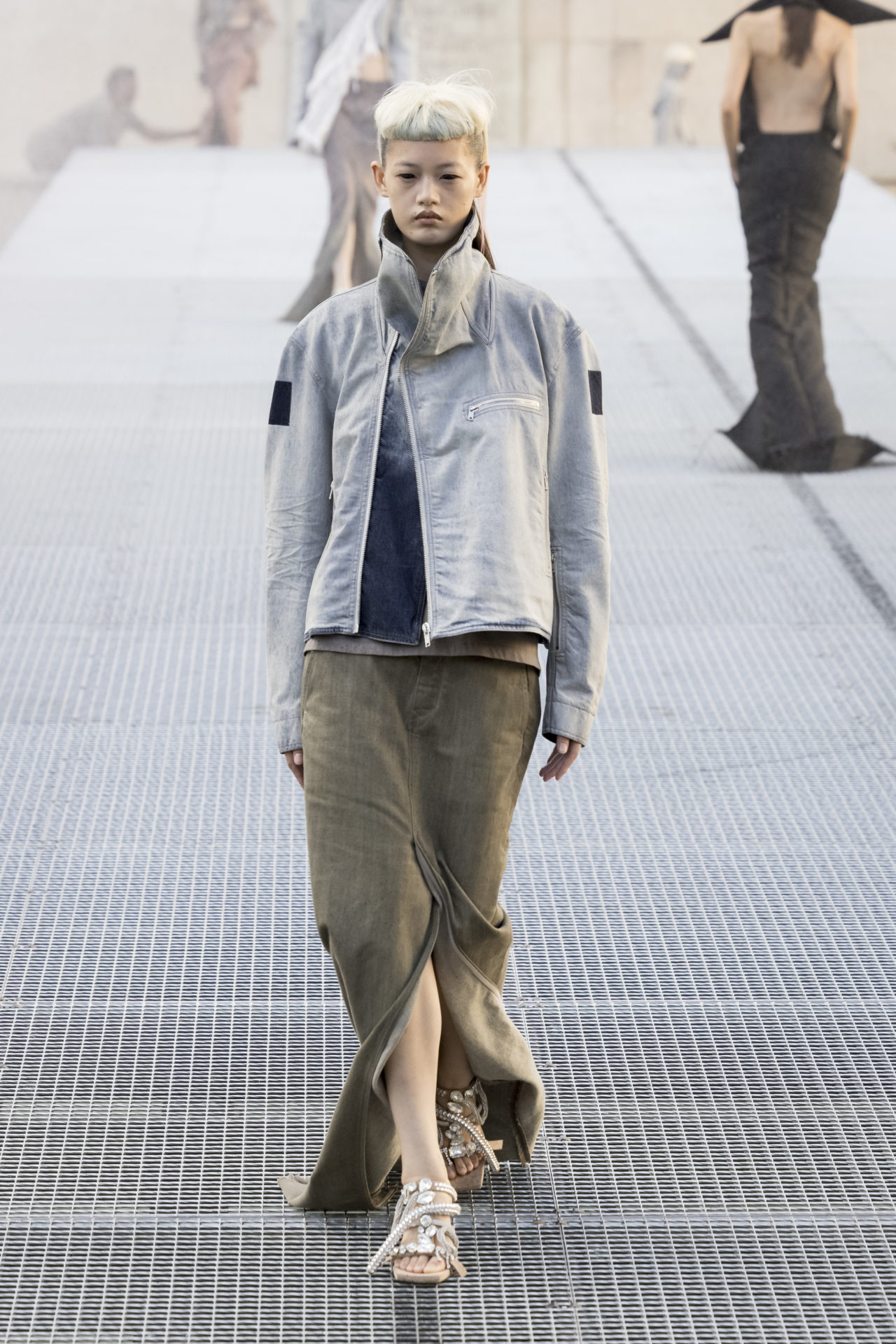
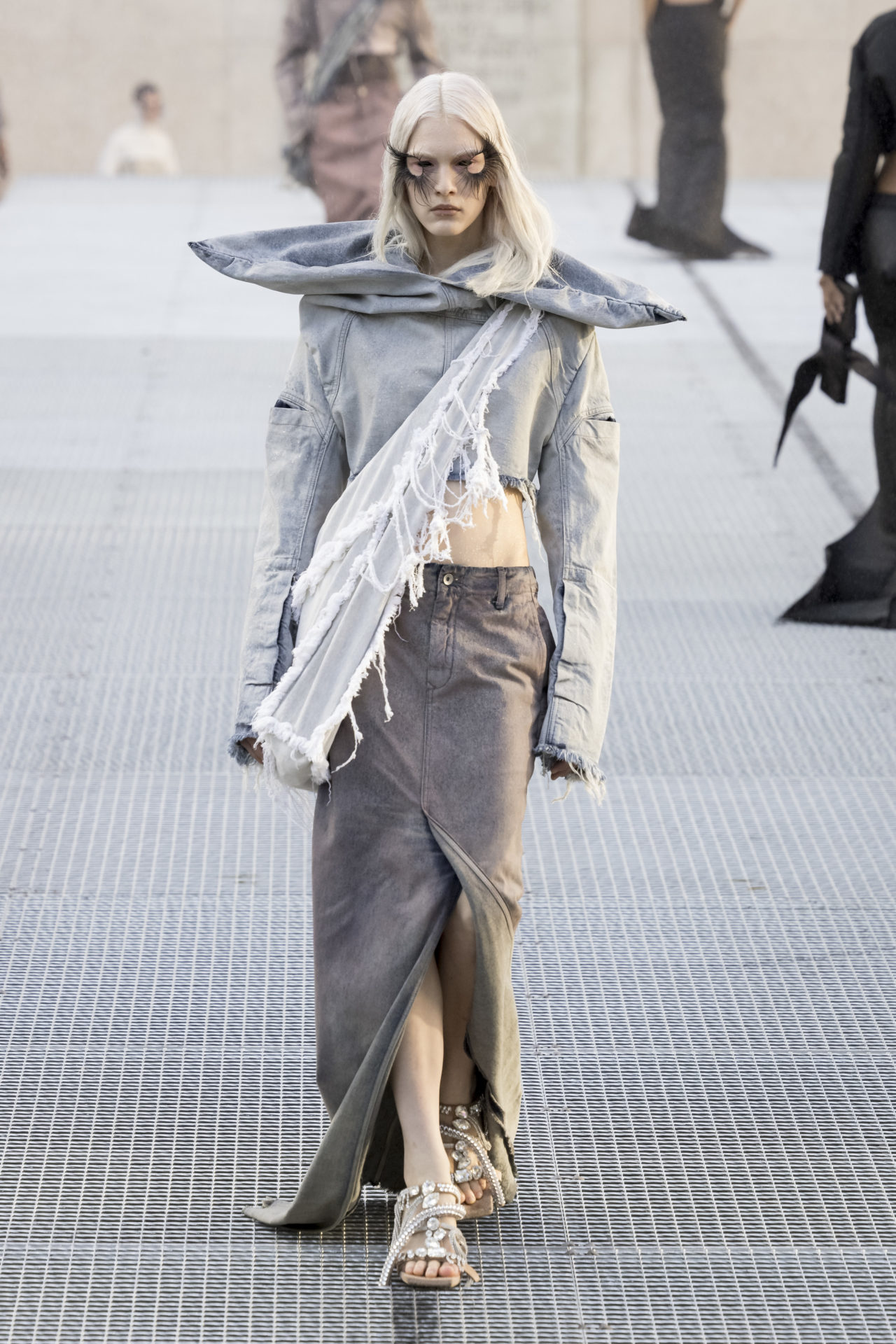
Long silhouettes transformed heavy industrial webbing into something almost aristocratic. Dresses appeared elongated to the point of abstraction. Bodies were covered, revealed, extended and distorted without ever losing their sense of control.
The Rick Owens woman has never really been interested in looking beautiful in the conventional sense.
She wants to look inevitable.
That is an important distinction.
Owens does not decorate the body.
He reprograms it.
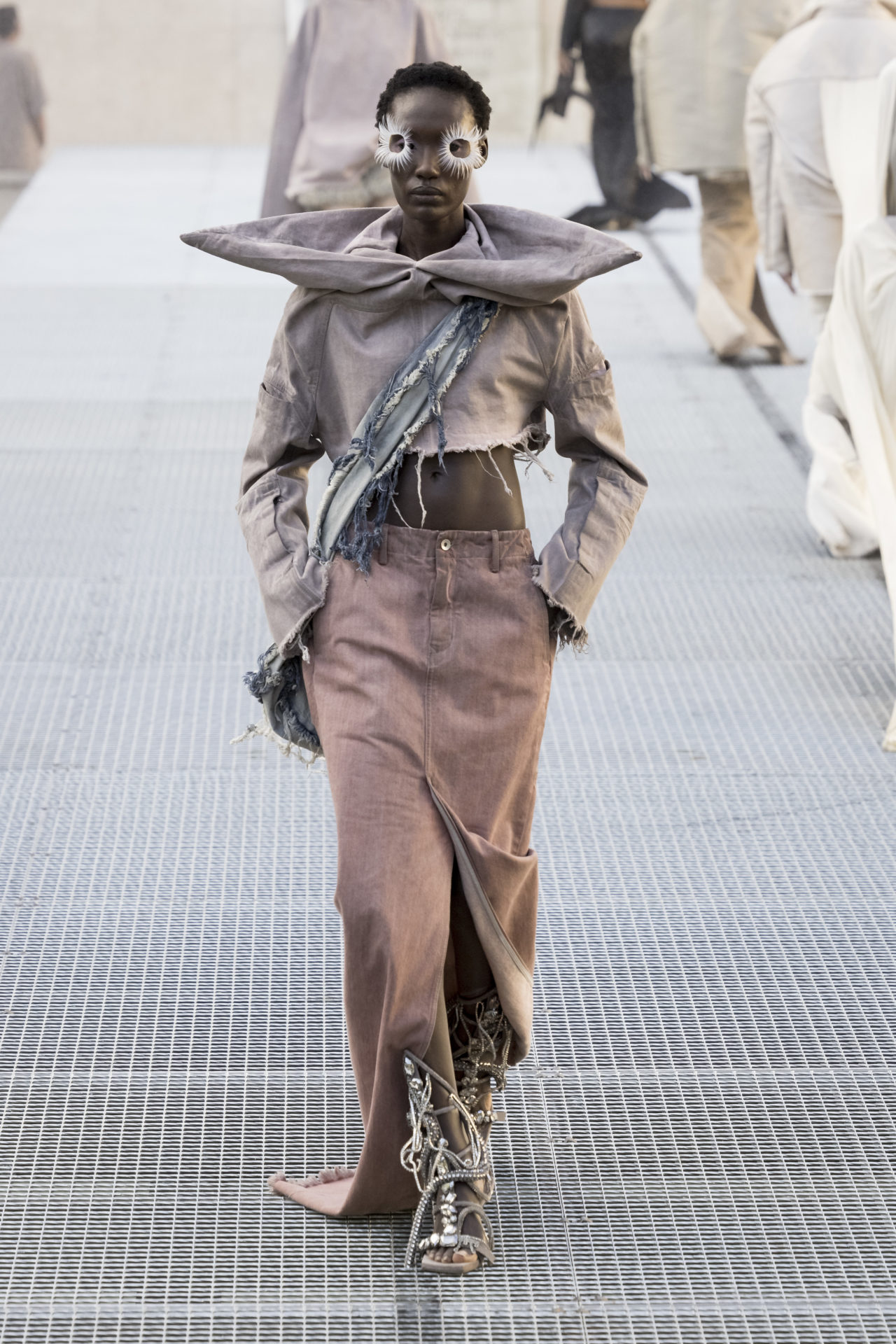
A platform changes the relationship between the body and gravity. A shoulder becomes architecture. A draped panel becomes protection. A stretched proportion creates distance between the wearer and everyone looking at her.
His clothes have always understood something that fashion often forgets: clothes are social technology.
They tell a body how to enter a room.
They determine how much space it occupies.
They influence whether it appears vulnerable, erotic, threatening, untouchable or exposed.
This is why the Owens woman has always felt less like a fashion fantasy than a social proposition.
She does not ask, How do I look?
She asks, What happens when I arrive?
STONE IS NOT STILL
The title suggests hardness.
The collection suggests something more complicated.
Stone implies permanence, gravity, resistance, the refusal to move.
Yet almost everything in this collection is trying to escape those conditions.
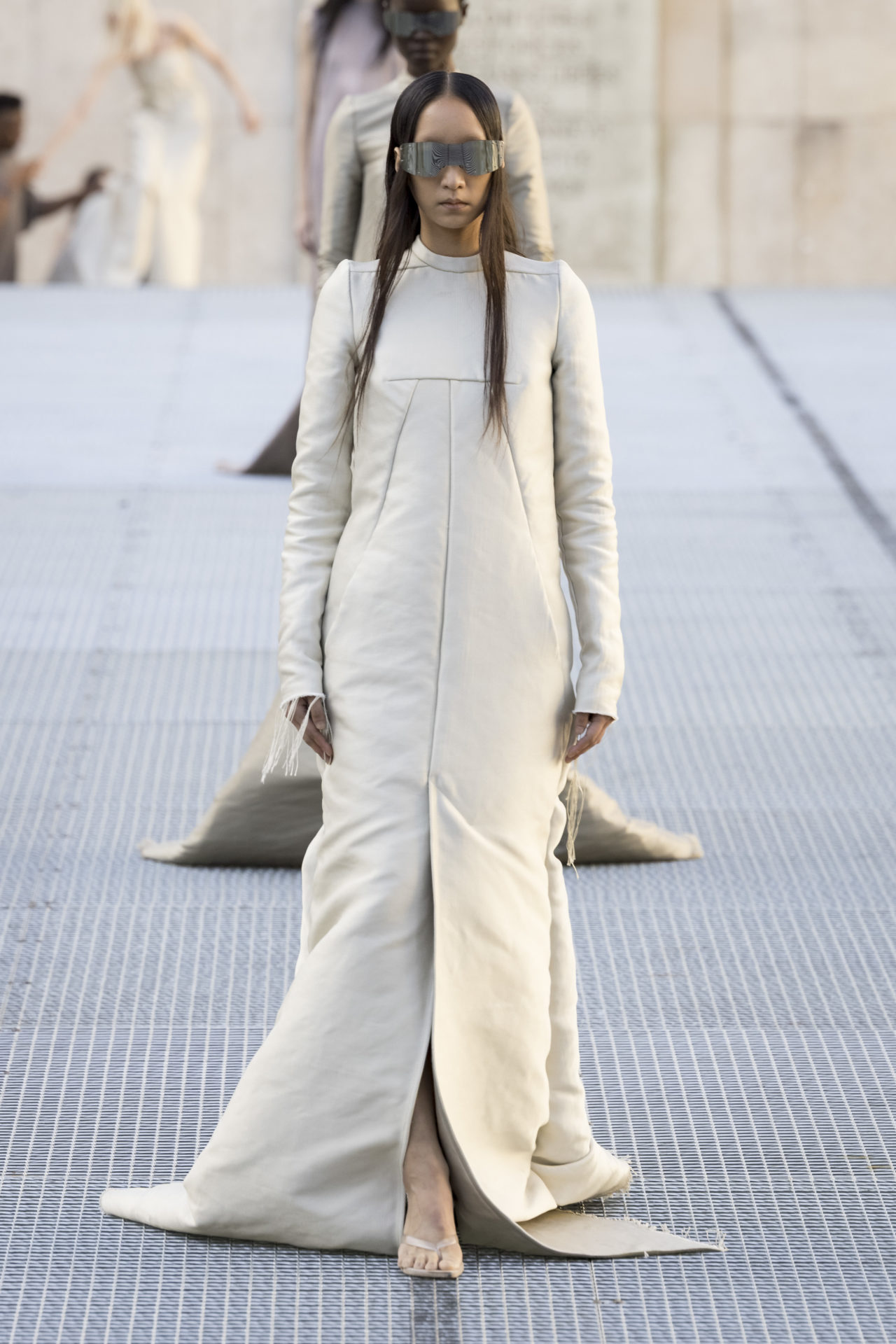
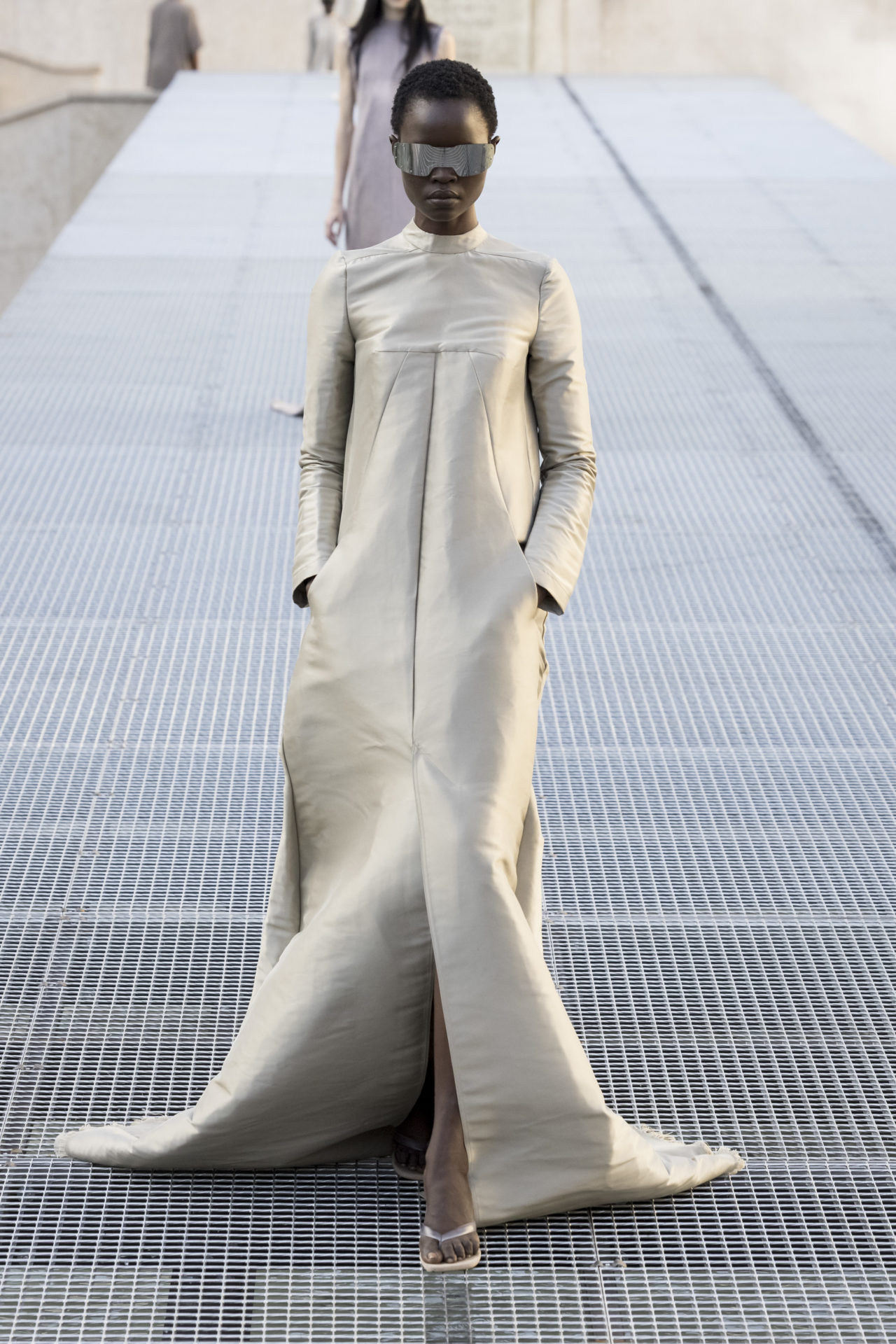
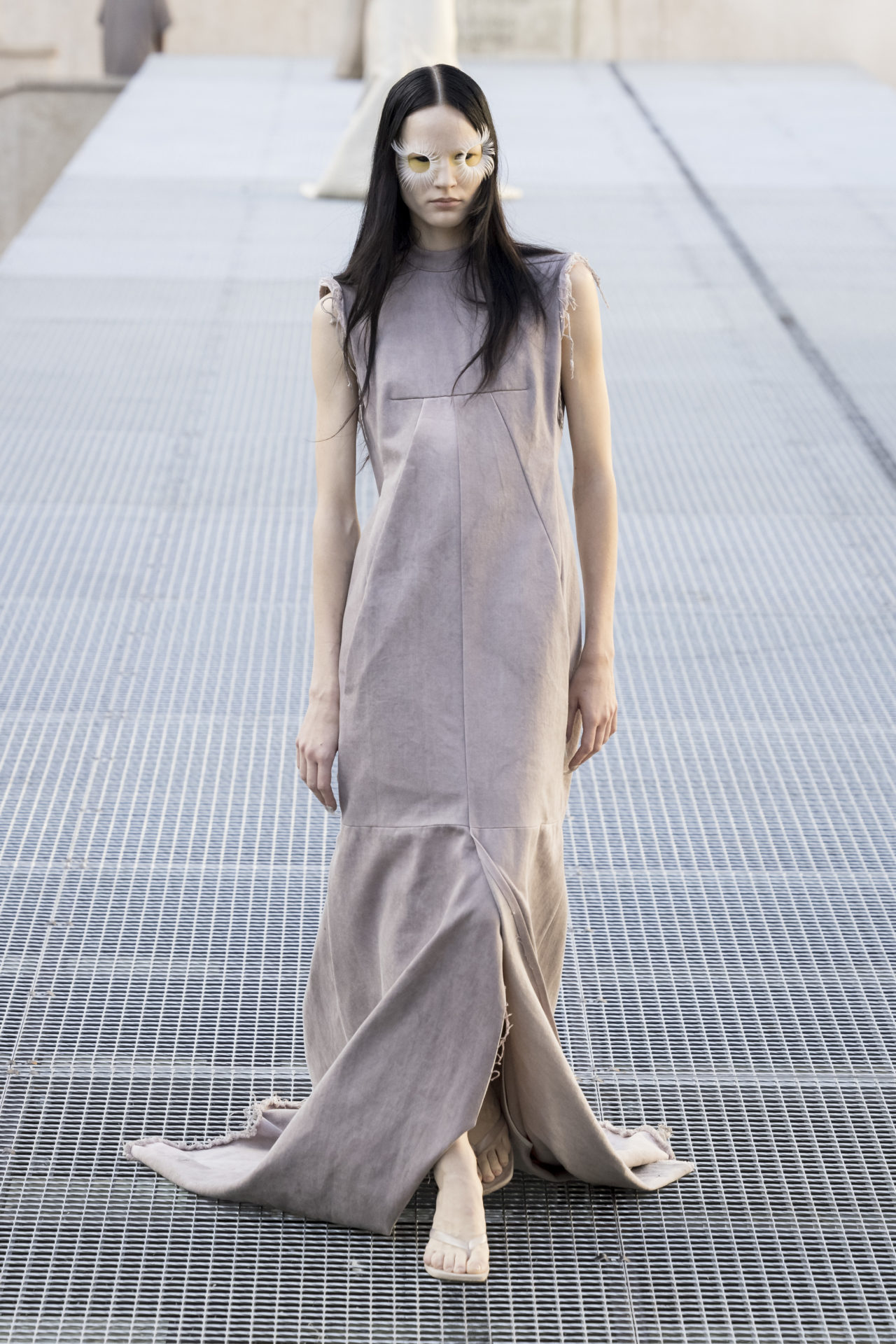
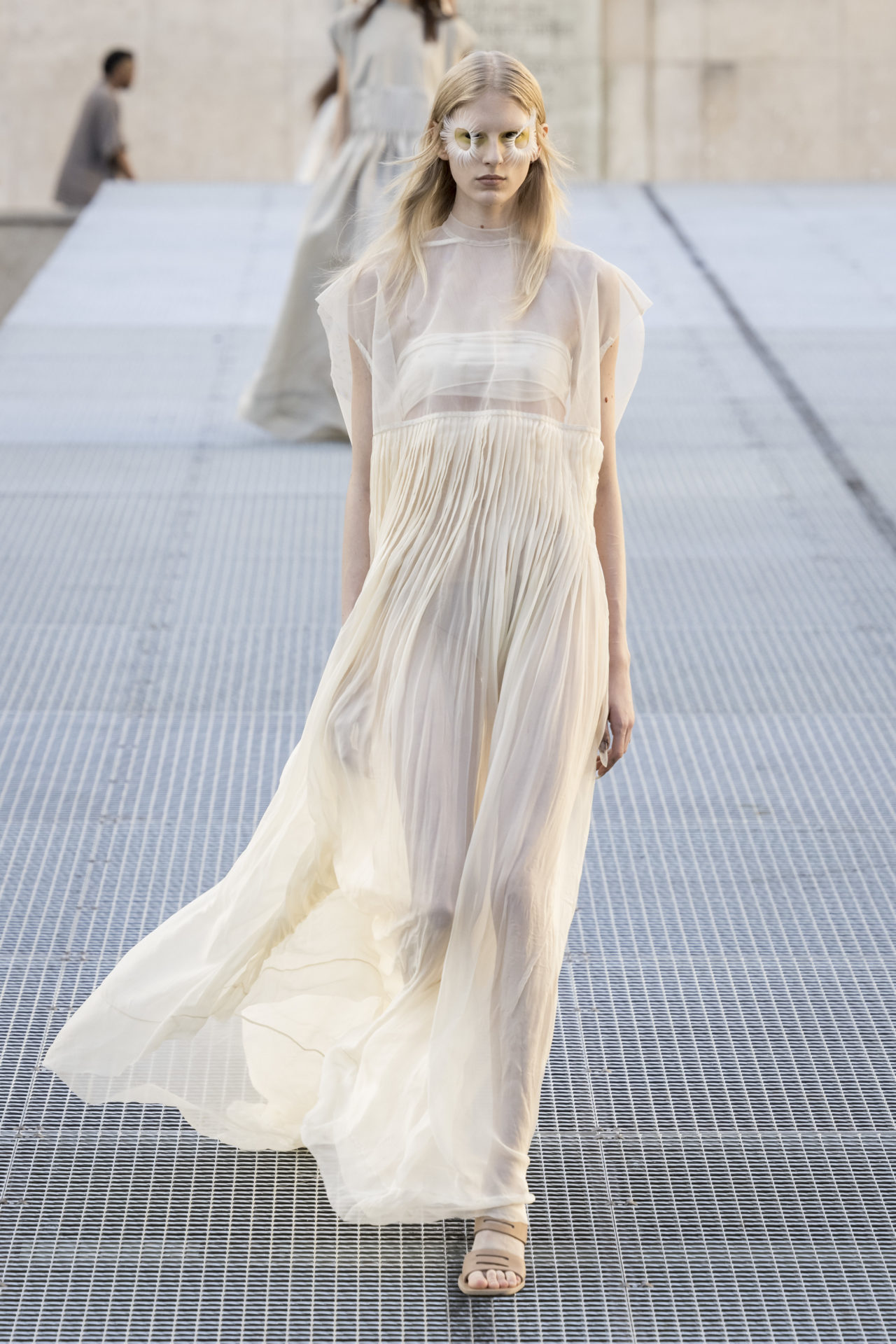
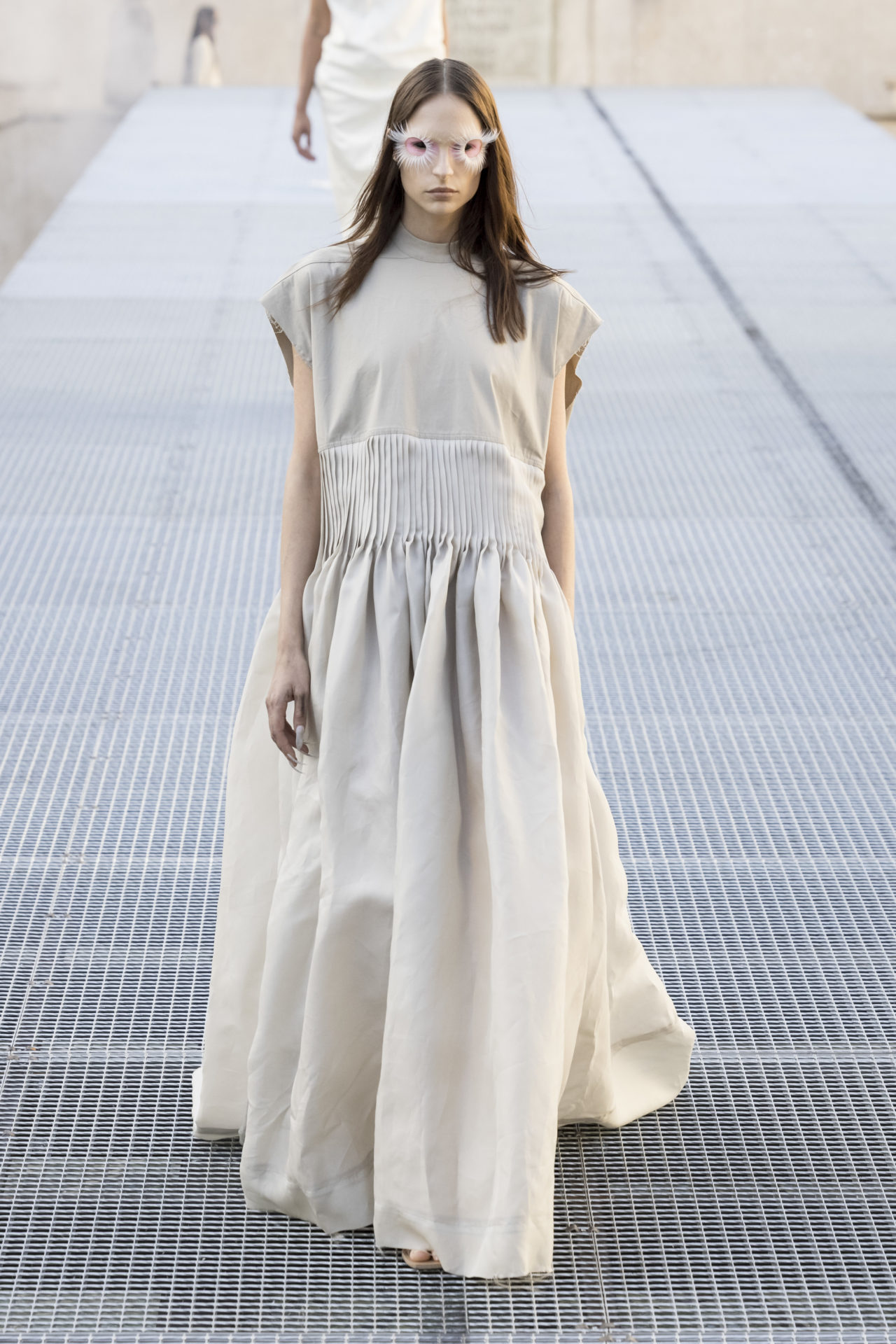
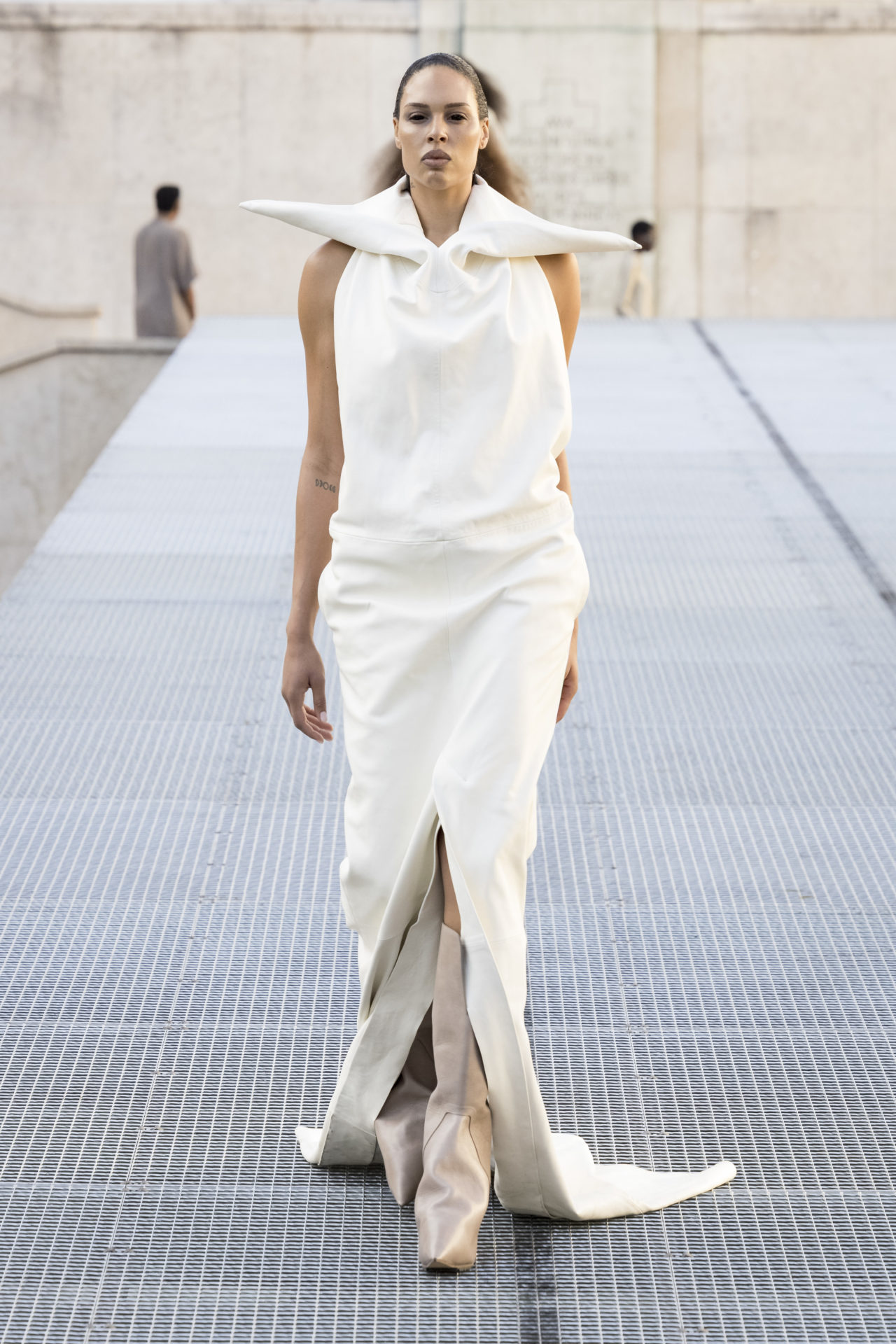
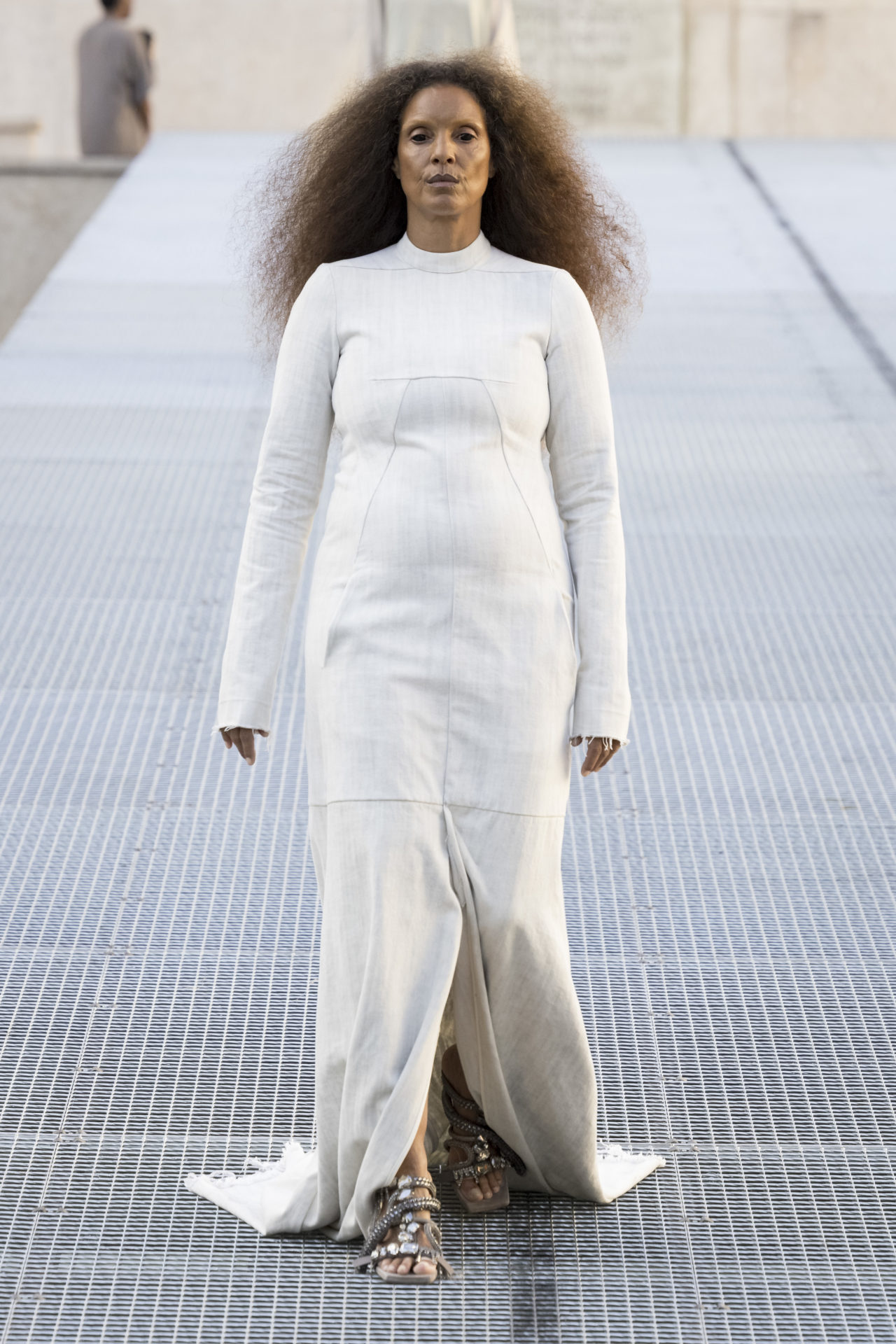
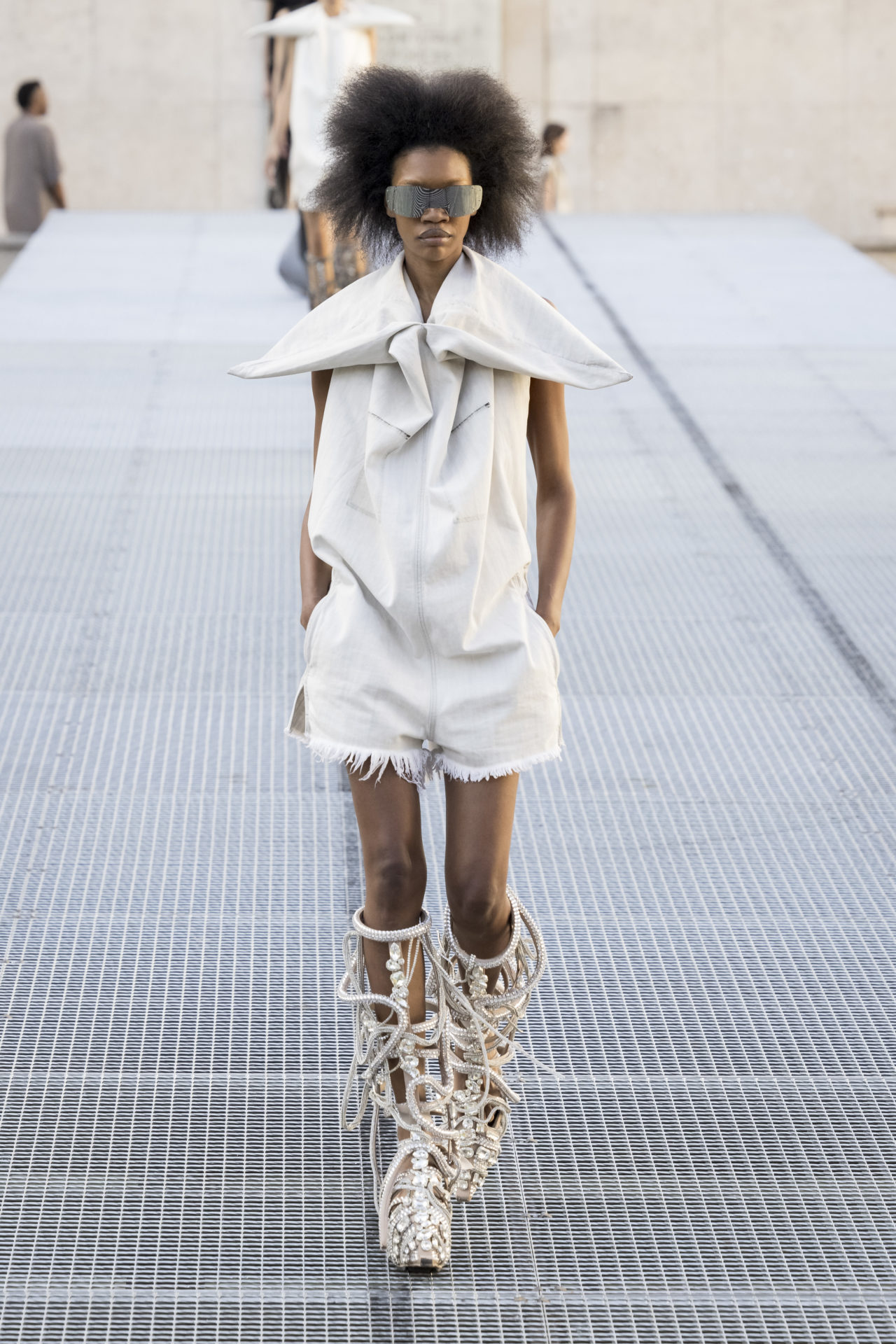
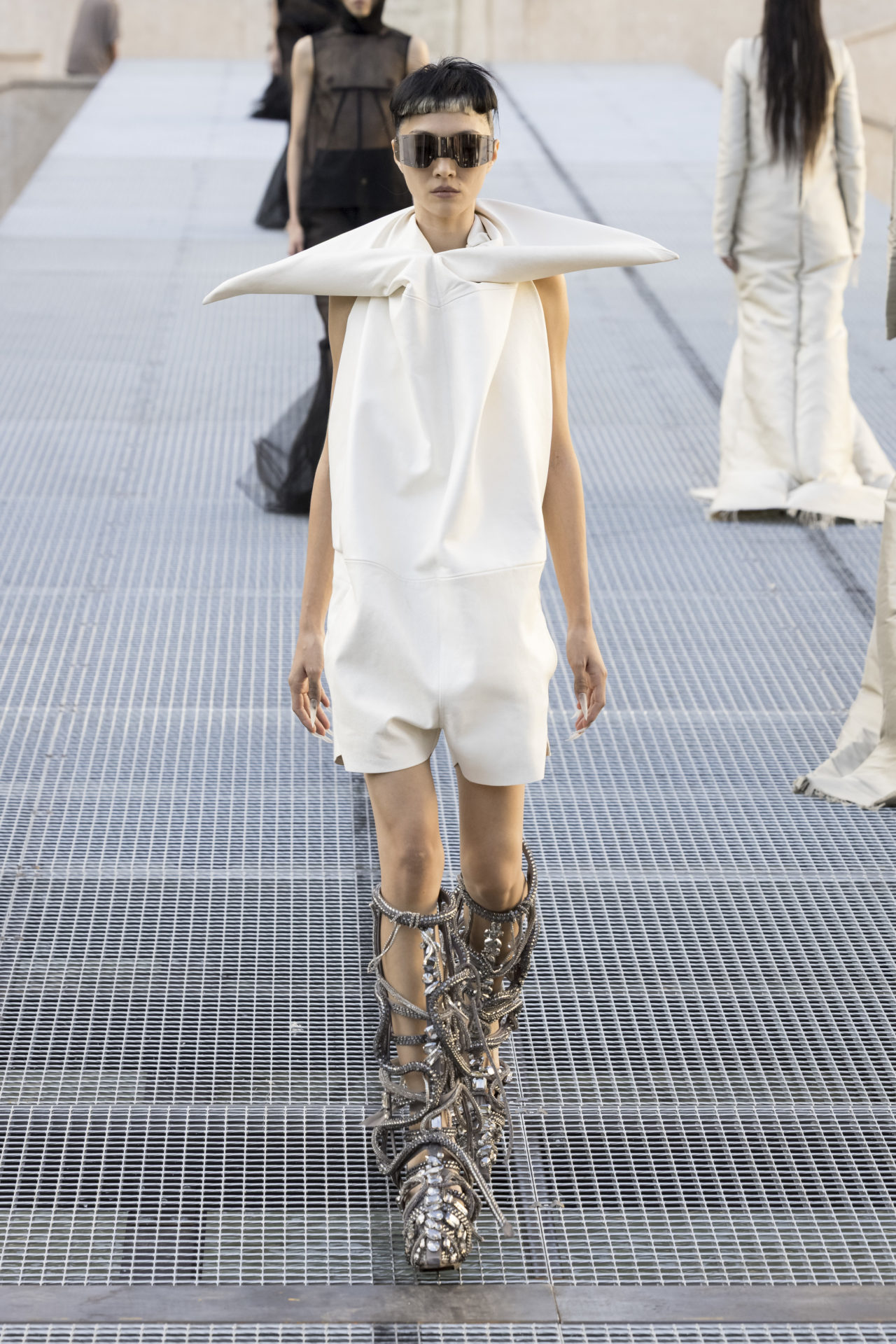
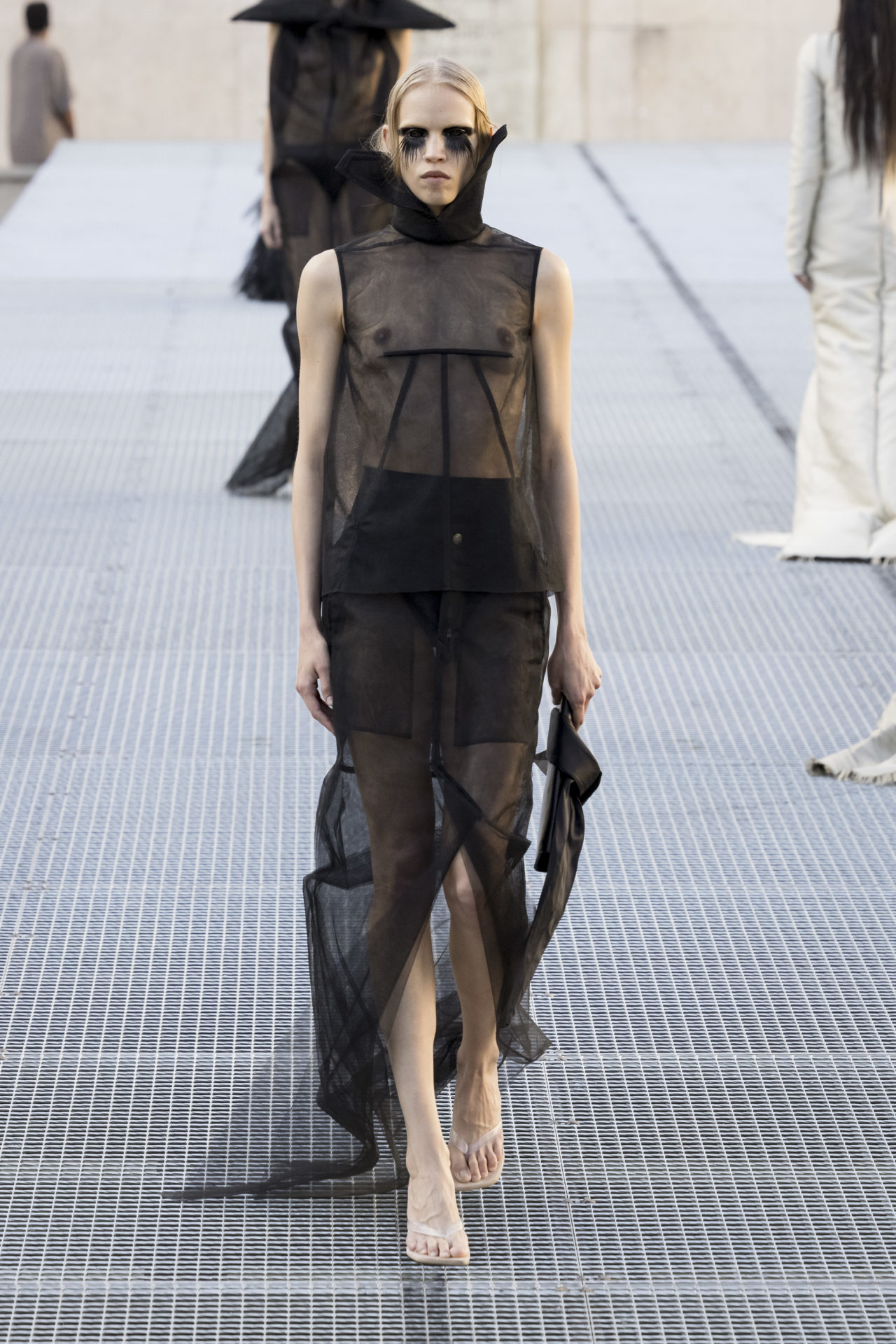
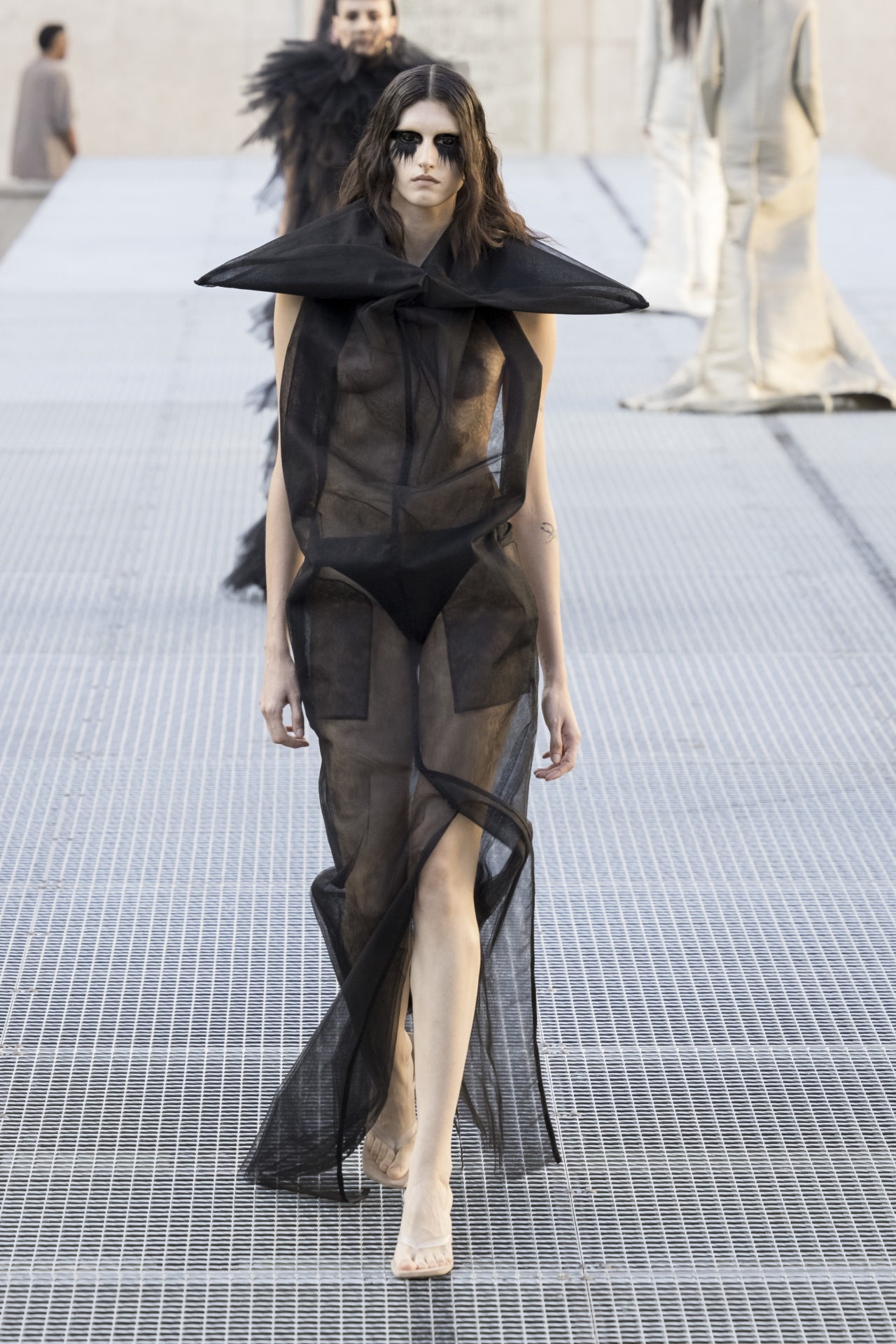
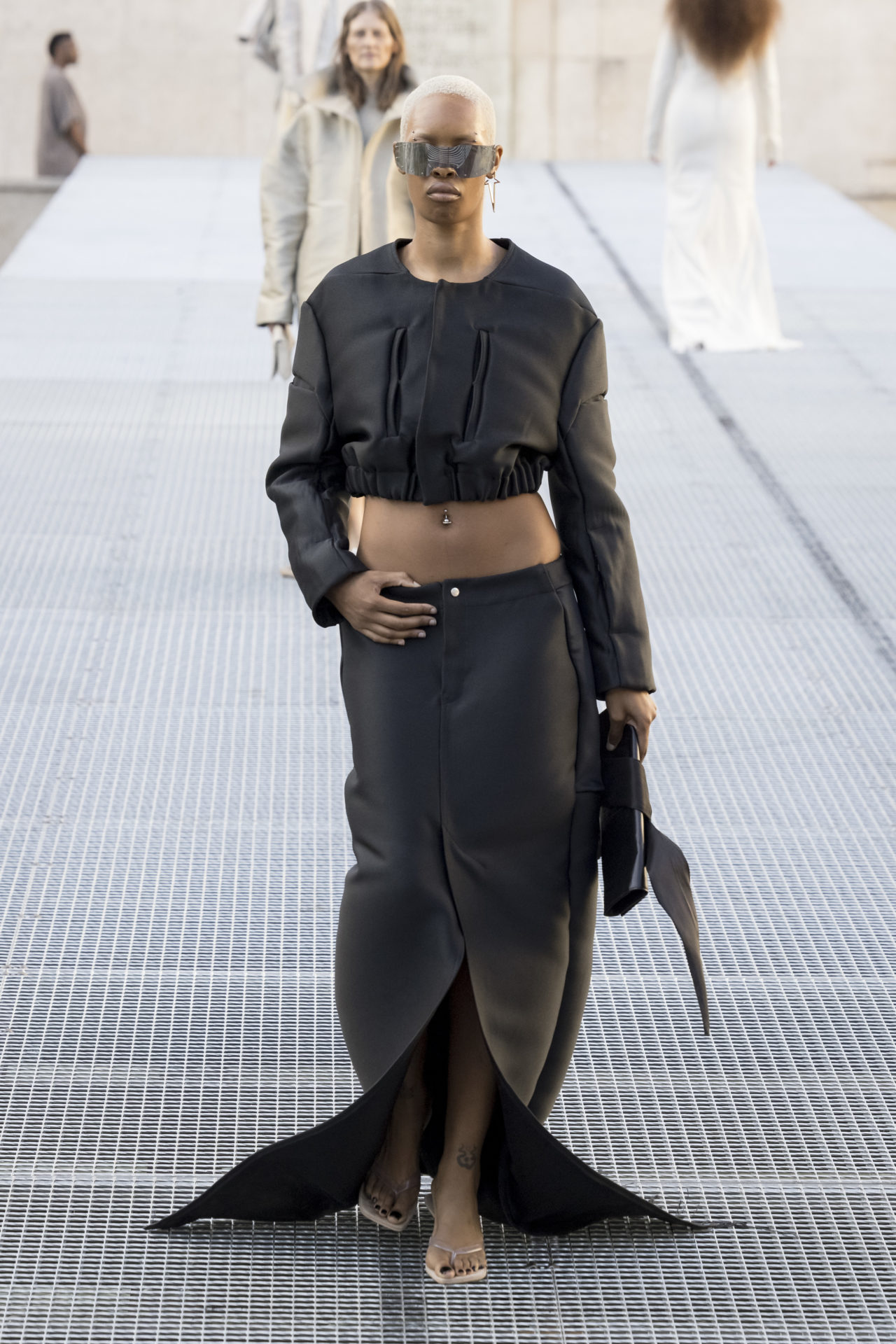
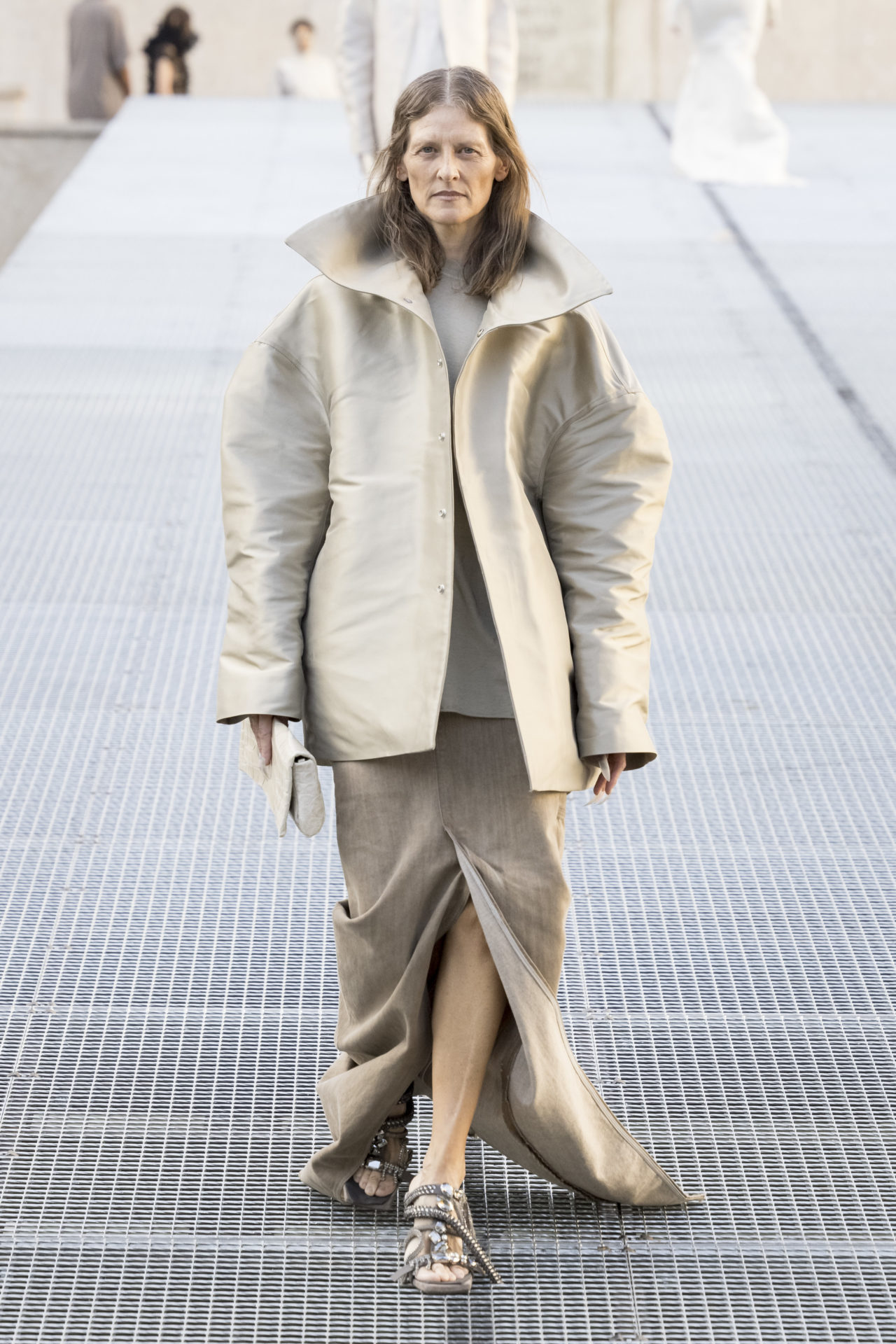
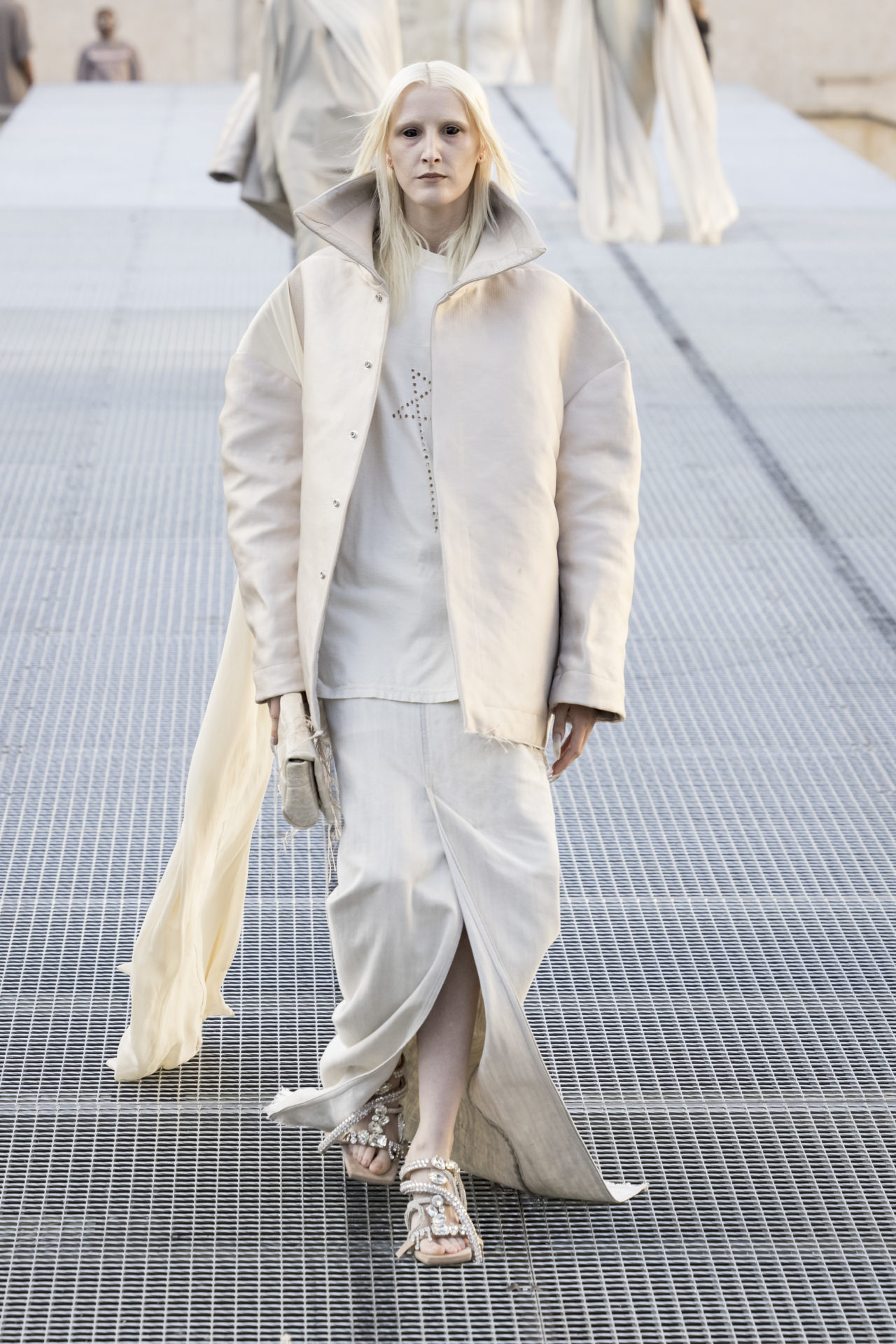
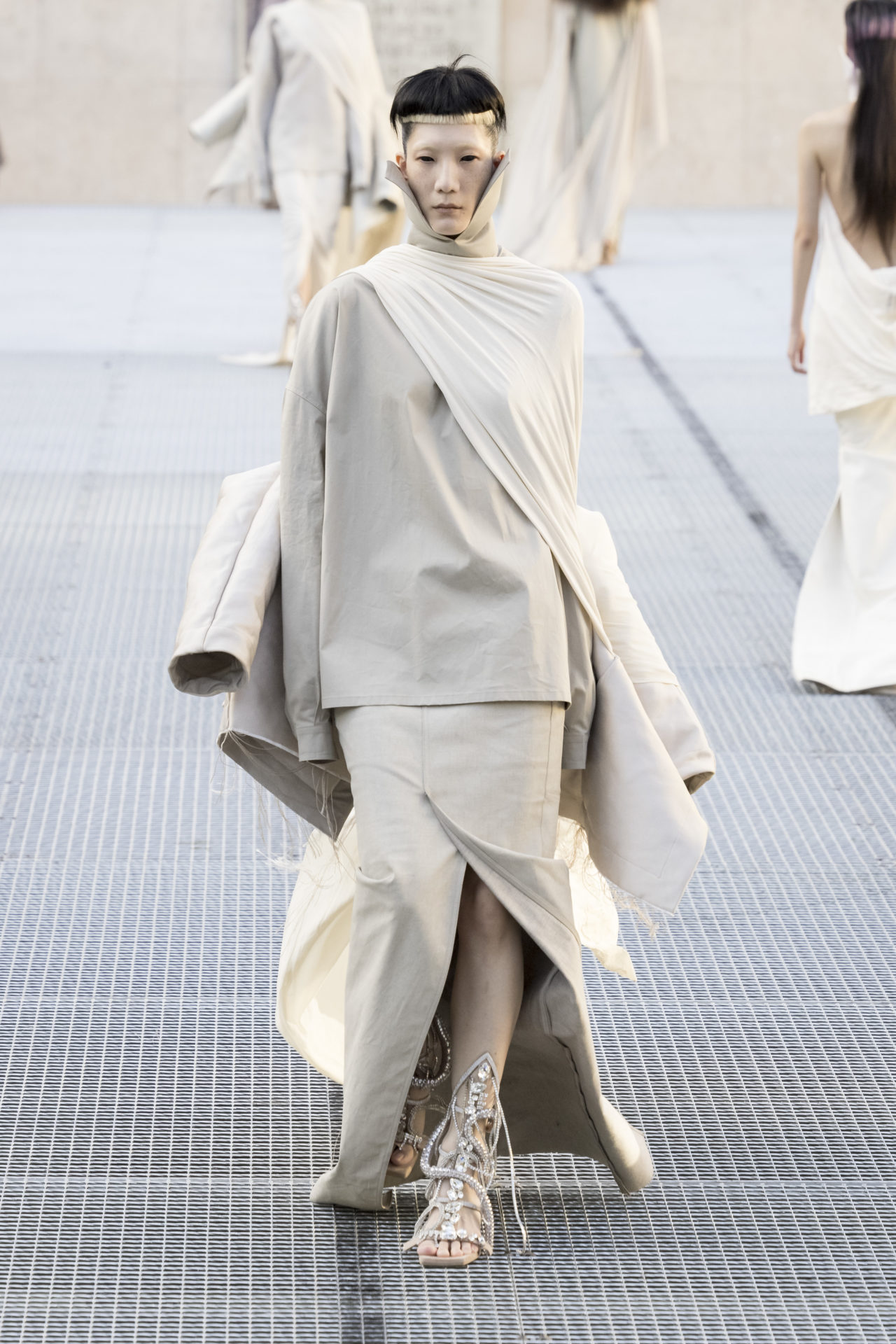
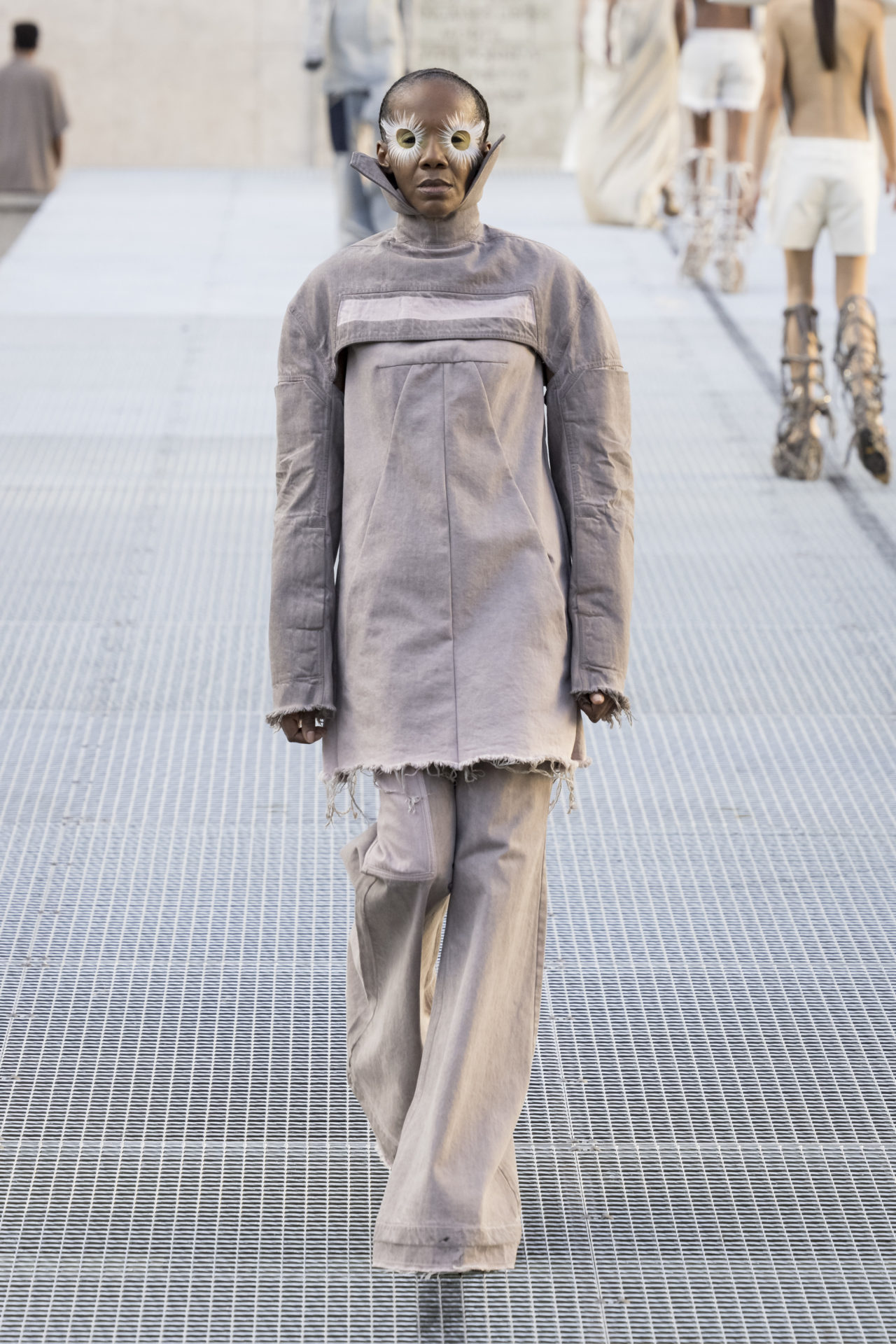
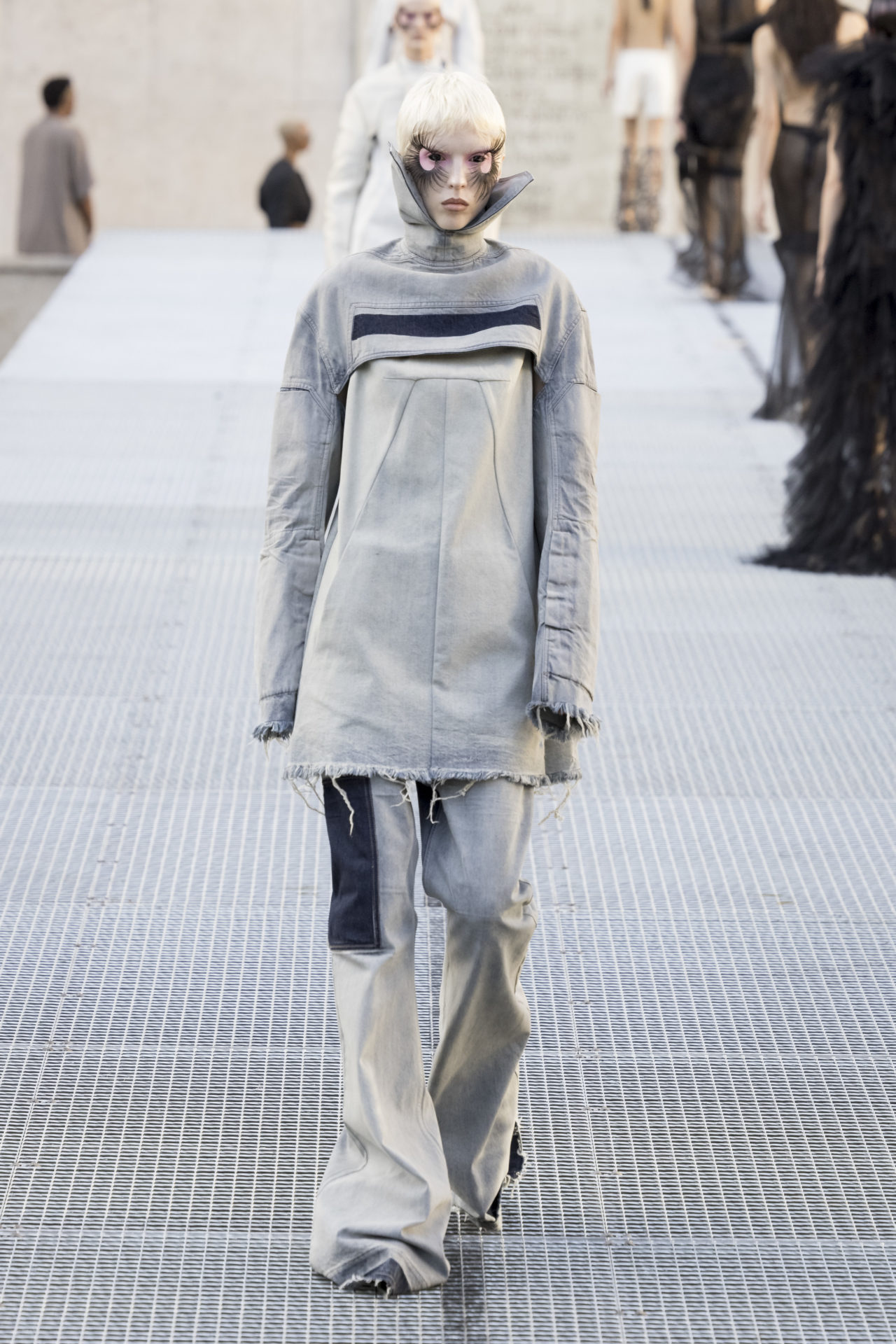
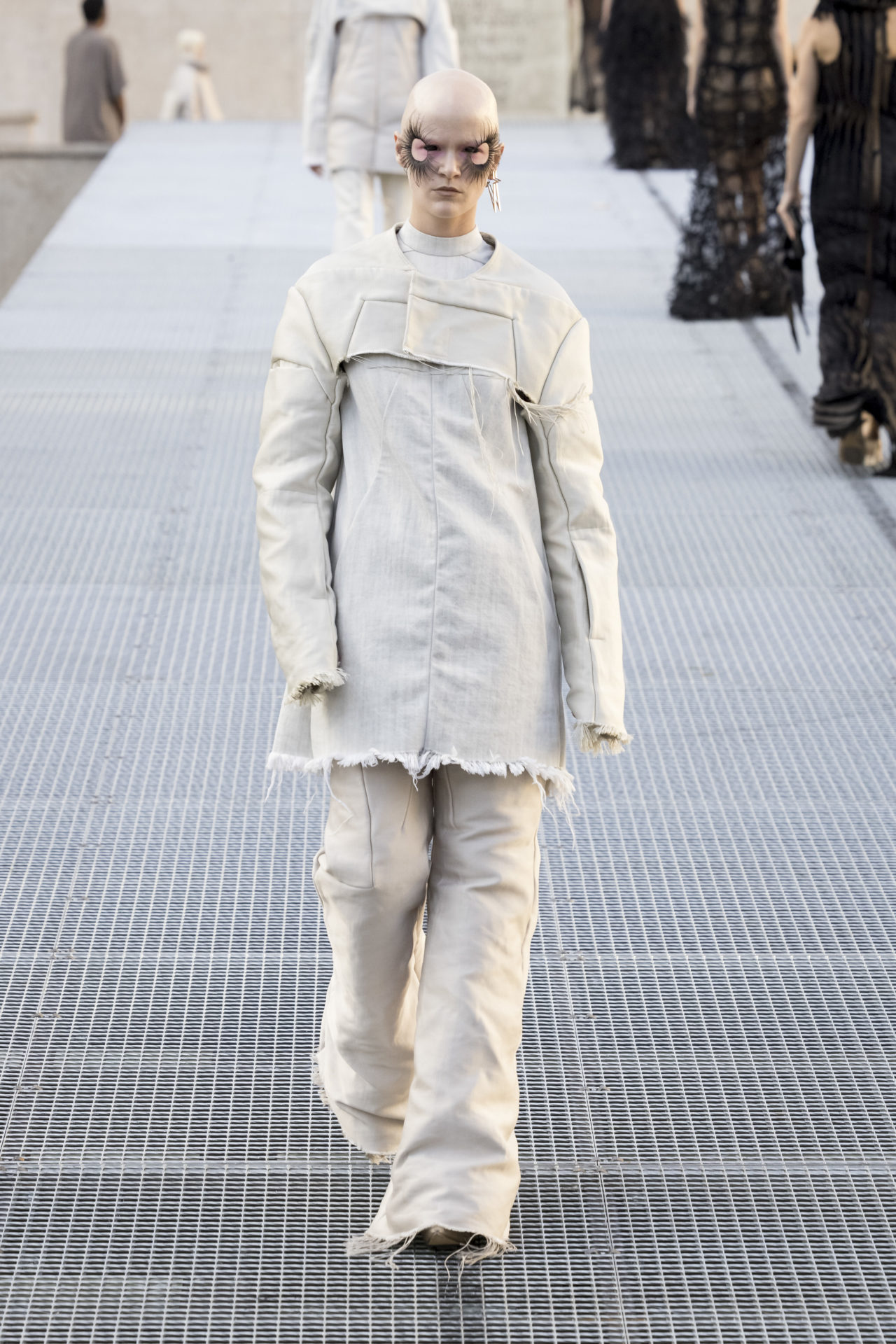
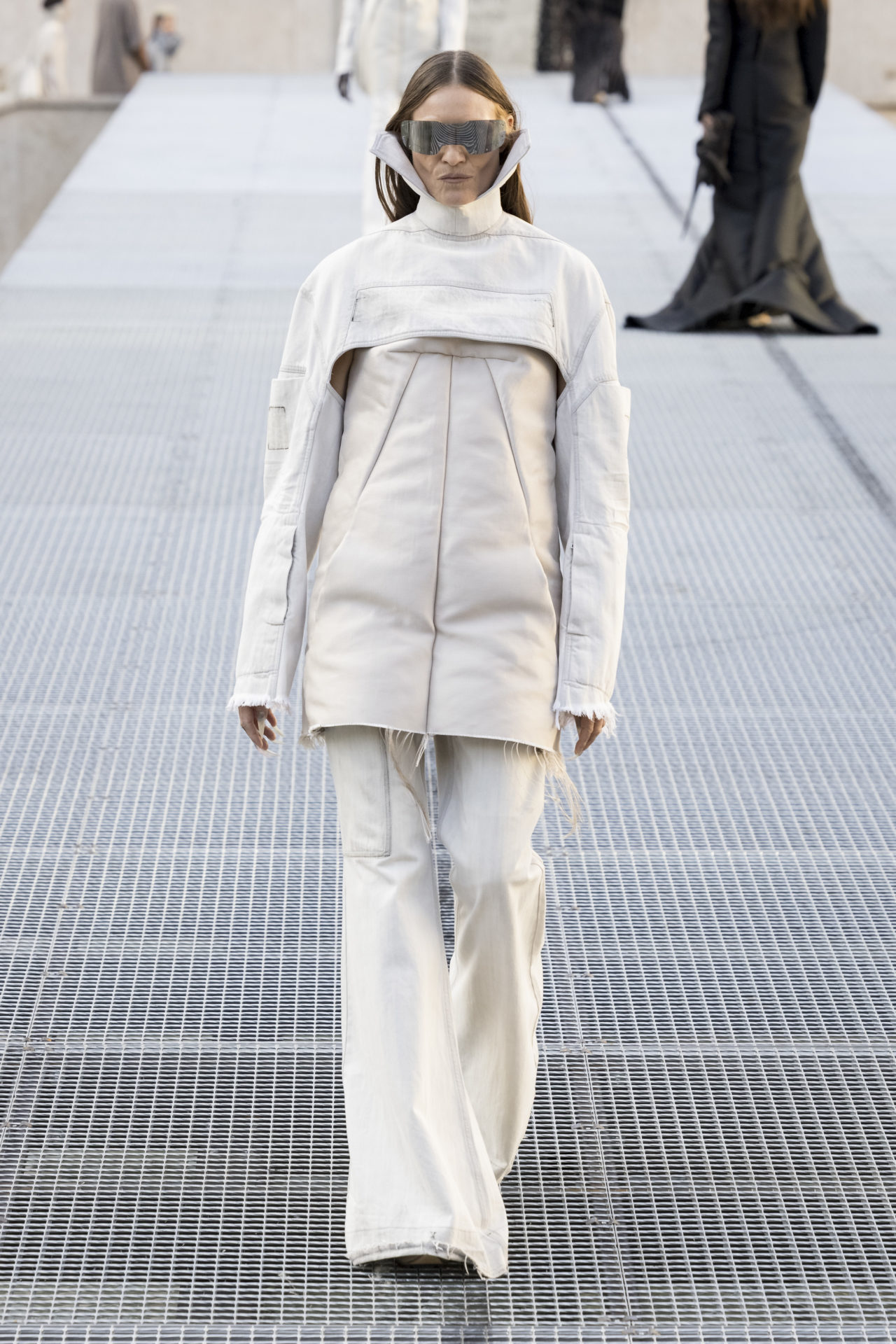
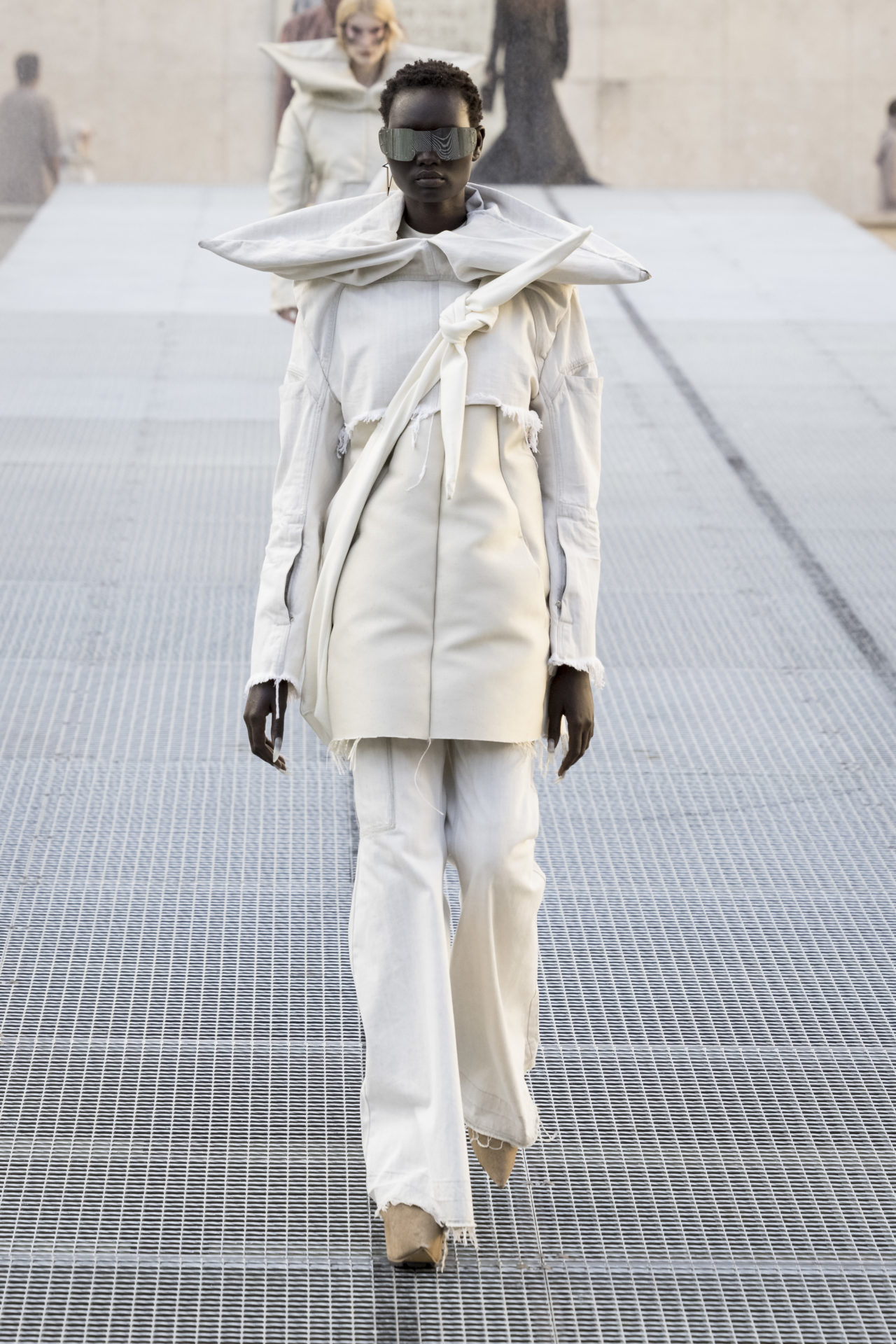
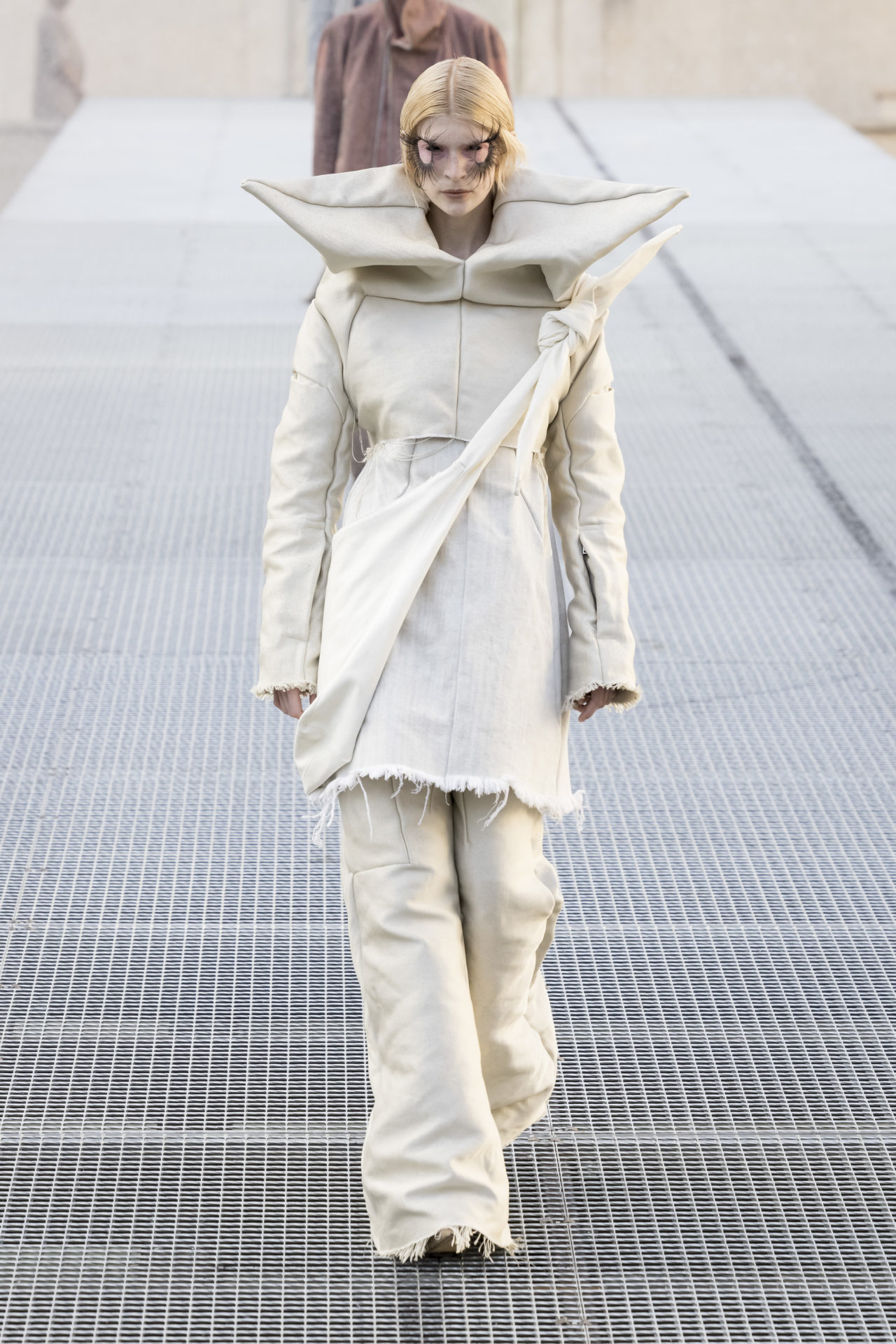
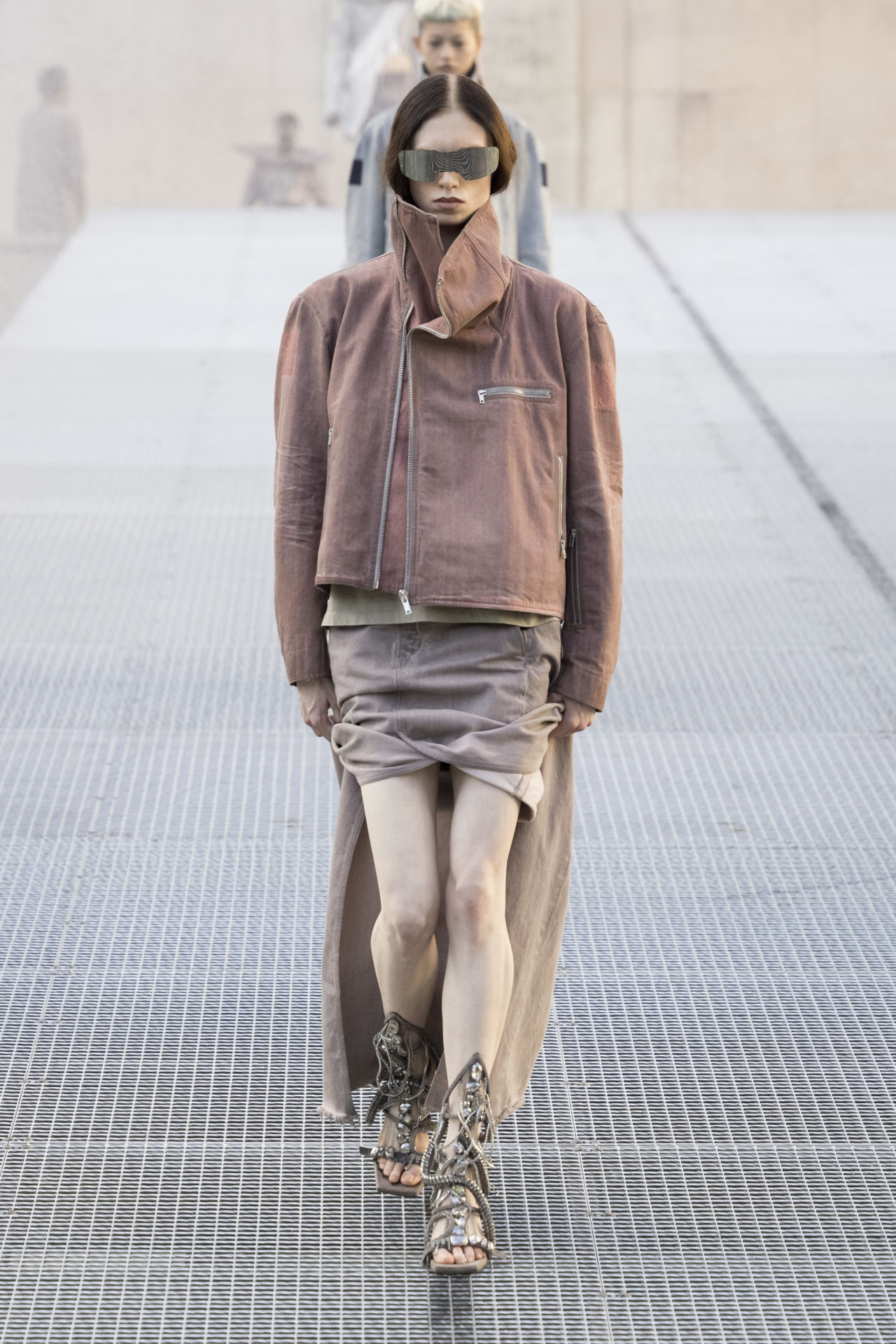
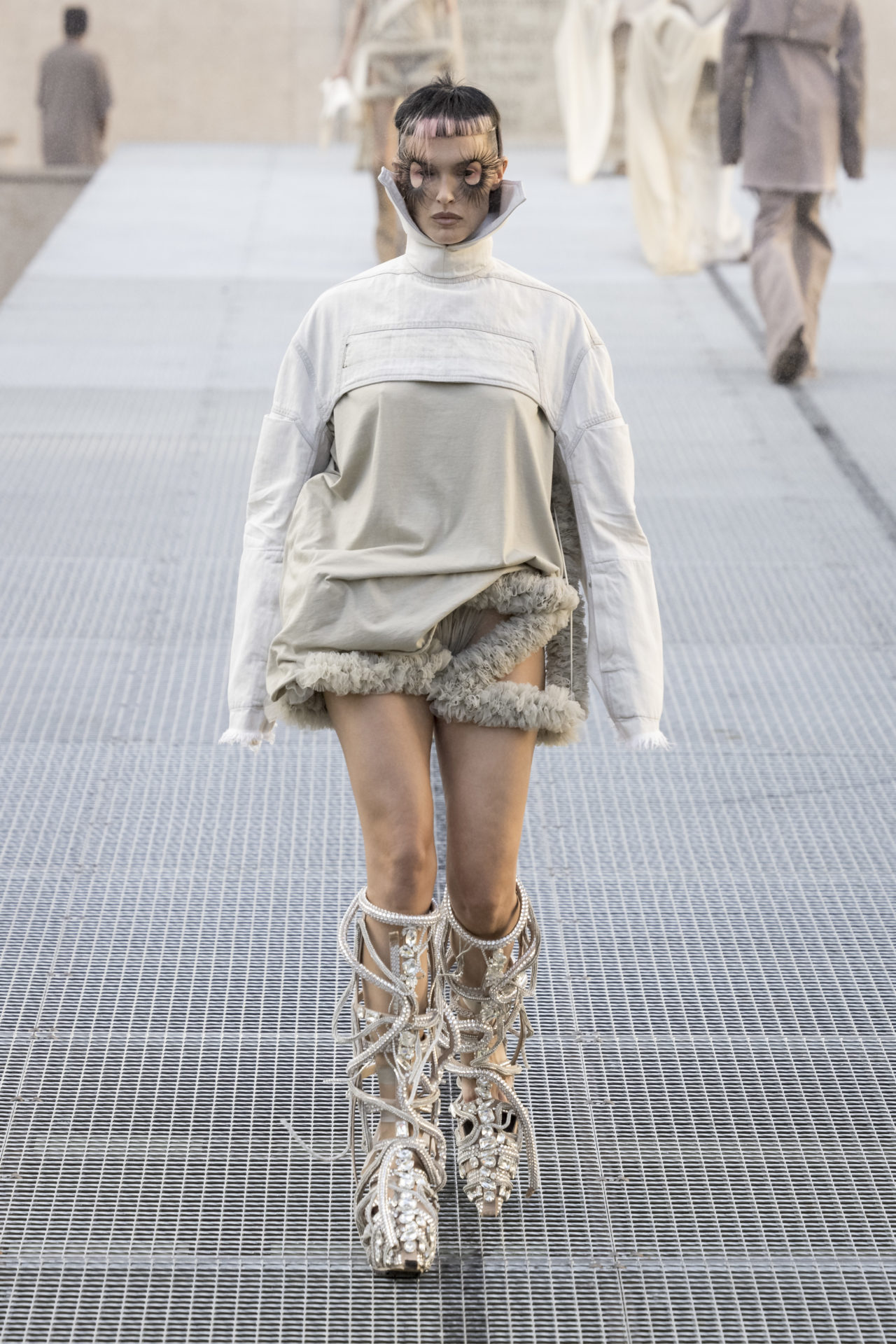
Parachute silk becomes a monumental dress capable of catching air. Sulfur-dyed denim is manipulated into enormous tunics, flared trousers and tiny jackets cropped high across the torso. Waxed and heat-pressed leather develops internal straps that allow garments to be carried across the shoulders like discarded wings.
Even the footwear changes its relationship with the ground.
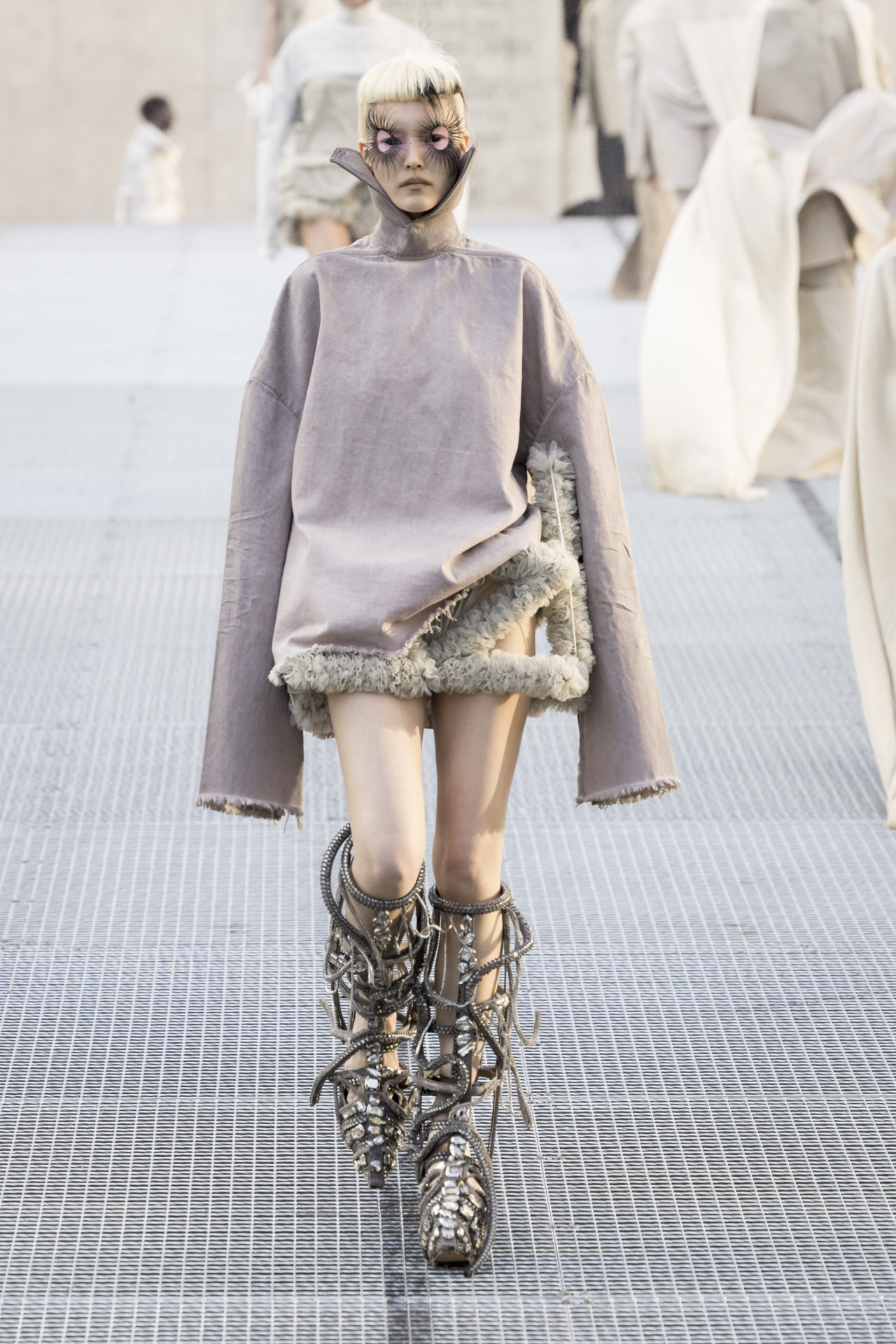
The monumental platform – one of the most immediately recognizable elements of Owens’s visual vocabulary – gives way to Perspex wedges and crystal-covered sandals.
The body has not become weaker.
It has simply become less obviously armoured.
That is a significant move.
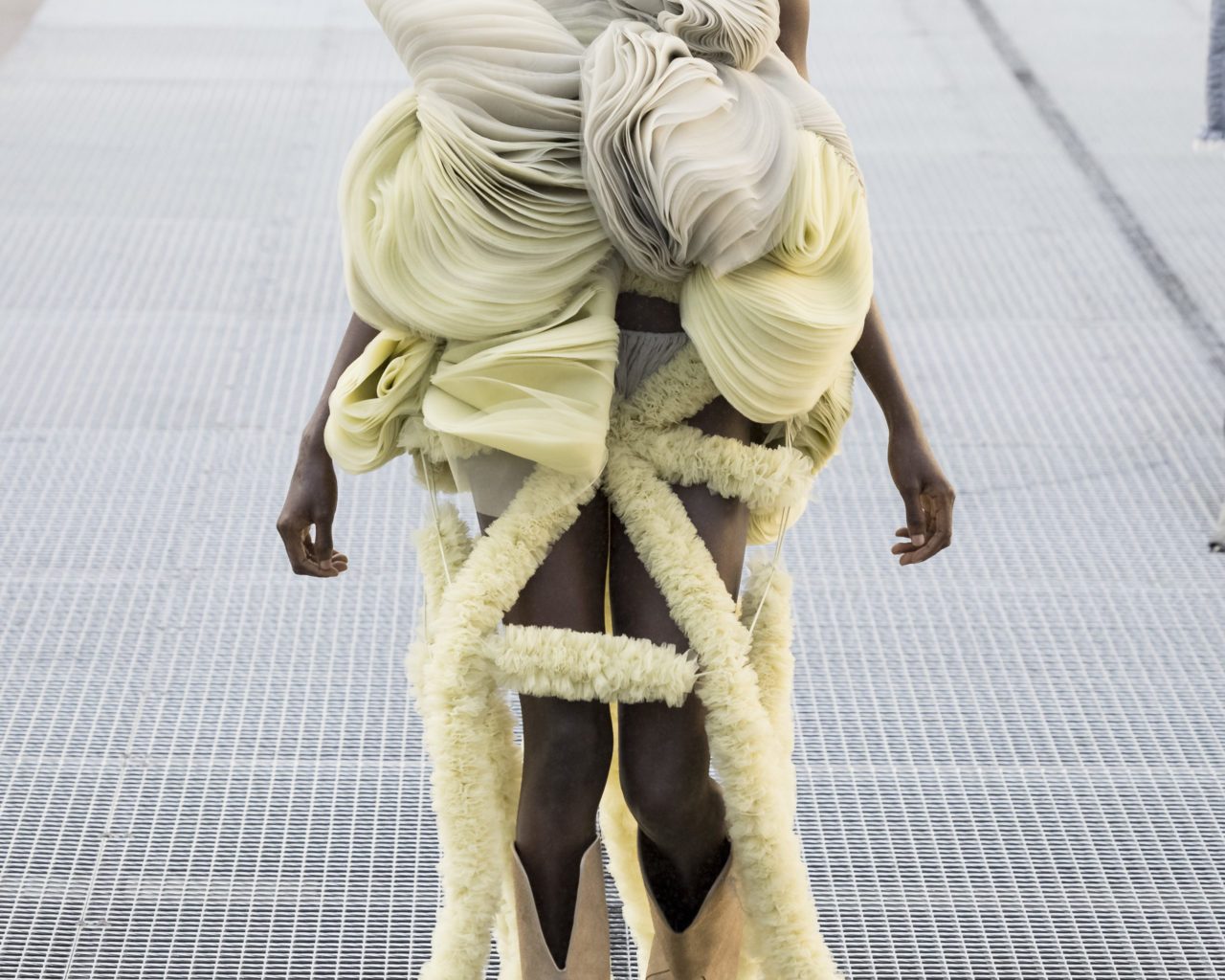
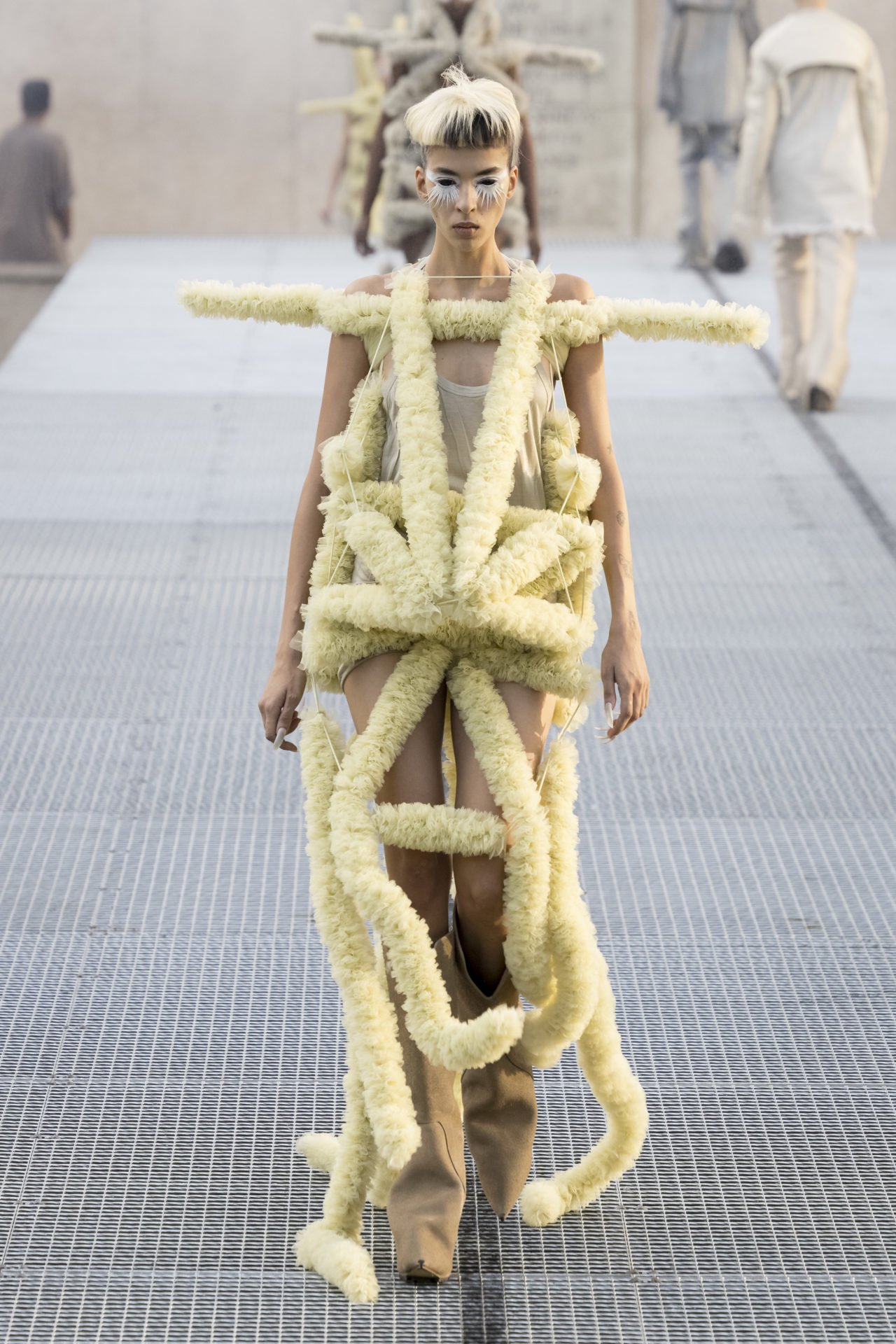
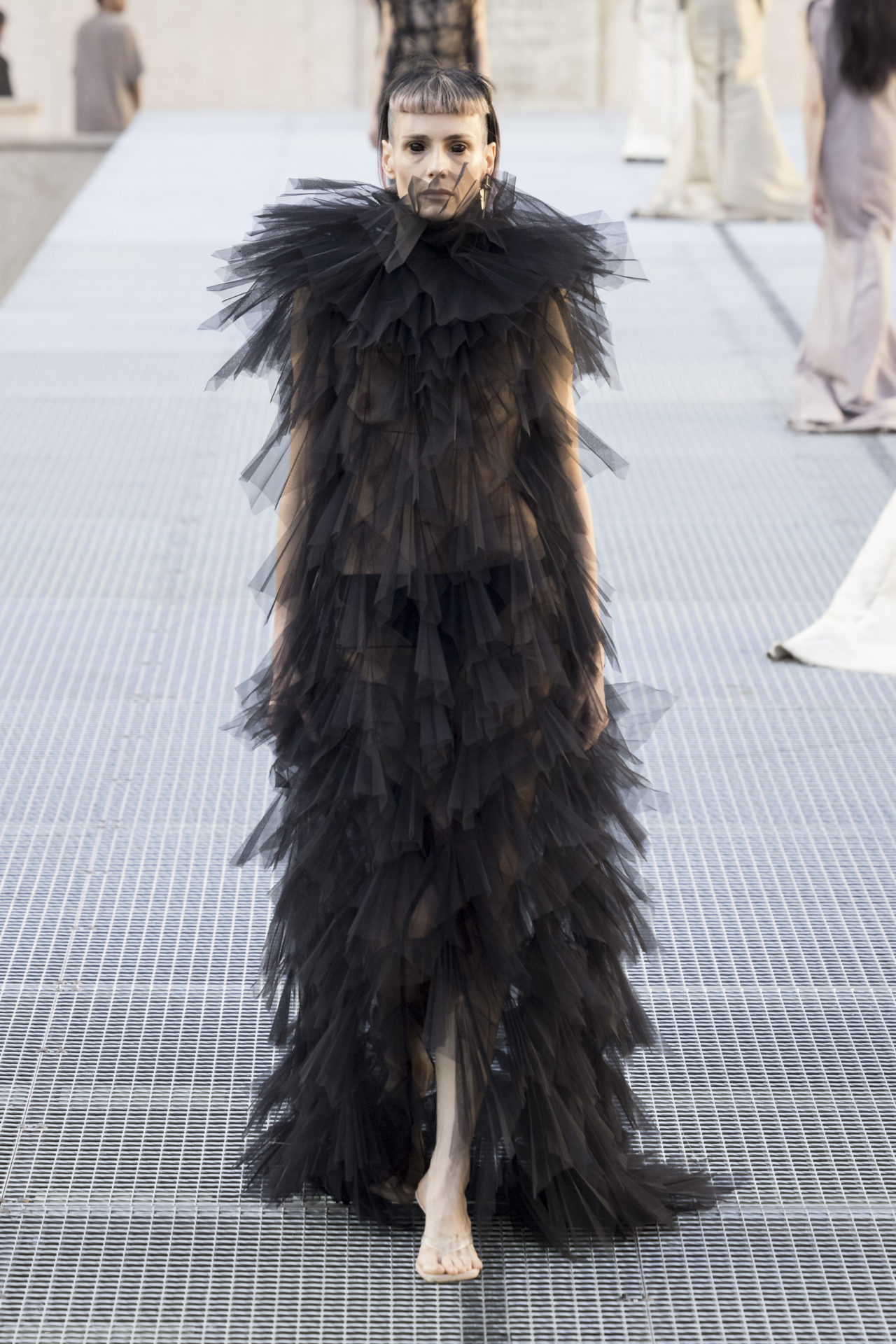
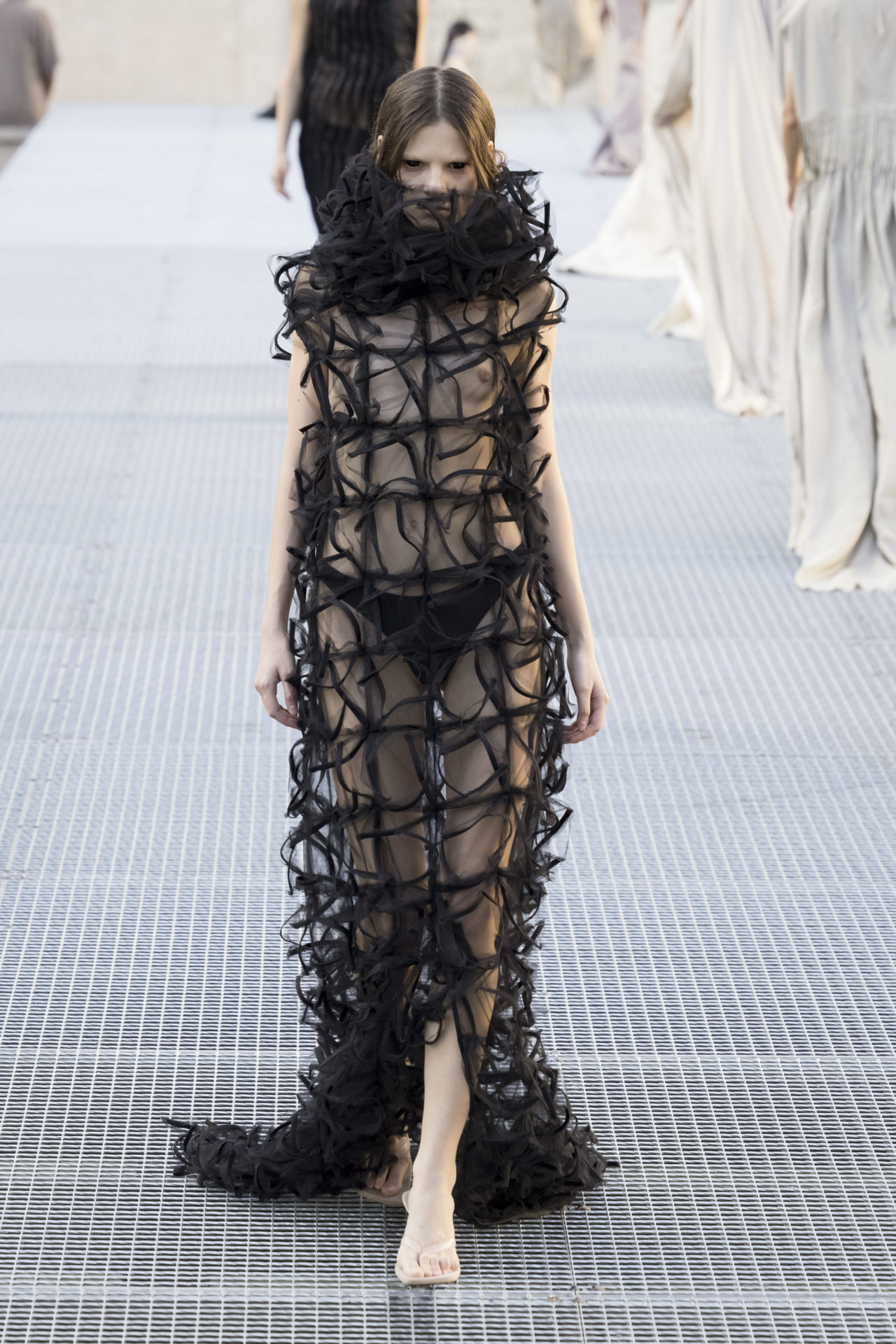
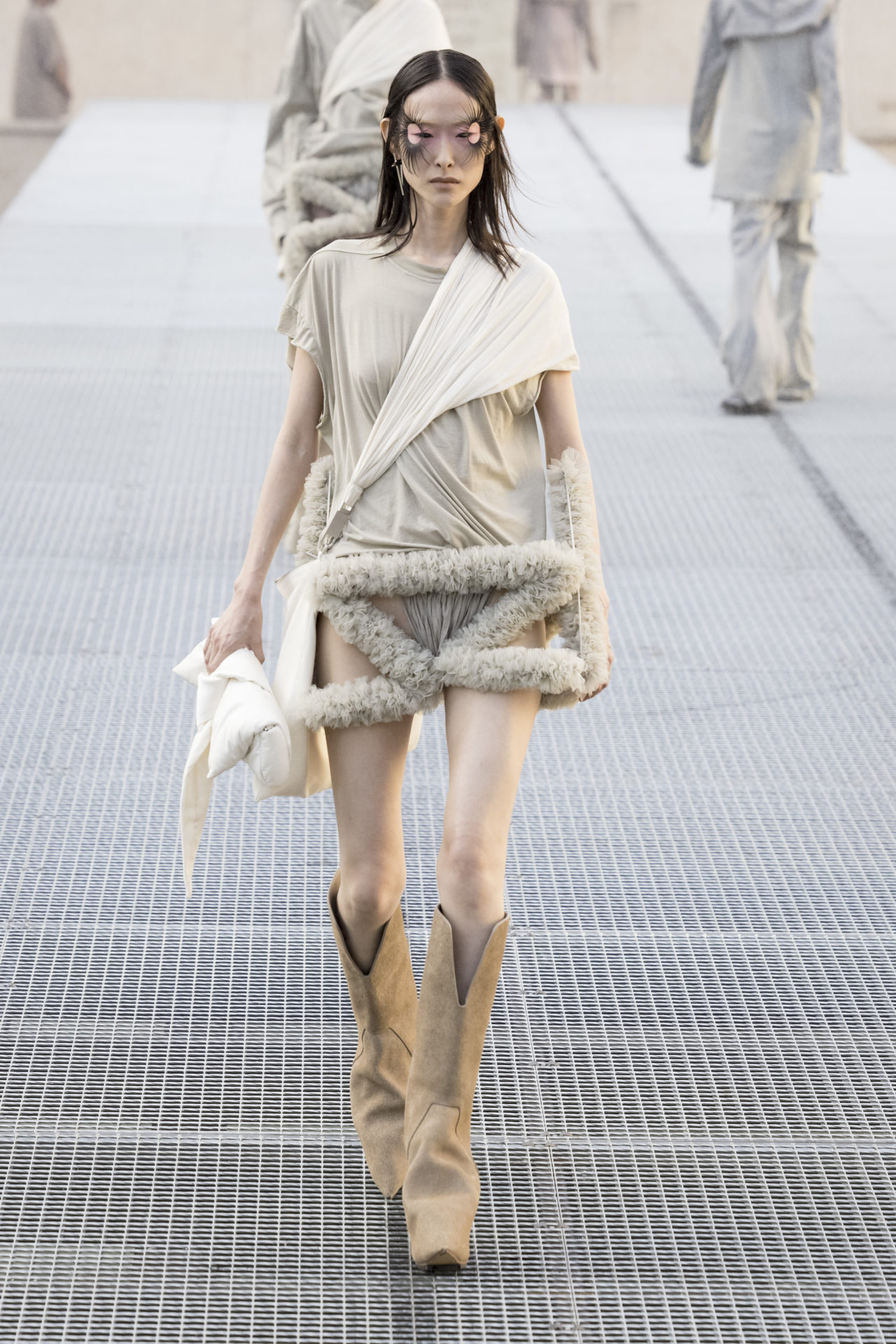
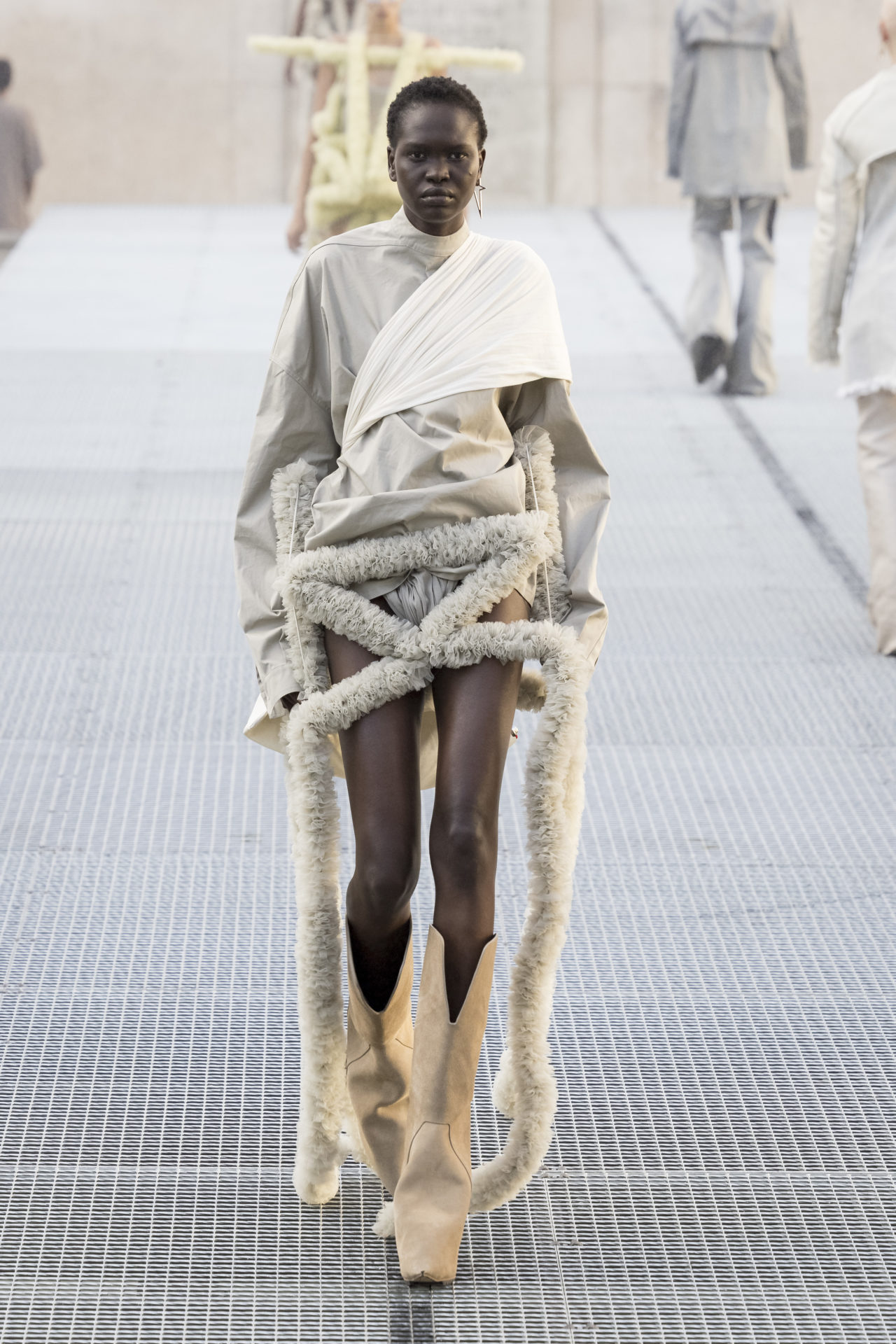
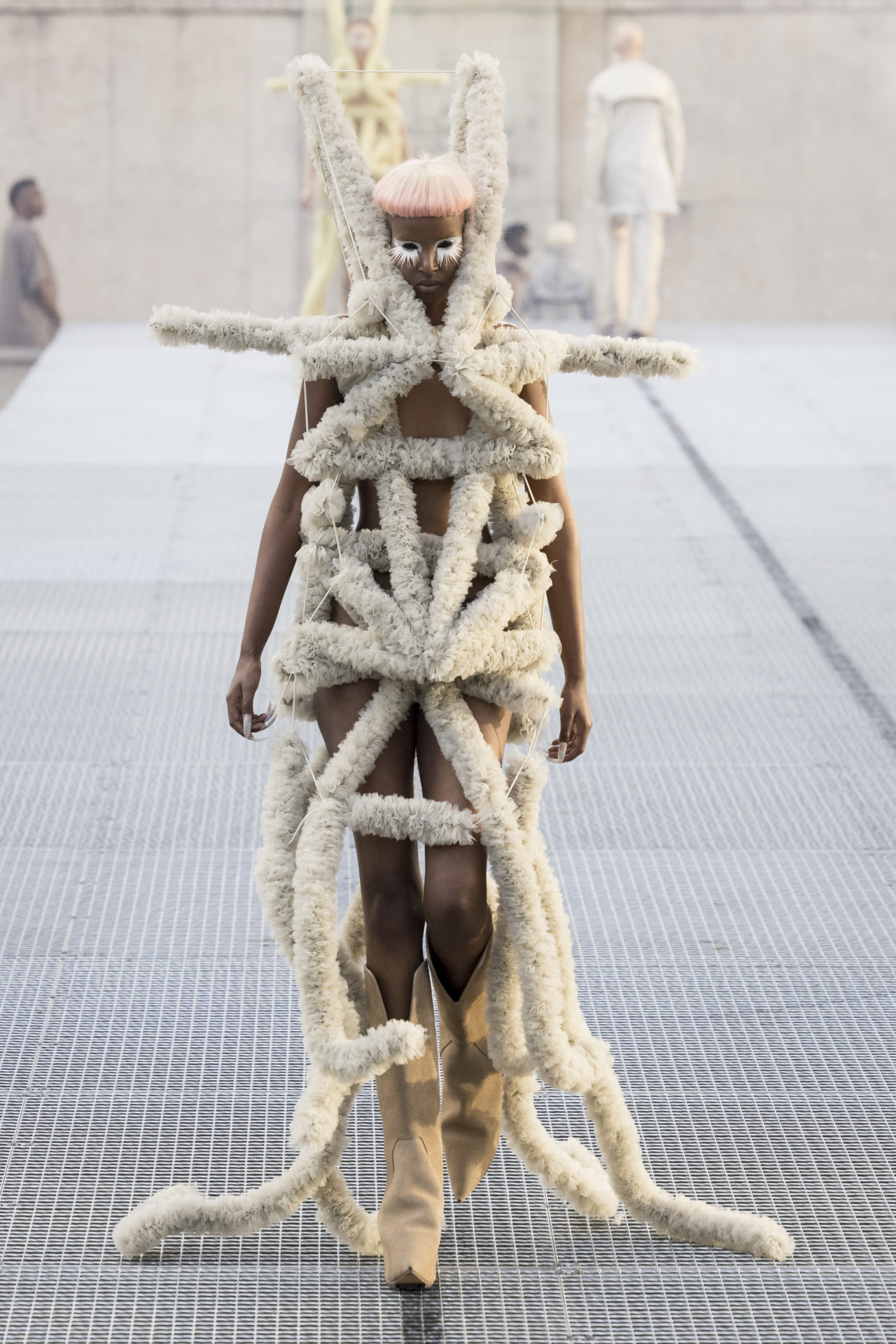
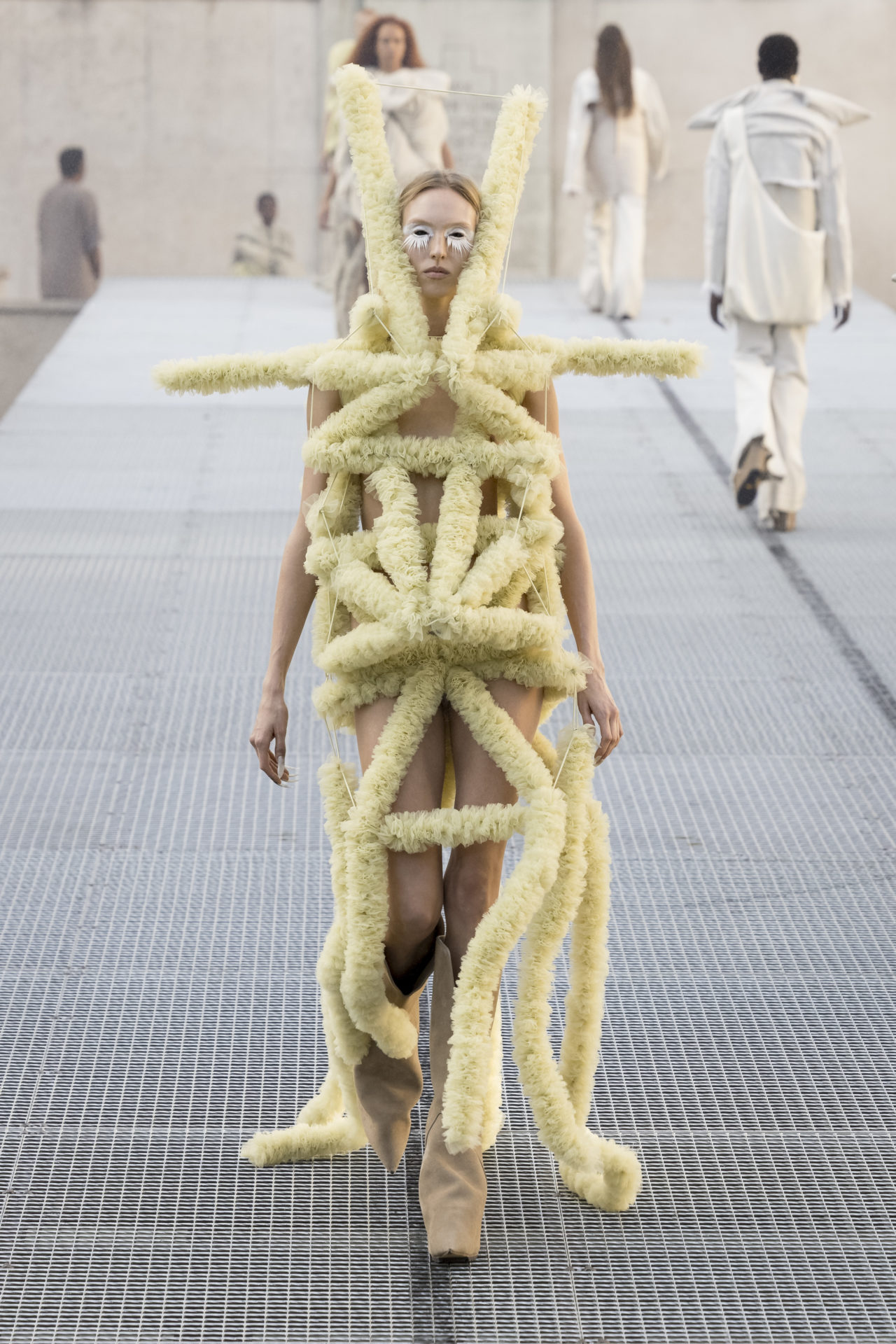
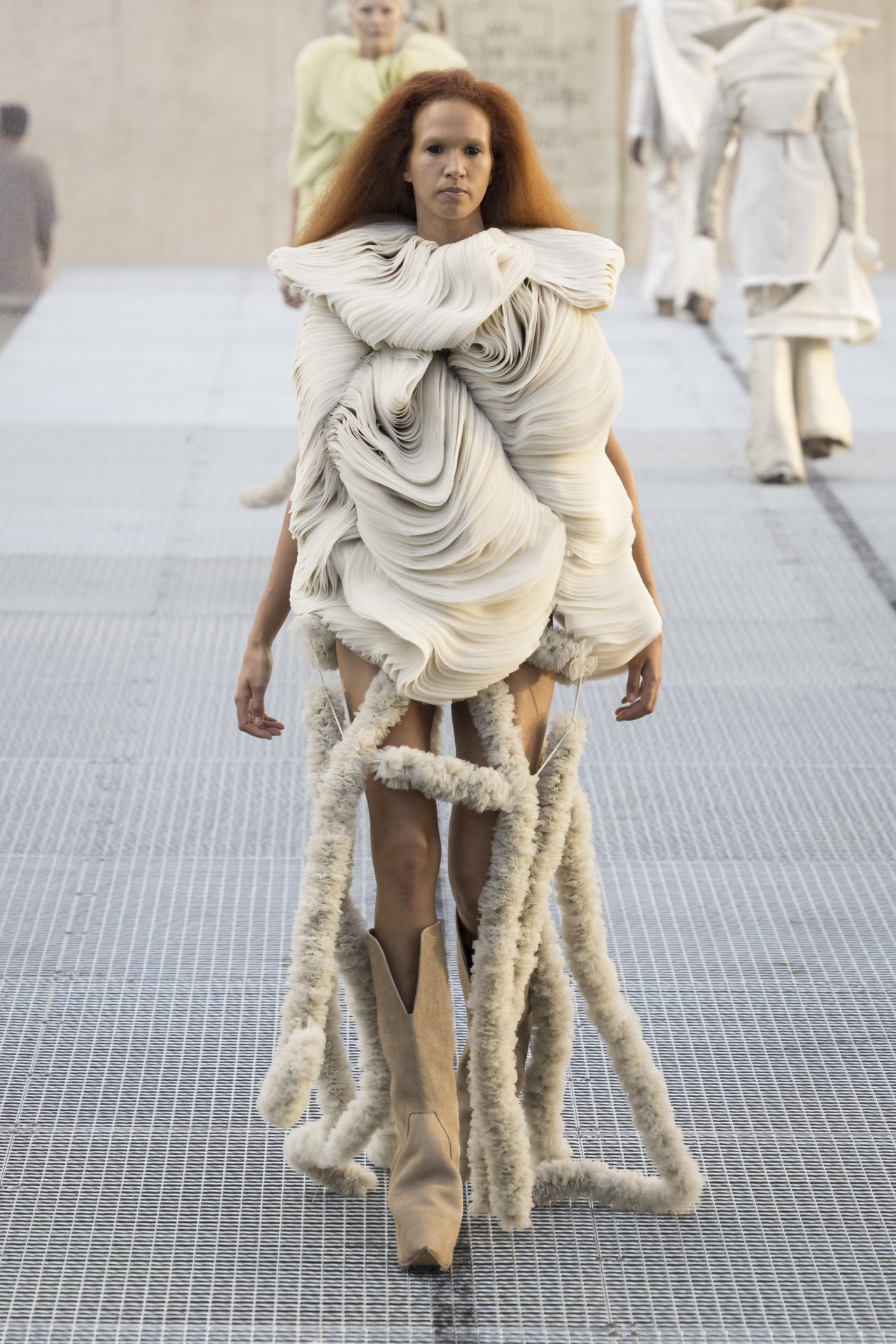
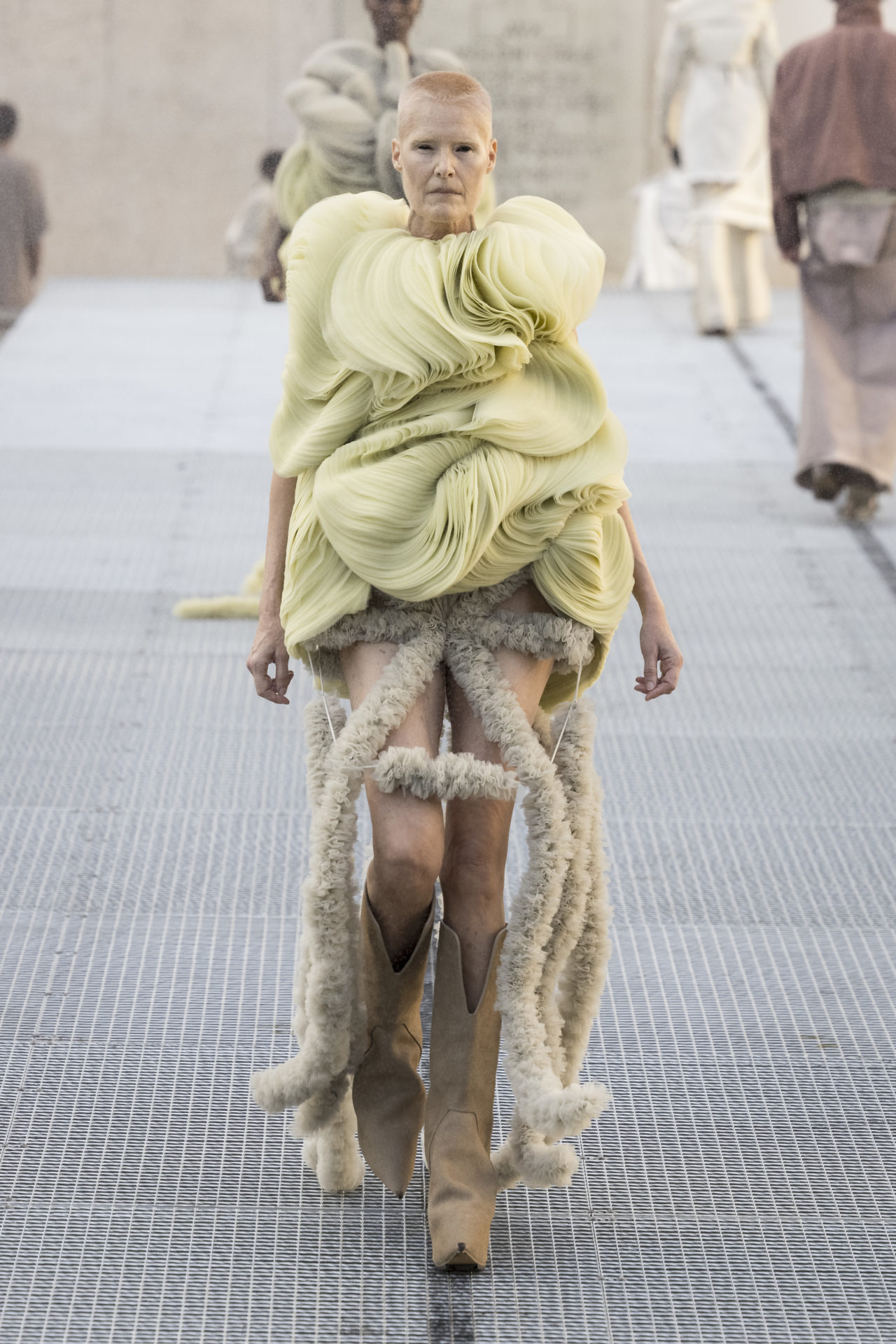
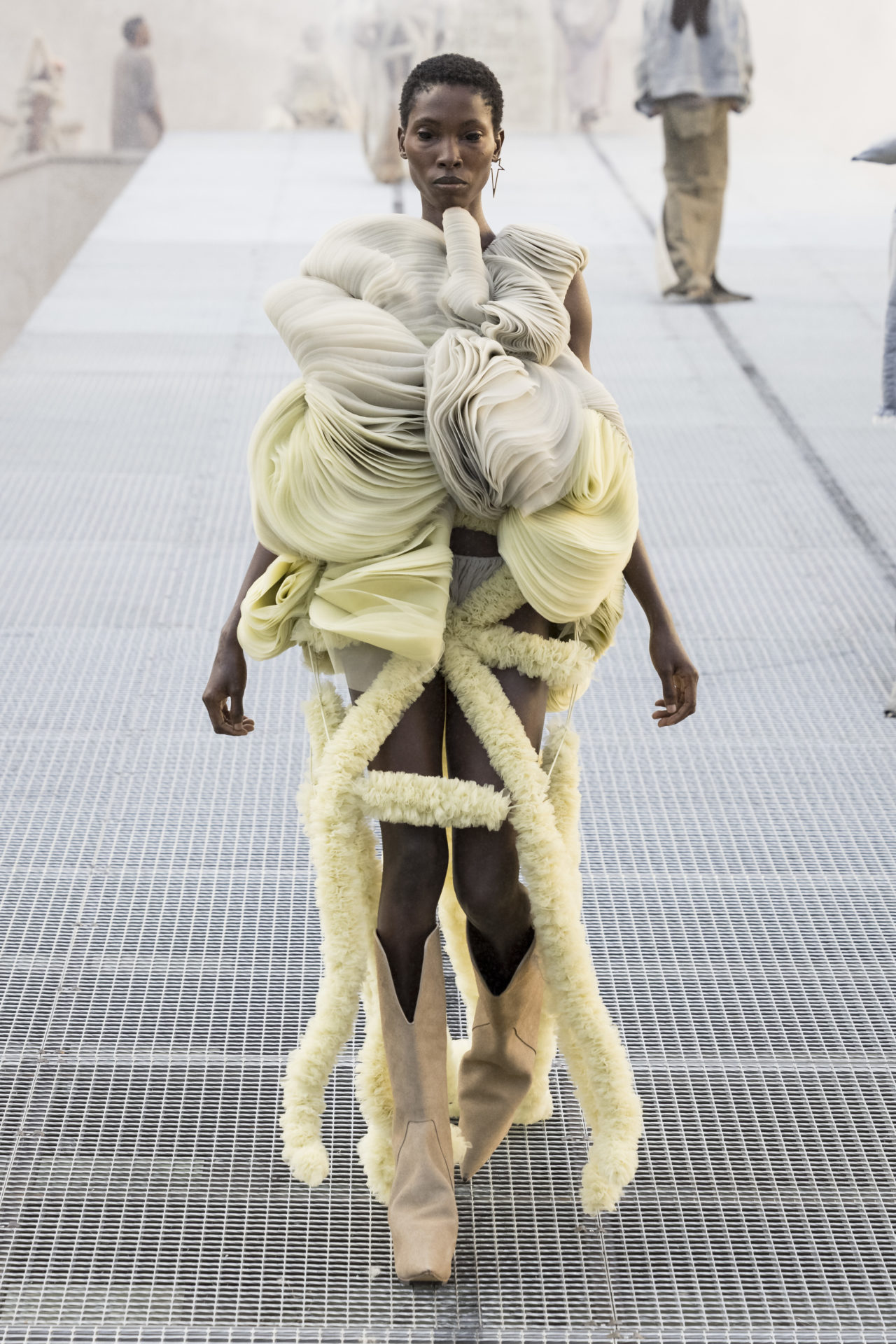
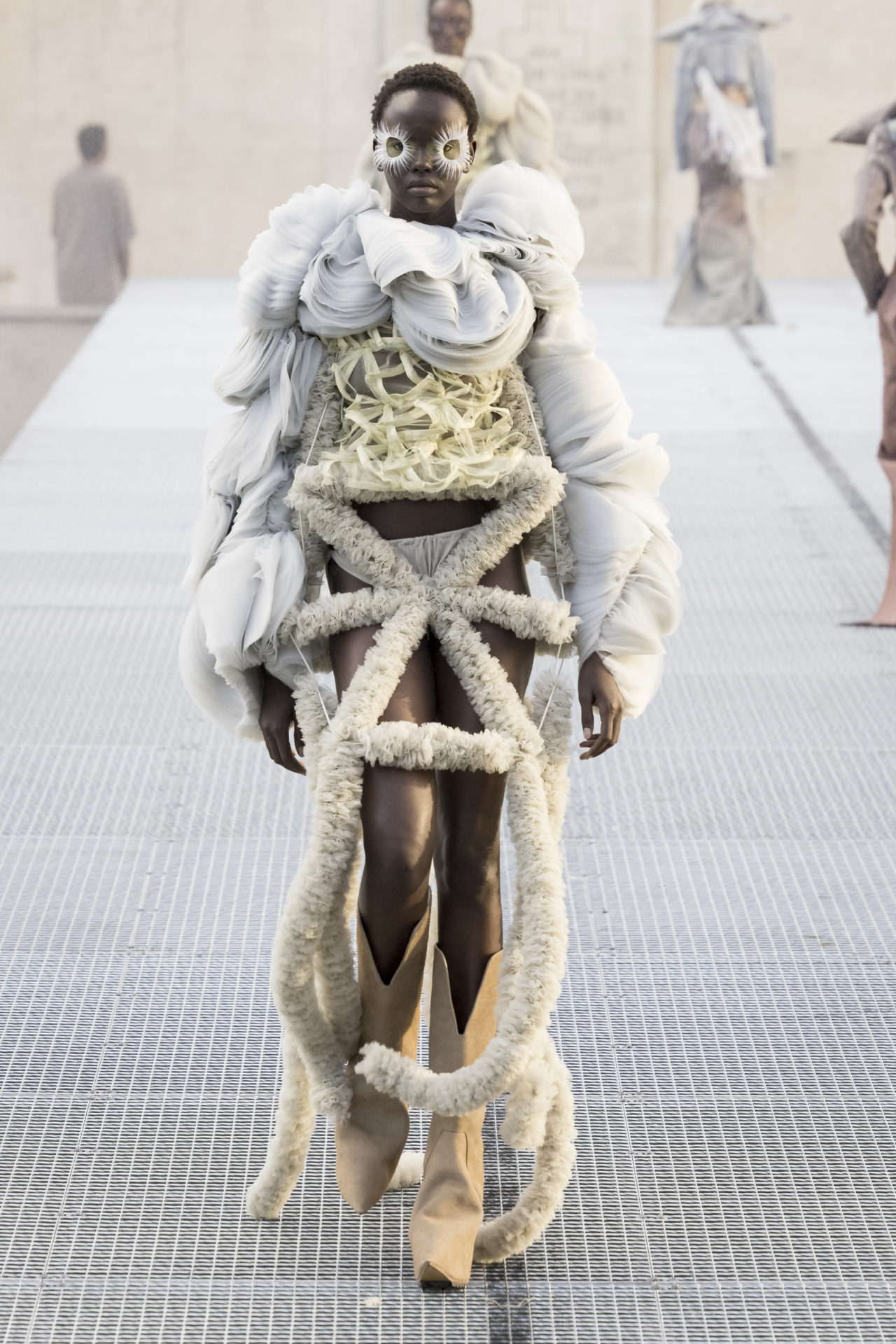
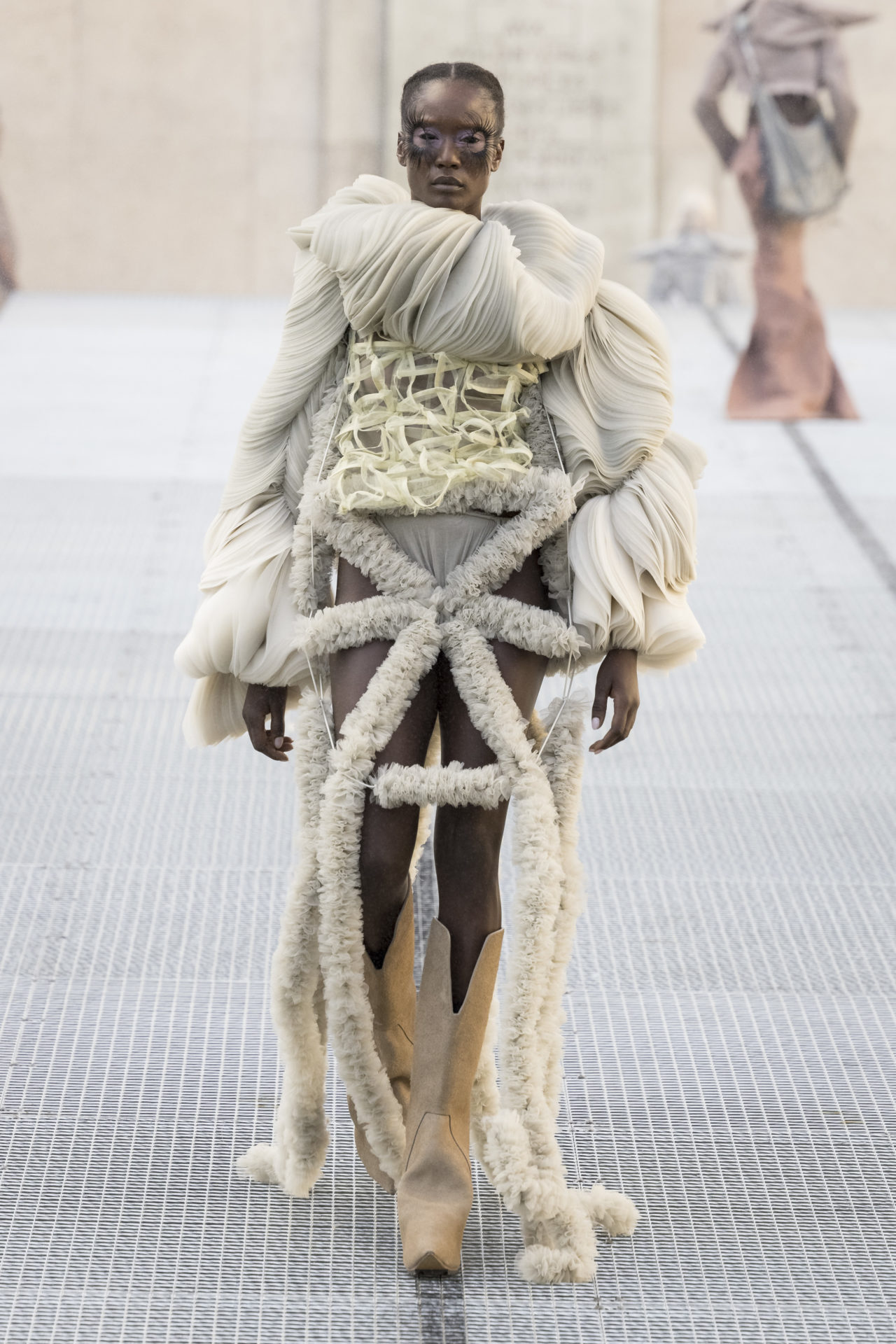
And then comes the final transformation: tulle, elastic and technical materials forming delicate structures around the body, almost like fragile exoskeletons.
The contradiction becomes clear.
Owens is not abandoning armour.
He is making armour vulnerable.
THE INDUSTRIAL BECOMES CEREMONIAL
This is where the intelligence of the collection lies.
Industrial webbing becomes duchesse.
Parachute silk becomes ceremony.
Leather becomes a wing.
Tulle becomes anatomy.
Materials associated with construction, restraint, protection and utility are pushed into territories of glamour and ritual.
Owens has always understood that materials carry social meanings.
Leather can be sex, violence, luxury or protection.
Industrial straps can suggest labour, discipline or restraint.
Tulle traditionally suggests fragility.
Owens refuses to let any of these associations remain fixed.
The strap becomes couture.
The fragile becomes structural.
The protective becomes sensual.
The industrial becomes almost sacred.
The result is not softness.
It is soft power.
And this may be the real conceptual movement of Stone.
Strength no longer needs to look hard.
THE MUSE WAS NEVER JUST A WOMAN
To talk about Rick Owens’s muses only in terms of women would be to misunderstand the mechanism behind his work.
Michèle Lamy is undoubtedly one of the central figures in his mythology, but the relationship has always exceeded the conventional idea of the muse.
A conventional muse inspires the designer.
A Rick Owens muse helps create the universe in which the designer can operate.
That distinction is crucial.
Lamy is not simply an image attached to the brand. She exists inside its mythology as collaborator, performer, provocateur, partner and cultural force.
But the idea extends far beyond her.
Owens has drawn from performers, artists, underground cultures, historical figures, architecture, religion, sexuality, death and the body itself.
The muse has progressively stopped being a person.
It has become a condition.
A permission to imagine another kind of body.
In Stone, that body feels particularly elusive.
It is neither warrior nor victim.
Neither goddess nor model.
It is something closer to an apparition.
Something that has survived long enough to no longer need to prove that it is strong.
THE PROBLEM WITH BEING RICK OWENS
And here is where the criticism begins.
Because Rick Owens has achieved something almost impossible: he has made his own rebellion recognisable.
Black is Rick Owens.
Platforms are Rick Owens.
Distortion is Rick Owens.
Brutalism is Rick Owens.
Fetishism is Rick Owens.
The elongated body is Rick Owens.
The theatrical ritual of the show is Rick Owens.
Even the rejection of fashion’s conventions has become part of the convention.
This does not make the work less important.
It makes it more complicated.
Owens began on the margins of fashion, drawing from Los Angeles underground culture, fetish, glamour, music and the visual language of people who did not necessarily belong inside the traditional luxury system.
Three decades later, his work has entered museums, archives and institutional culture.
The outsider became the reference.
The reference became the archive.
The archive became the exhibition.
And the exhibition became part of the mythology.
This is the paradox of successful rebellion: once the system understands your language, what exactly are you rebelling against?
AFTER THE OUTSIDER
Fashion has become exceptionally good at absorbing whatever once looked dangerous.
Fetish became mainstream.
Gender ambiguity became a commercial language.
Extreme footwear became desirable.
Subculture became content.
Provocation became marketing.
The strange became a product category.
Owens survived this transformation by doing something more sophisticated than simply becoming more extreme.
He built an entire ecosystem around his own refusal to conform.
That is why the Rick Owens universe remains powerful.
But it is also why every new collection carries a particular burden.
When a designer has already created the vocabulary of his own rebellion, the challenge is no longer to make something recognisable.
It is to make the recognisable feel unstable again.
That is a much harder task.
SPRING/SUMMER 2027
Stone does not solve that problem.
It does something more interesting.
It changes the temperature.
The collection feels less interested in aggression than in endurance. Less interested in making the body invincible than in asking whether vulnerability itself can become a form of power.
That shift is visible everywhere.
In the movement from platforms to sandals.
In the tension between heavy industrial materials and almost weightless silk.
In the transformation of straps into couture.
In the juxtaposition of monumental silhouettes with exposed torsos.
In the strange delicacy of the final looks.
And in the show’s water: the perfect opposite of stone.
The runway becomes a metaphor without ever needing to announce itself as one.
The body crosses the water.
The clothes appear heavy.
The wearer remains in motion.
That is perhaps the most elegant idea in the collection.
Stone is not about becoming immovable.
It is about learning what can remain solid while everything around it moves.
THE BODY AFTER ARMOUR
This is where Spring/Summer 2027 feels particularly relevant.
For years, the Owens body has been imagined as an armoured body.
Protected from the outside world.
Elevated above it.
Detached from ordinary proportions.
This season, the armour remains, but it becomes permeable.
The body can breathe through it.
It can move.
It can appear fragile.
It can even appear beautiful without becoming passive.
That last point matters.
Owens has never been particularly interested in prettiness.
Here, beauty returns — but on his terms.
Not as decoration.
As consequence.
The clothes are beautiful because they have survived their own violence.
WHO IS THE MUSE NOW?
Maybe the muse is no longer the outsider.
Maybe the outsider has become too familiar.
Maybe the muse is the body that has already survived the inside.
A body that does not need to scream in order to occupy space.
A woman who can be fragile without becoming weak.
A figure who can be monumental without becoming immobile.
A creature that can wear industrial straps and still look capable of flight.
This may be the most interesting evolution in Owens’s language right now.
He has not become softer.
He has become more interested in what softness can do.
He has not abandoned his codes.
He has started testing what happens when those codes contradict themselves.
And perhaps that is the only real way forward for a designer who has spent thirty years building a mythology.
Not by destroying the world he created.
By allowing it to mutate.
Rick Owens already has the myth.
He already has the institution.
He already has the language.
The question is whether the language can still surprise the man who invented it.
So perhaps the question was never really who is the muse now?
Perhaps the real question is much more dangerous:
What happens when the muse stops inspiring the designer; and starts changing him?