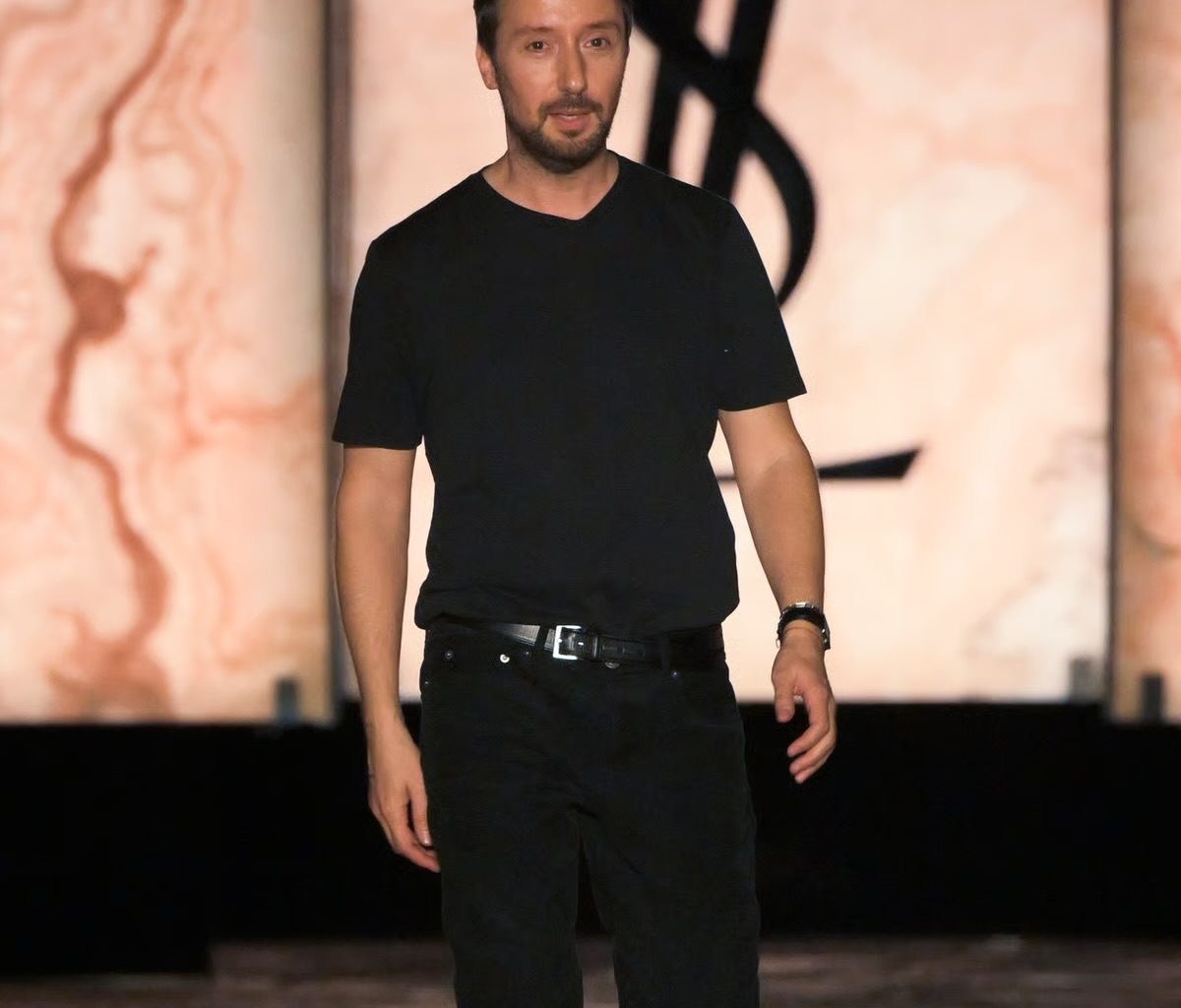
Or, more importantly: why does fashion keep falling in love with the next big thing before the current one is even over?
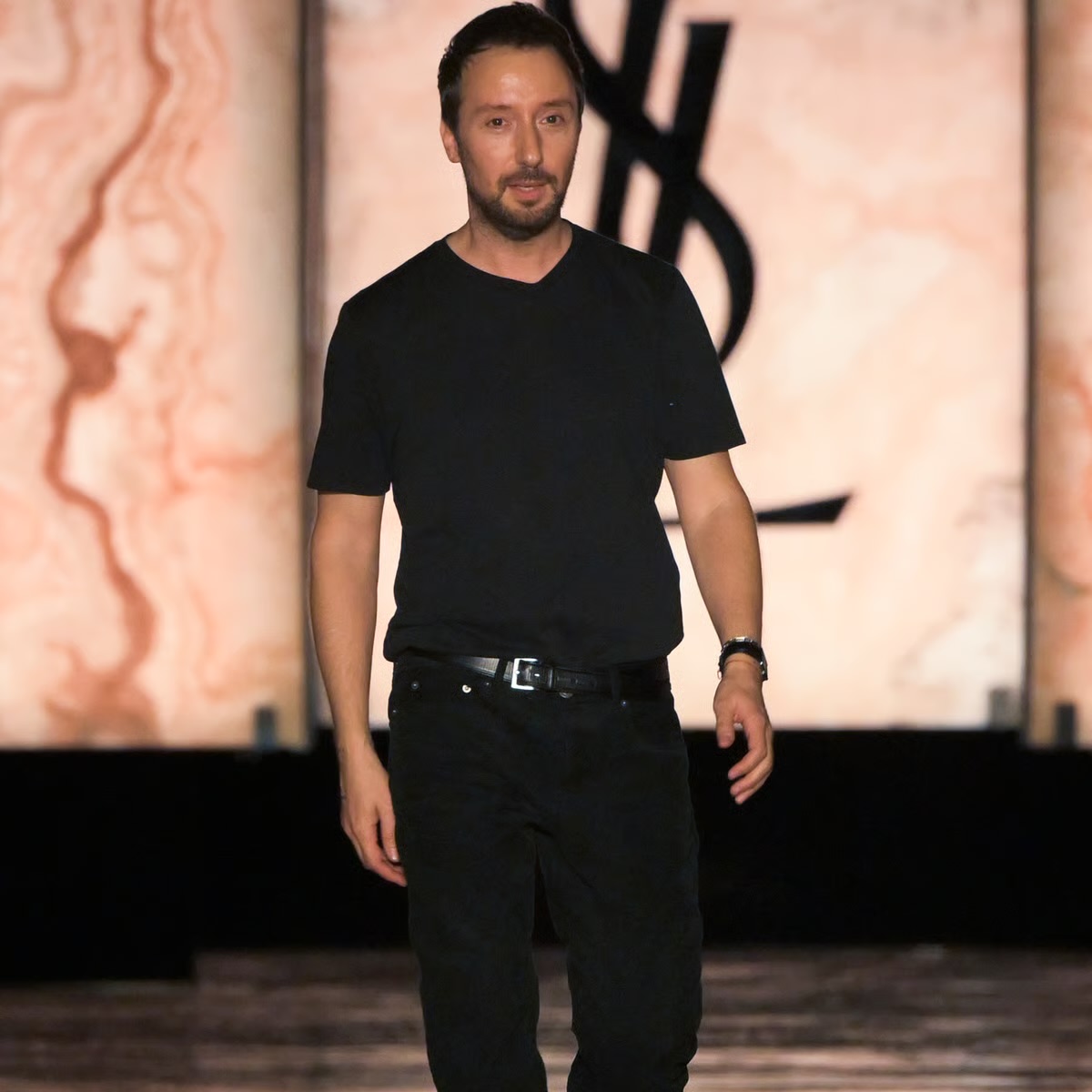
WHY?
Why would Anthony Vaccarello leave Saint Laurent?
Why would you leave one of the most powerful fashion houses in the world after ten years, just when you have finally made it completely, unmistakably yours?
And perhaps the more uncomfortable question:
Why does fashion seem to want its creative directors gone almost as soon as it has taught the world to recognize them?
Nothing is official yet. The rumor is still a rumor. But in today’s fashion ecosystem, that distinction is almost beside the point. The story has already escaped into the wild: Instagram whispers, insider accounts, screenshots, speculation, the inevitable succession fantasy. Chemena Kamali’s name has entered the conversation. Vaccarello’s possible exit has become fashion’s latest collective obsession.
And perhaps that is the real story.
Not whether Anthony Vaccarello is leaving Saint Laurent.
But why we are so ready to replace him.
THE CREATIVE DIRECTOR MUST DIE
There was a time when a creative director could become almost indistinguishable from the house itself.
Karl Lagerfeld was Chanel.
Marc Jacobs was Louis Vuitton.
Tom Ford was Gucci.
John Galliano was Dior.
Yves Saint Laurent was Yves Saint Laurent.
Time was part of the language.
A fashion house was not supposed to reinvent itself every three seasons. It was supposed to develop a mythology slowly: through repetition, obsession, failure, refinement, customers, muses, silhouettes, memories.
Today, time has become the enemy.
Fashion lives inside a beautifully dysfunctional contradiction: it needs continuity to build desire, but disruption to maintain attention.
The creative director has therefore become something more than a designer.
They are a headline.
A personality.
A notification.
A campaign.
A moodboard with a passport.
A walking press release.
And when they leave, the industry gets to do it all over again.
New designer.
New era.
New logo.
New casting.
New mood.
New everything.
New is the product.
THE DESIGNER AS CONTENT
This is what makes the Vaccarello situation particularly fascinating.
Because Anthony Vaccarello did not simply design Saint Laurent for ten years.
He built a world around it.
Rive Droite.
The campaigns.
The celebrities.
The Eiffel Tower.
The music.
The photography.
The nightlife.
The bodies.
The black.
And eventually, cinema.
With Saint Laurent Productions, Vaccarello pushed the house beyond fashion and into film, working with filmmakers including Pedro Almodóvar and Paolo Sorrentino and turning the maison itself into something closer to a cultural production company.
Saint Laurent stopped behaving like a clothing label.
It became an atmosphere.
A universe.
A place you could enter without necessarily buying anything.
And that is where the paradox begins.
If a creative director succeeds in turning a fashion house into a world, why is replacing them suddenly considered the obvious next move?
THE TEN-YEAR ITCH
Vaccarello arrived at Saint Laurent in 2016, following Hedi Slimane.
He was 34.
He closed his own label to devote himself entirely to the house.
Ten years later, he has done something that initially seemed almost impossible: he stopped being the successor to Hedi Slimane and became Anthony Vaccarello at Saint Laurent.
At first, he had to prove he could be Saint Laurent.
Then he had to prove he wasn’t Slimane.
Then he had to prove he was Vaccarello.
And eventually, he no longer had to prove anything.
Which might be the most dangerous moment of all.
Because once a creative language becomes recognizable, once the audience understands the code, once the business knows how to monetize it, the system starts craving the one thing it cannot manufacture through repetition: novelty.
Not necessarily because something is broken.
But because fashion has become addicted to the feeling that something is about to happen.
THE NEW LUXURY CLOCK
The Vaccarello rumor is therefore bigger than Vaccarello.
Because Saint Laurent is not an isolated case.
The luxury industry has entered an era of musical chairs: creative directors arriving, leaving, swapping houses, resurfacing elsewhere, becoming the protagonists of a never-ending game of fashion bingo.
And the biggest groups – LVMH, Kering, Richemont – are operating houses that are no longer simply fashion businesses.
They are enormous cultural and financial ecosystems.
Inside them, creativity has to coexist with growth.
Heritage has to coexist with quarterly results.
Art has to coexist with shareholder expectations.
And desire has to become measurable.
The creative director sits directly in the middle of this contradiction.
They are expected to create magic.
But magic now has a spreadsheet.
THE RESET BUTTON
Perhaps this is the real function of the modern creative-director turnover.
The new designer is a reset button.
Not necessarily because the previous one failed.
But because a new name allows a company to tell a new story without having to admit that the previous story was over.
A new creative director instantly creates headlines.
Headlines create attention.
Attention creates anticipation.
Anticipation creates desire.
And desire, eventually, becomes business.
It is almost too perfect.
The person changes. The machine stays.
BUT WHAT HAPPENS TO THE PERSON?
Here is where the story becomes almost sociological.
What exactly do we expect from a creative director now?
Be an artist.
Be a manager.
Be a strategist.
Be a cultural commentator.
Be commercially successful.
Be culturally relevant.
Understand Gen Z.
Understand the archives.
Understand China.
Understand celebrities.
Understand TikTok.
Understand Hollywood.
Make beautiful clothes.
Make viral images.
Make the shareholders happy.
And, somehow, still have something original to say.
The creative director is no longer simply responsible for the collection.
They are responsible for the entire emotional infrastructure of the brand.
Behind one name sits an organization of thousands of people, millions in revenue, stores, e-commerce, celebrities, campaigns, clients, markets, investors and algorithms.
Creativity has become corporate infrastructure.
And perhaps we should stop pretending otherwise.
THE PARADOX OF SUCCESS
Which brings us back to Vaccarello.
If he really is leaving Saint Laurent, perhaps the question should not be:
Why does Saint Laurent want him gone?
Maybe the more interesting question is:
Why would anyone leave once they’ve finally built exactly what they wanted?
Because Saint Laurent does not currently look like a house desperately searching for a creative identity.
Kering said in its first-half 2026 results that Saint Laurent had returned to growth, with renewed momentum across the business and particularly strong demand in North America and Western Europe.
The house is still producing campaigns under Vaccarello’s creative direction. Its Fall 2026 materials are explicitly credited to him.
And the Fédération de la Haute Couture et de la Mode still lists:
Artistic Direction: Anthony Vaccarello.
The next Saint Laurent show is scheduled for September 29. (Fédération Haute Couture)
So if he leaves, it does not necessarily look like the ending of a failed chapter.
It could look like something much stranger: a successful chapter reaching its natural ending.
TEN YEARS IS A LONG TIME NOW
In October 2025, Vaccarello told Vogue Italia that he had received offers from other brands but turned them down, describing Saint Laurent as the ultimate fashion house.
At the time, he was approaching his tenth anniversary.
Ten years.
In fashion terms, that is practically geological time.
Especially now.
The industry moves faster.
The news cycle moves faster.
The trend cycle moves faster.
The consumer moves faster.
The feed moves faster.
And eventually, even careers are expected to move faster.
THE DISPOSABLE GENIUS
There is something deeply strange about the way fashion worships creative directors.
We call them visionaries.
Geniuses.
Authors.
Icons.
Then we replace them.
The same industry that builds the mythology of the auteur increasingly seems to have no patience for the auteur.
It is a strange form of disposable genius.
We ask designers to become indispensable.
Then, once they are, we start searching for their replacement.
The creative director becomes a luxury product with an expiration date.
And perhaps this is why the fashion industry now produces nostalgia almost as quickly as it produces novelty.
The moment someone leaves, we start missing them.
WHY CHEMENA?
Which is why the Chemena Kamali speculation is so revealing.
Because if her name really is being considered, the choice would not necessarily represent a revolution.
Kamali knows Saint Laurent.
She worked at the house from 2016 to 2023, during Vaccarello’s tenure, before becoming Chloé’s creative director.
She would therefore represent something far more interesting than a clean break.
Continuity disguised as change.
Not: Forget Vaccarello.
But: What happens after Vaccarello?
That is a much more sophisticated question.
MAYBE THE PROBLEM ISN’T VACCARELLO
Maybe it is a system that has forgotten the difference between evolution and replacement.
A designer can evolve.
A house can change.
An aesthetic can age, mutate and reinvent itself without necessarily changing the person behind it.
But the contemporary fashion machine has discovered an easier solution: change the name.
New designer.
New narrative.
New attention.
New attention.
New desire.
And suddenly the machine is moving again.
THE FEED
There is also something generational happening here.
The generation consuming fashion today lives inside an endless stream of replacement.
A trend appears.
It becomes an aesthetic.
The aesthetic becomes a micro-community.
The micro-community becomes a campaign.
The campaign becomes a product.
The product becomes cringe.
And something else takes its place.
Fashion no longer has only seasons.
It has a feed.
And feeds hate stability.
Feeds want the next frame.
SO, WHY?
So why would Anthony Vaccarello leave Saint Laurent?
Maybe because he has done everything he came to do.
Maybe because ten years has become an unusually long sentence in the contemporary fashion system.
Maybe because Kering wants a new cycle.
Maybe because Saint Laurent wants a new generation.
Maybe because Vaccarello wants cinema.
Maybe because he simply wants something else.
Maybe because the rumor is wrong.
Or maybe because the fashion industry is already writing the next chapter before the previous one has officially ended.
And that might be the strangest part.
The rumor has already become a cultural event before it has become a corporate fact.
A post becomes a story.
The story becomes a conversation.
The conversation becomes anticipation.
The anticipation becomes a narrative.
And the narrative starts behaving like reality.
Fashion doesn’t always wait for facts.
Sometimes it manufactures the future first.
WHAT REMAINS?
If Vaccarello does leave Saint Laurent, the most interesting question will not be:
Who comes next?
It will be:
What remains?
The Eiffel Tower.
The black.
The body.
The sharp shoulder.
The smoking.
The cold sensuality.
Rive Droite.
The cinema.
The photography.
That particular Saint Laurent universe where Paris feels simultaneously glamorous, dirty, aristocratic, erotic and slightly dangerous.
Because perhaps the real measure of a creative director is not how long they stay.
It is how much of them survives after they leave.
If the language survives without the author, then perhaps the author really succeeded.
Vaccarello may have spent ten years turning a signature into a vocabulary.
And vocabulary, unlike a creative director, doesn’t need a contract.
So yes: why is Anthony Vaccarello leaving Saint Laurent?
Maybe the answer isn’t really about why he wants to leave.
Maybe it is about something much more uncomfortable:
Why does fashion keep asking us to fall in love with a world, and then immediately start looking for someone new to build it?