Simone Rocha’s SS27 collection turns vulnerability into a fashion language, and puts the exposed body on trial at London’s Old Bailey
What happens when the woman who spent fifteen years building armour out of tulle, pearls, lace and flowers decides to take it off?
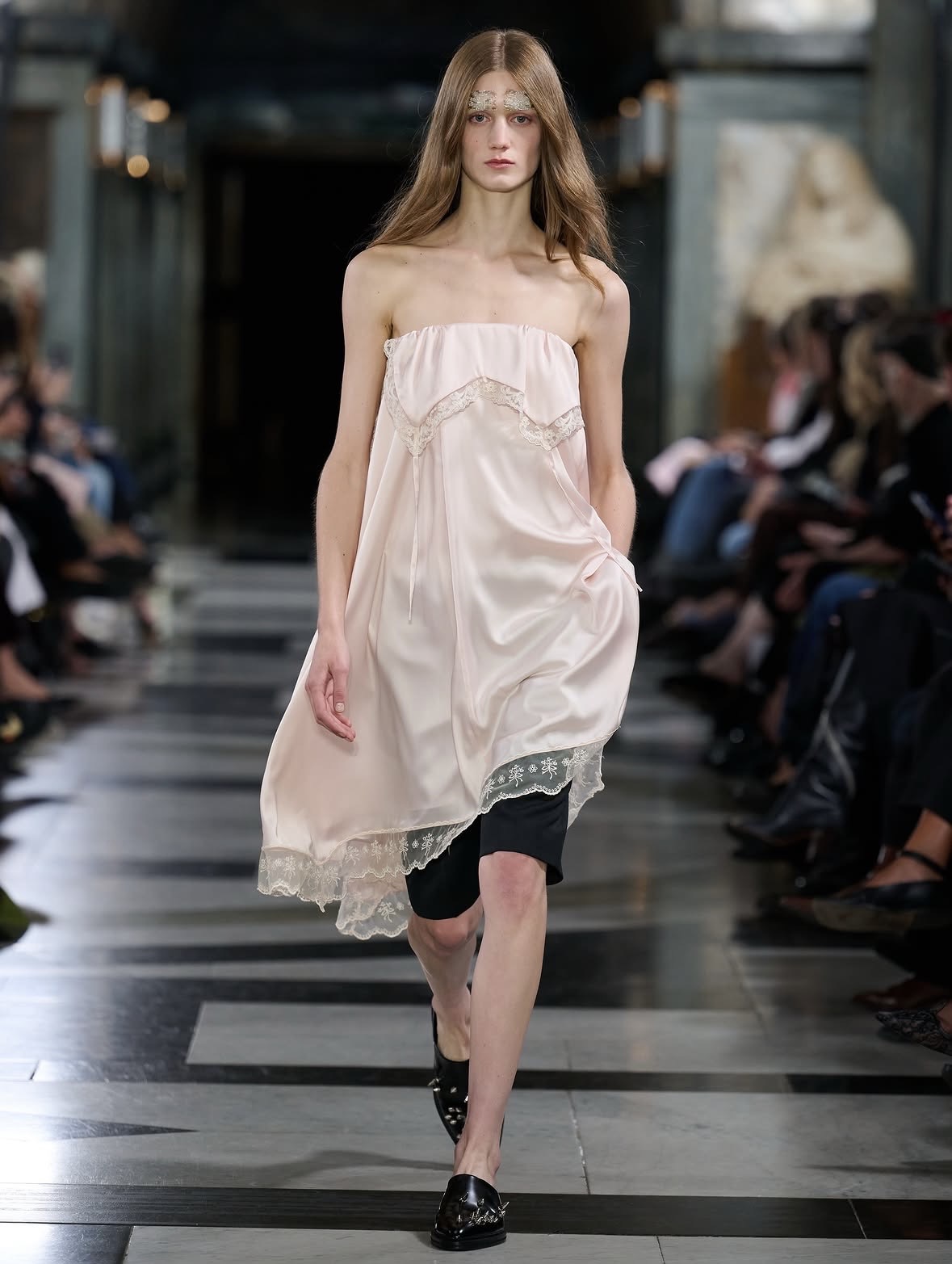
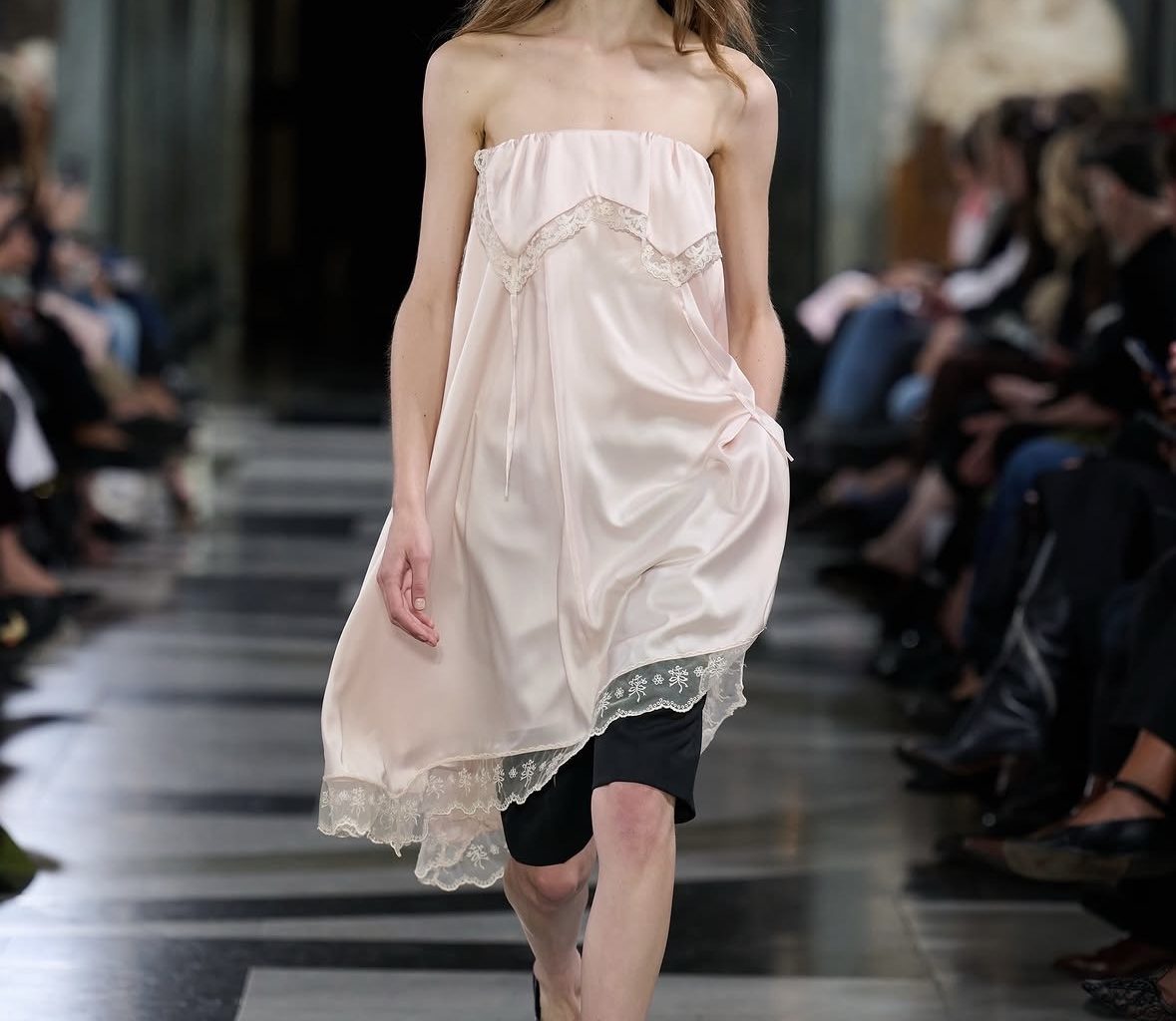
At 10am on Sunday morning, inside the marble corridors of London’s Old Bailey, Simone Rocha sent out a woman who looked less protected than usual. She wore sheer dresses, plunging leather, visible underwear, bare skin, oversized roses and fragments of tailoring that seemed to have slipped out of place. The location was not incidental: this is the Central Criminal Court of England and Wales, a building synonymous with judgement, guilt, testimony and public scrutiny. Rocha turned it into a theatre of intimacy.
The collection was called I Was Trying To Love You.
And perhaps the most interesting thing about it is that Rocha was not trying to make love look beautiful. She was asking what love looks like when it becomes vulnerable.
For a designer whose language has historically been built around layers, this is a significant gesture. Rocha has always dressed the body as though it needed protection: tulle over lace, lace over corsetry, florals over skin, volumes over the silhouette. Her clothes have the seductive quality of armour disguised as romance. Vogue has long described that world as an eerie, melancholic form of femininity, somewhere between coquettishness and darkness.
For Spring/Summer 2027, the armour is still there.
It has simply been opened.
THE BODY ON TRIAL
The Old Bailey makes the metaphor almost brutally obvious.
A courtroom is a place where bodies are observed, interpreted and judged. Rocha placed her models directly inside that architecture of judgement, then did something almost confrontational: she exposed them.
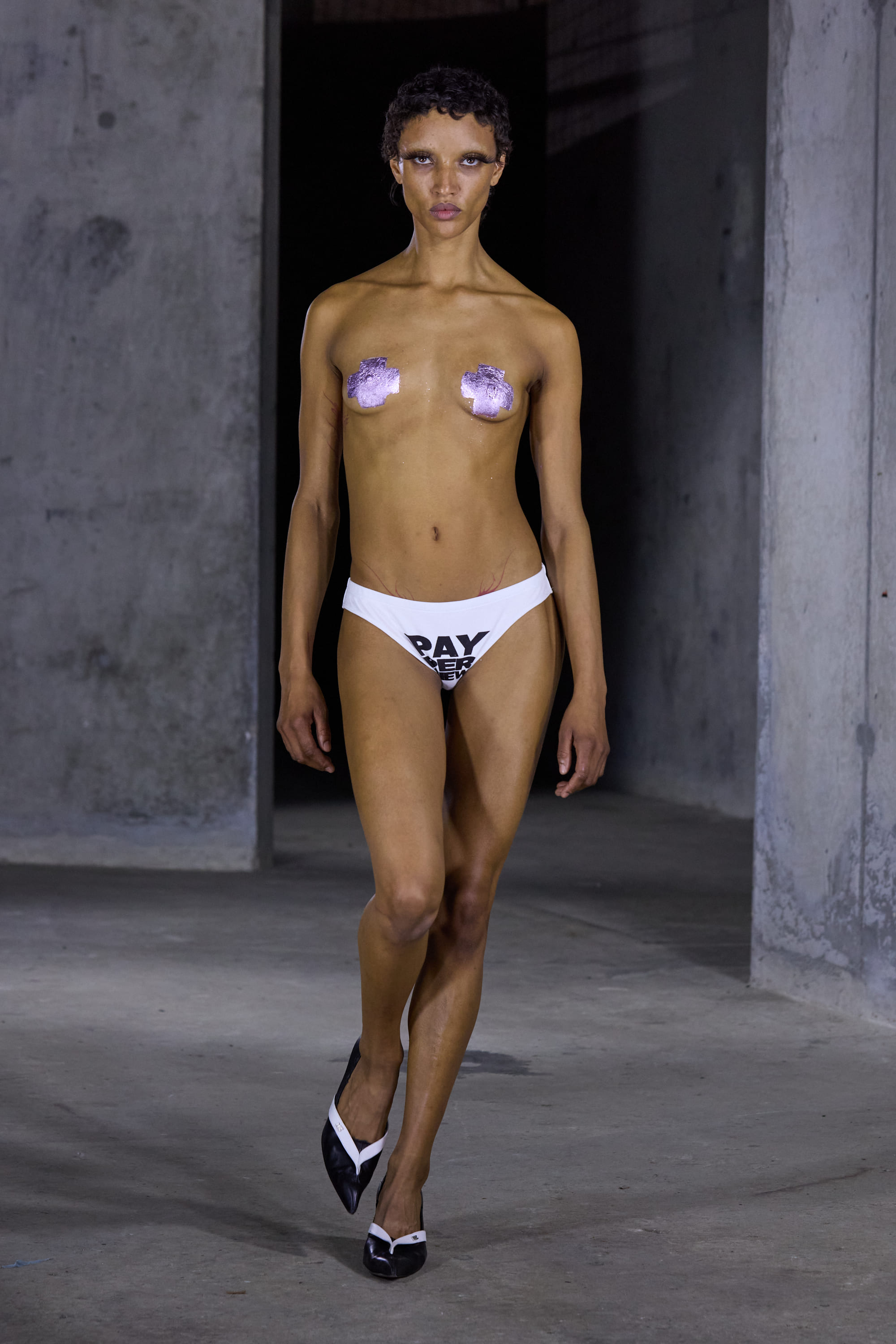
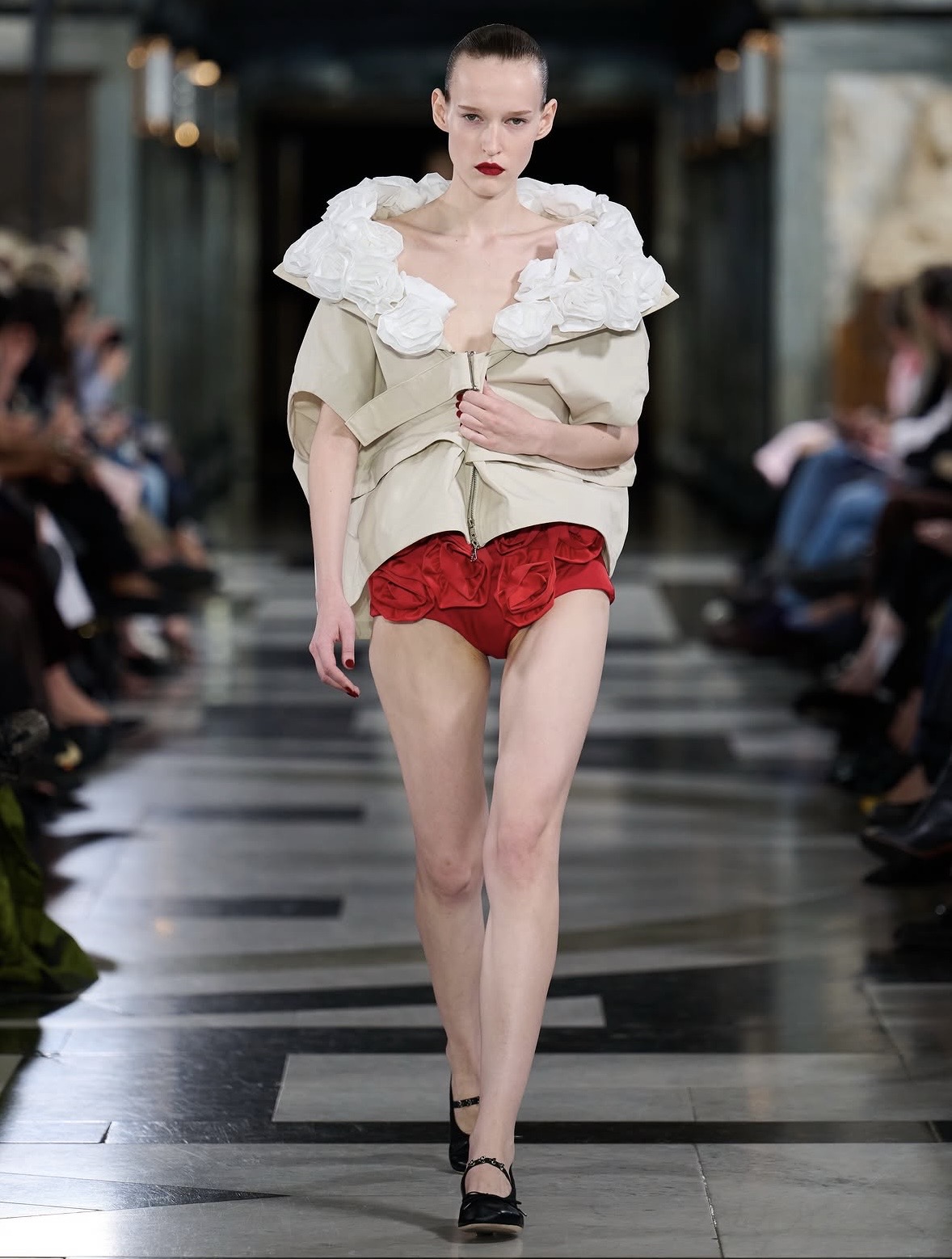
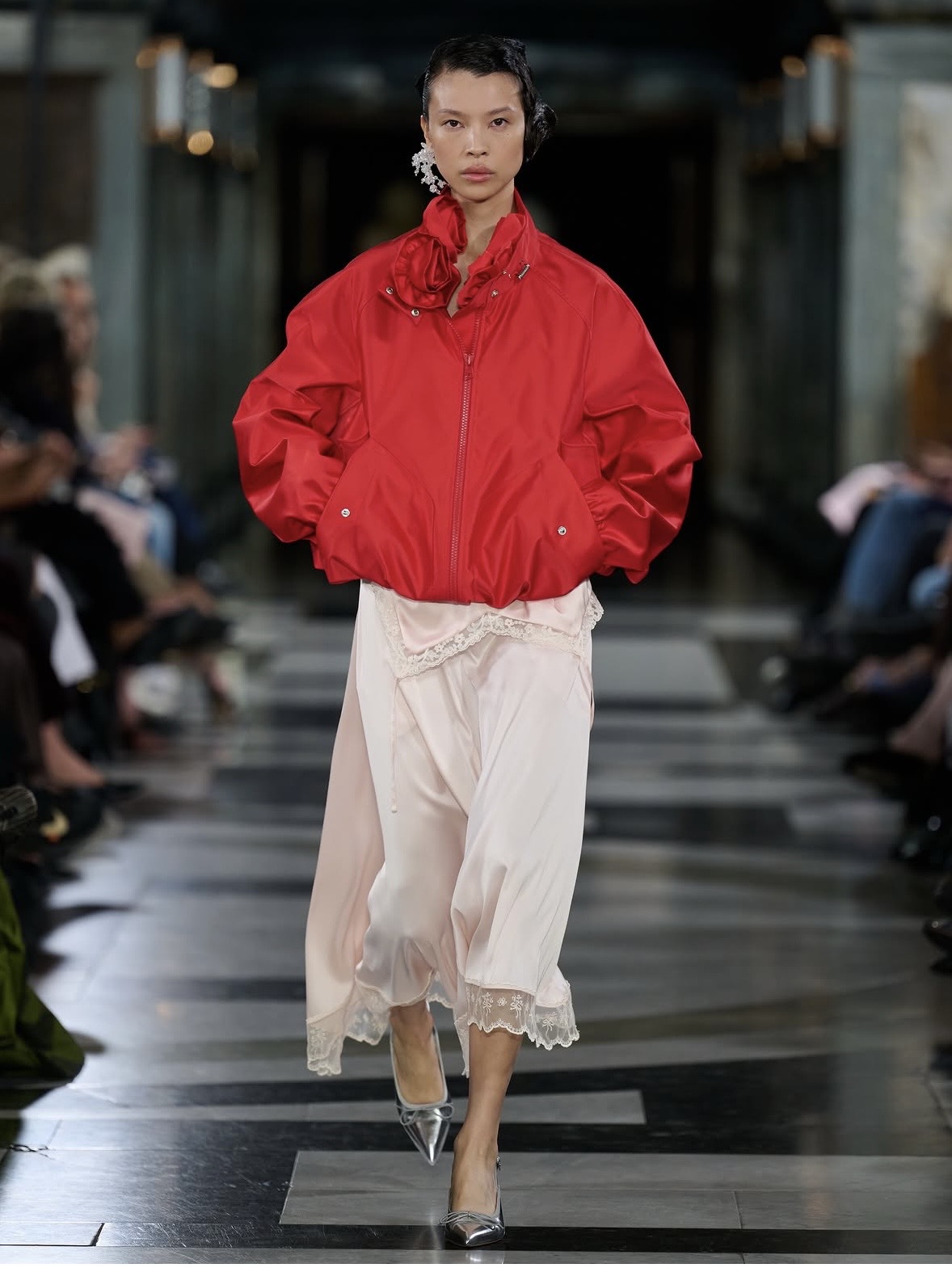
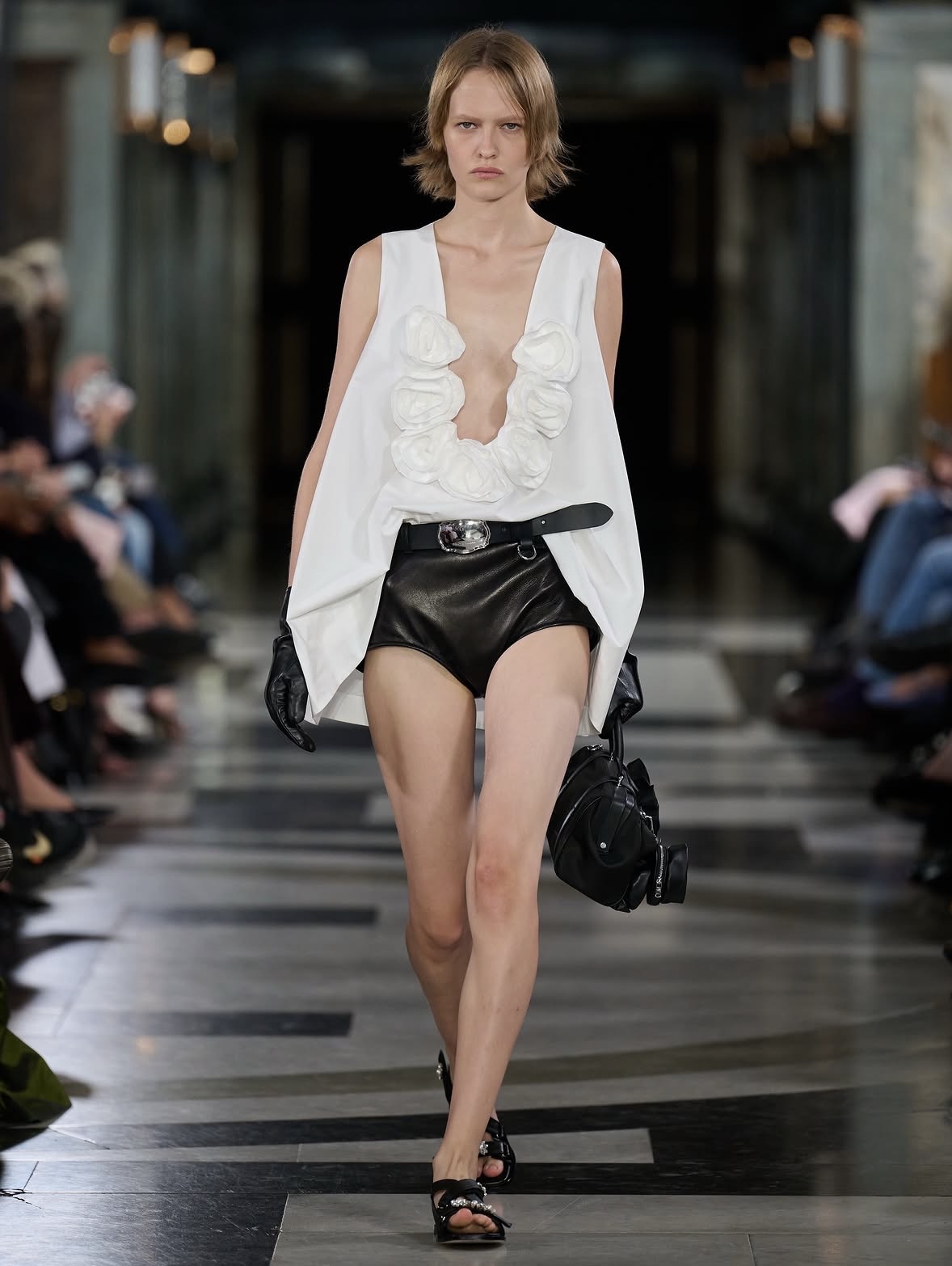
Underwear became visible. Leather jackets opened almost to the waist. Sheer dresses revealed red briefs beneath. One of the most striking looks paired a cream jacket and enormous floral collar with red underwear decorated with fabric roses. Another reduced the familiar Rocha silhouette to a black leather jacket, matching trousers and bare skin, its lapels transformed by gigantic leather flowers.
This isn’t simply another chapter in the endless underwear-as-outerwear cycle.
The difference is psychological.
In most contemporary fashion, exposed underwear is a gesture of confidence. It says: I know you are looking, and I have decided to show you more.
Rocha makes it feel more ambiguous.
The body is exposed, but not necessarily empowered by exposure. It is seen.
And being seen is not the same thing as being liberated.
That distinction gives the collection its tension.
FROM PROTECTION TO EXPOSURE
Rocha herself described the shift backstage in almost physical terms: she said that layering clothes has always been a protective gesture for her, and that this season she wanted something more vulnerable.
That sentence could almost function as a manifesto for the entire collection.
Since her debut after Central Saint Martins, Rocha has developed one of the most immediately recognisable visual languages in contemporary British fashion. Tulle, pearls, florals, exaggerated skirts, lace, leather, corsetry and deliberately strange proportions have become a vocabulary rather than a trend.
She emerged in the early 2010s with an aesthetic that seemed unusually complete from the beginning; she became an inaugural LVMH Prize finalist in 2014 and remained independent, preserving an idiosyncratic identity while her clothes found their way onto Rihanna, Keira Knightley and a growing international audience.
The crucial point is that Rocha has never really been interested in minimalism.
Her clothes accumulate.
They gather references, materials, memories, histories and emotions until the body almost disappears beneath them.
That is why SS27 feels less like a new direction than an act of subtraction.
The flowers remain.
The romance remains.
The tulle remains.
The theatricality remains.
But the body underneath is suddenly visible.
BEAUTY IN THE WRONG PLACE
The intellectual key to the collection comes from Caravaggio.
Rocha was thinking about The Taking of Christ, a painting that spent years hanging in a Dublin drawing room without being recognised as an authentic Caravaggio. Her idea was to search for “the most beautiful thing in the most unobvious place” and translate that into the garments.
It is a very Rocha idea.
Because her entire career has been built around placing beauty somewhere it shouldn’t quite belong.
A rose on leather.
A pearl on something violent.
A childish silhouette carrying erotic undertones.
A romantic dress with something unsettling underneath.
A delicate flower growing out of an aggressive garment.
And now: lingerie inside a courtroom.
The Old Bailey becomes the physical manifestation of that contradiction.
The location is severe; the clothes are sensual.
The architecture is institutional; the garments are intimate.
The building represents judgement; the collection asks for acceptance.
And suddenly Caravaggio makes sense.
The question is not simply where beauty exists.
It is who gets to recognise it.
LOVE, BUT WITHOUT THE FILTER
The title I Was Trying To Love You introduces another layer.
The past tense matters.
I was trying.
Not I love you.
Not I will love you.
Trying implies effort, failure, uncertainty, desire, disappointment.
It makes love a process rather than a destination.
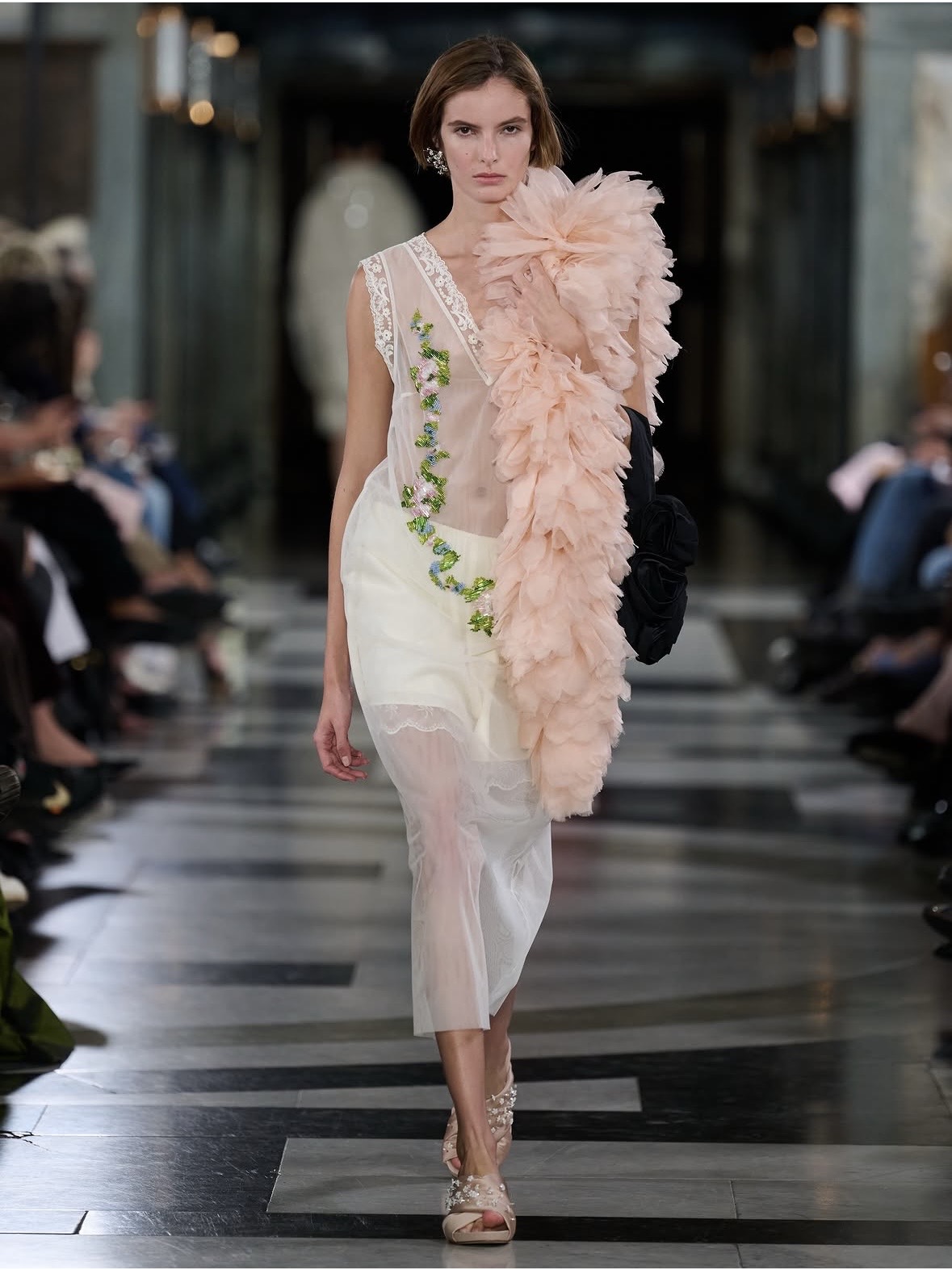
That emotional instability is reflected in the clothes. Nothing feels completely settled. Jackets are open. Underwear escapes. Layers separate. Tailoring meets lingerie. Dresses become transparent. Romantic flowers become almost aggressive in scale.
The clothes seem to be caught between the desire to cover and the desire to reveal.
Which is, perhaps, what contemporary intimacy looks like.
THE FEMININE IS NO LONGER ONE THING
There is another important element beneath the surface.
Rocha has spent years constructing an unmistakable version of femininity. But SS27 seems interested in breaking that femininity into multiple characters.
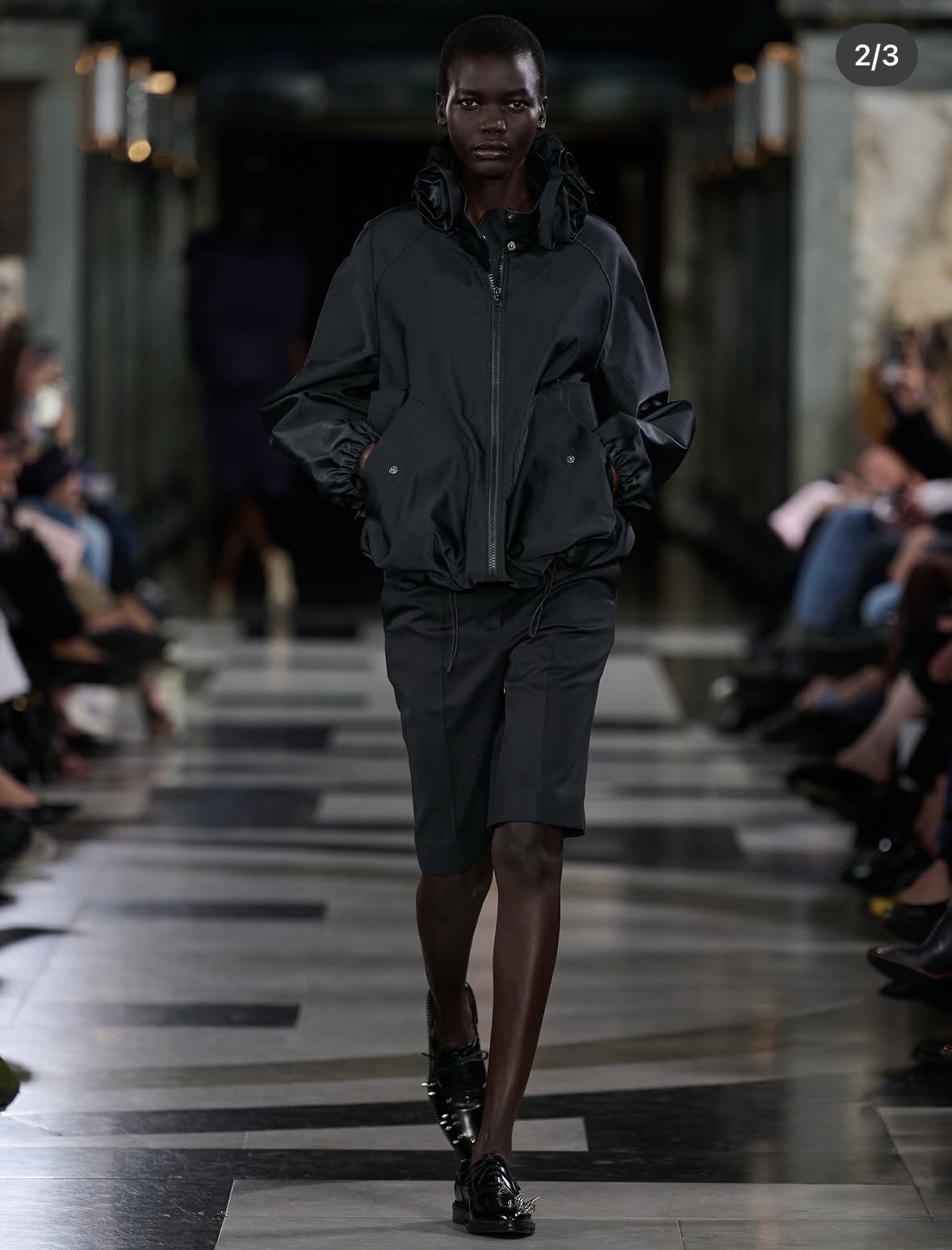
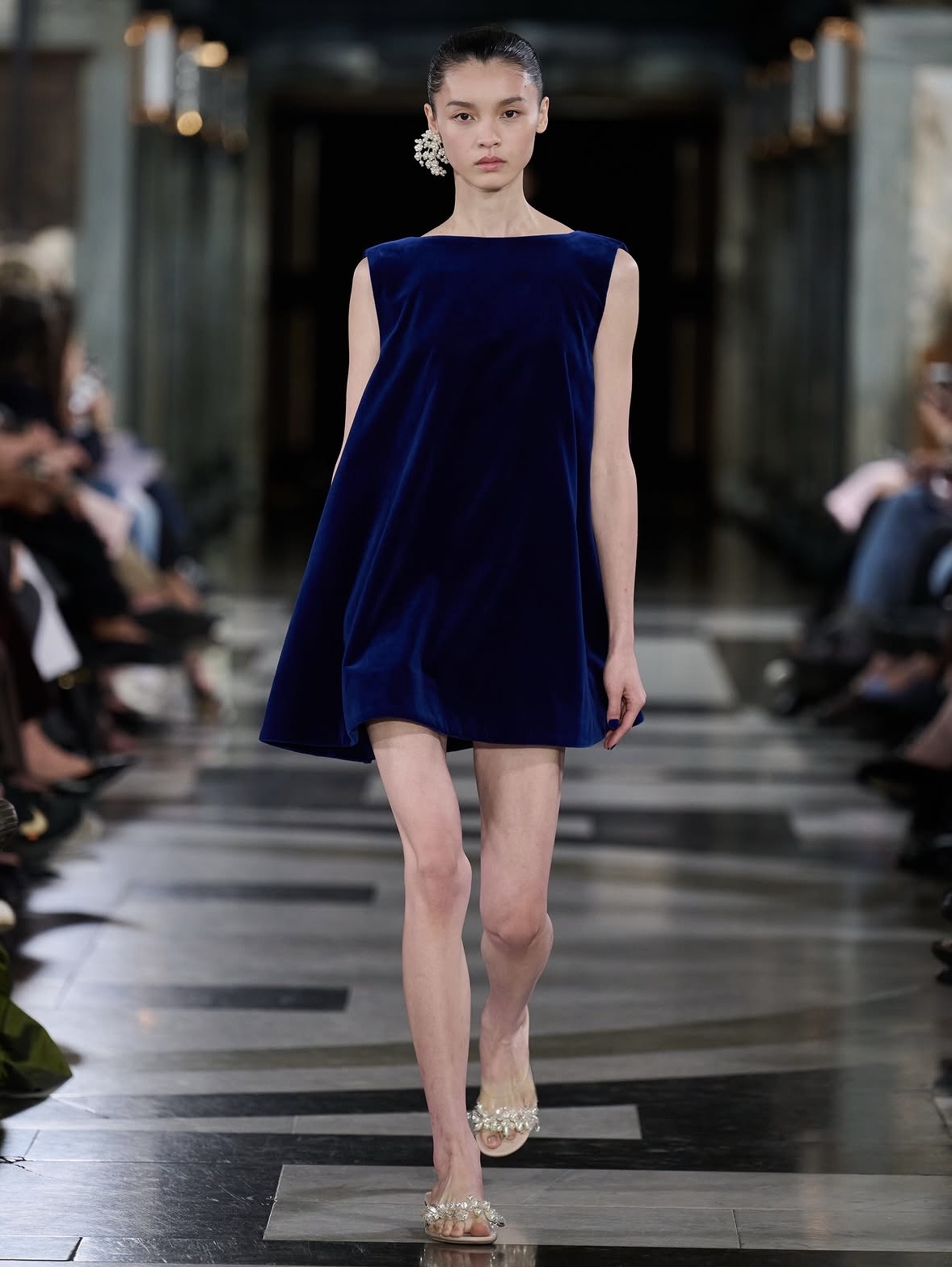
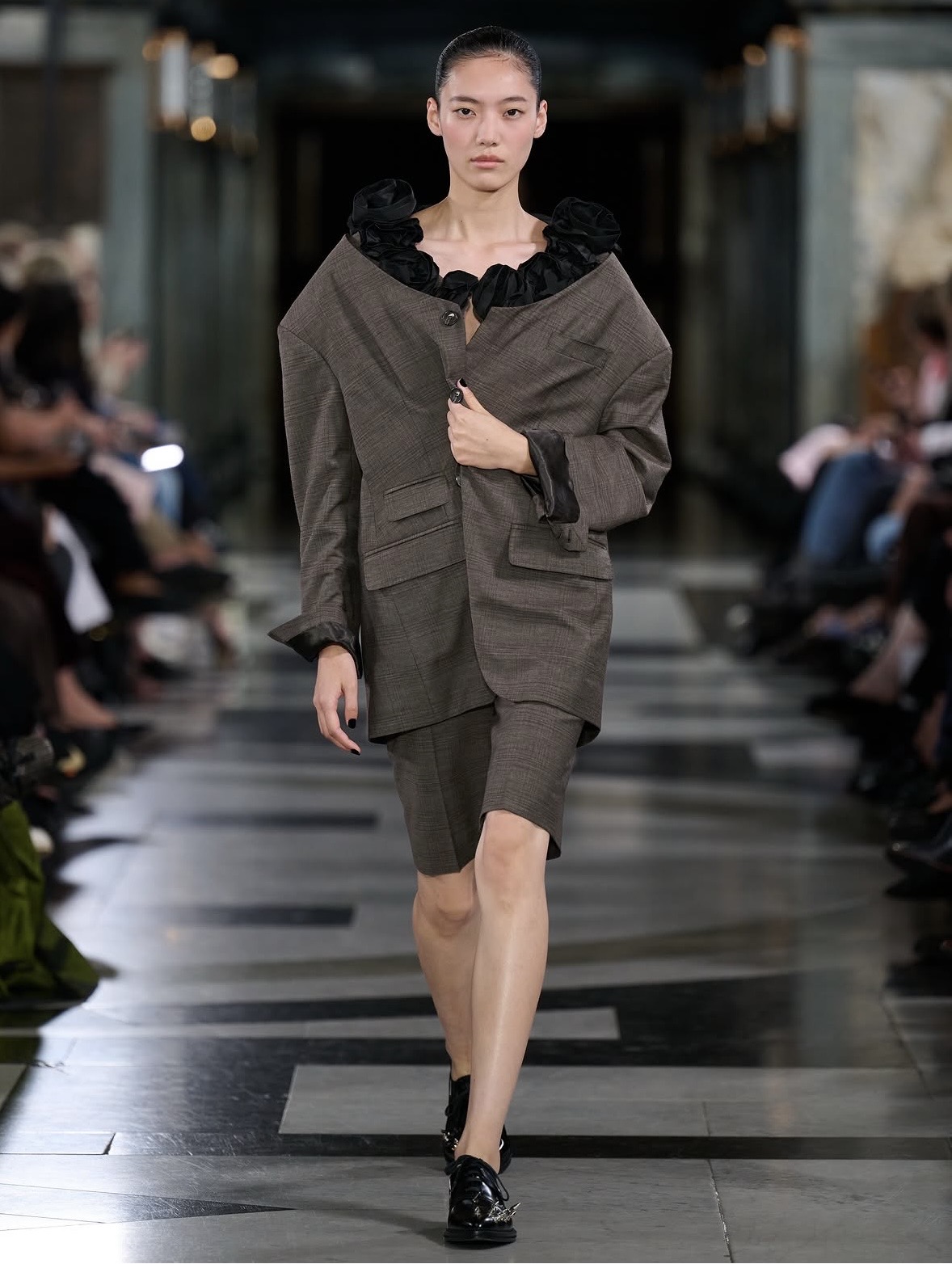
The collection moves from tailored bombers and Bermuda shorts to sheer evening dresses, from leather to lace, from ballet references to exposed underwear. The palette moves through lilac, black, cream and pink, while the beauty remains deliberately heightened: embellished brows, flushed skin and deep velvet lips.
This isn’t one woman.
It’s a cast.
A girl who wears the bomber.
A woman in leather.
A ballerina who has grown up.
A romantic who has stopped behaving.
A body that refuses to decide whether it wants to hide or be seen.
That multiplicity feels particularly relevant now, when fashion has spent years selling highly defined identities: the clean girl, the mob wife, the coquette, the office siren, the whatever-girl of the week.
Rocha offers something less algorithmic.
Not an aesthetic identity.
A contradiction.
THE END OF THE VIRAL DRESS?
There is a strange irony to the timing.
British Vogue recently described the current fashion climate as a kind of “gag recession”: after years of increasingly elaborate runway stunts engineered for social media circulation, fashion appears to be moving back towards clothes and straightforward runway presentation.
Rocha’s show doesn’t need a gimmick.
The gimmick is the location, but the location becomes meaningful because it is inseparable from the clothes.
This matters for London.
The SS27 London schedule is itself undergoing a kind of identity negotiation. McQueen is returning from Paris. Mulberry is returning to the runway under Christopher Kane. Burberry remains one of the city’s major anchors, while a new generation continues to occupy the ecosystem around them.
London therefore finds itself asking a familiar question:
What is London fashion now?
Is it commercial heritage?
Is it celebrity?
Is it young designers?
Is it provocation?
Is it craft?
Is it cultural weirdness?
Rocha’s answer is quietly old-fashioned and radically contemporary at the same time: it can still be about a point of view.
THE ROSE AS ARMOUR
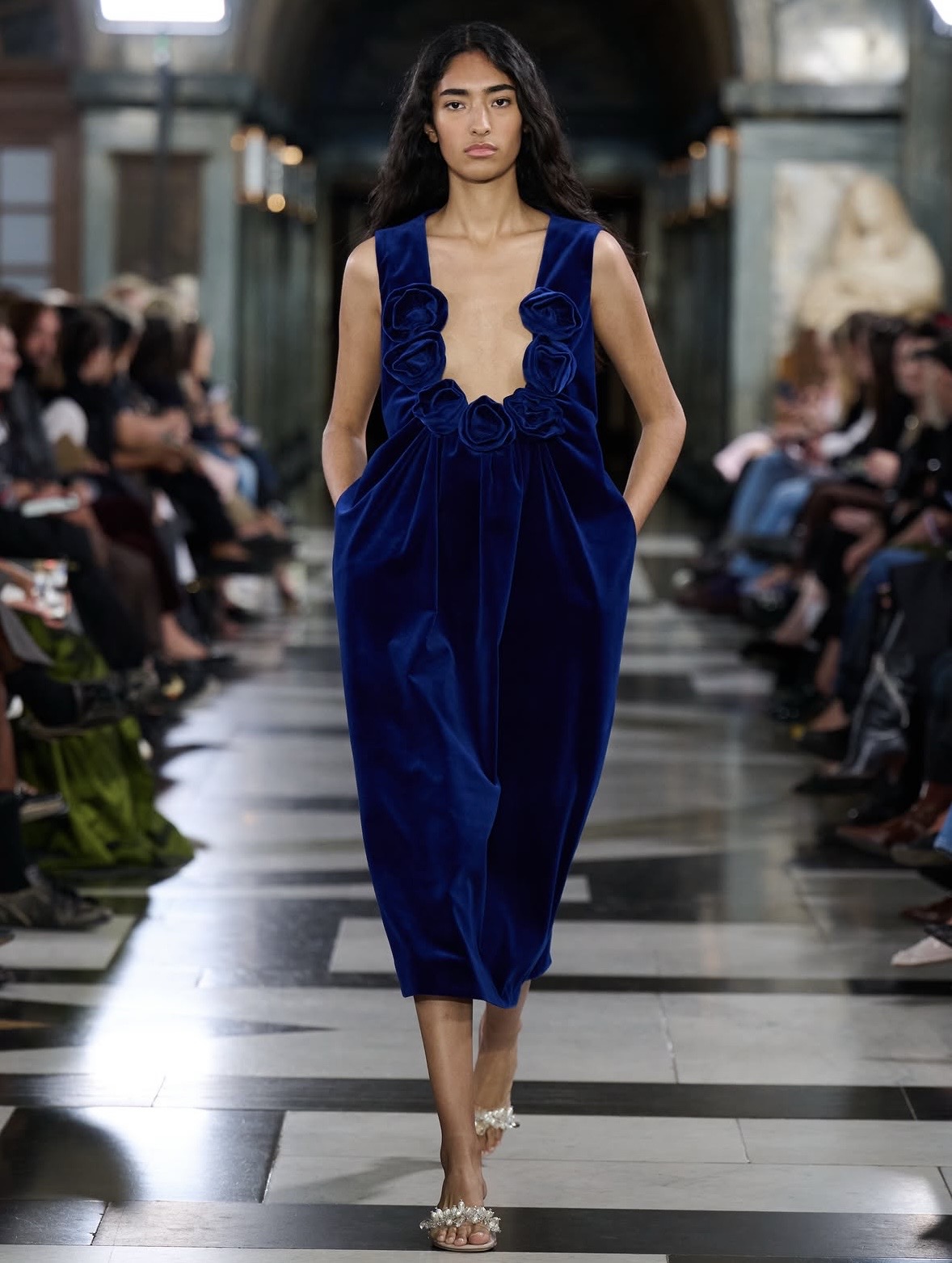
The rose has become one of Rocha’s signatures, but here it changes function.
It is no longer simply decoration.
It becomes almost anatomical.
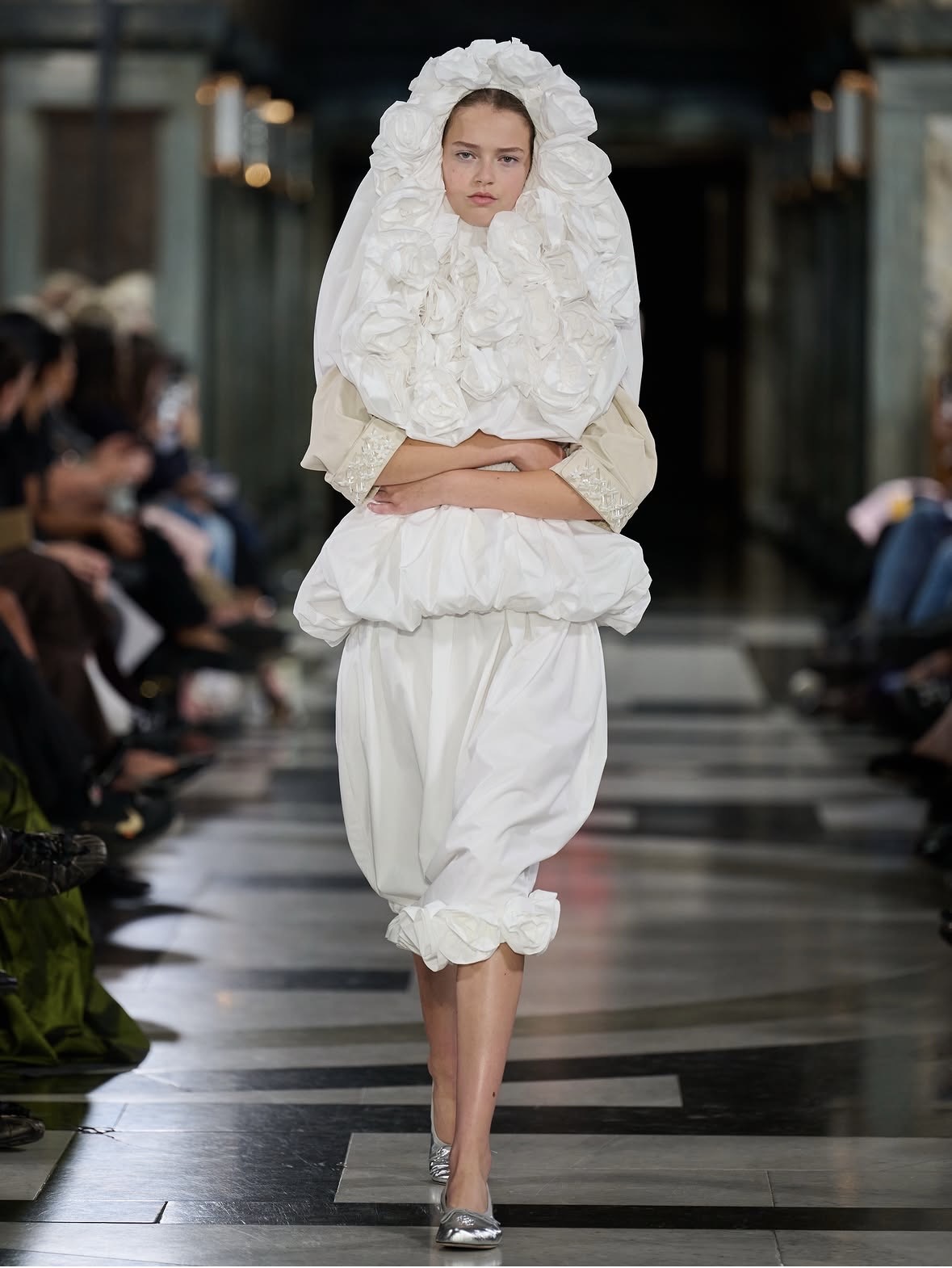
A flower sits where a shoulder might be. Another swallows a lapel. Others appear around the body like protective growths.
This is where the collection connects most directly to Rocha’s historical vocabulary.
The flower is soft.
The leather is hard.
The underwear is intimate.
The rose is romantic.
Together they become something more complicated than any of those elements alone.
The result is a kind of botanical armour.
And that may be the most accurate description of Rocha’s entire career.
She has always made clothes that look like flowers but behave like armour.
SS27 simply asks what happens when the armour opens.
THE BEAUTY OF IMPERFECTION
There is also something deliberately anti-perfectionist happening in the styling.
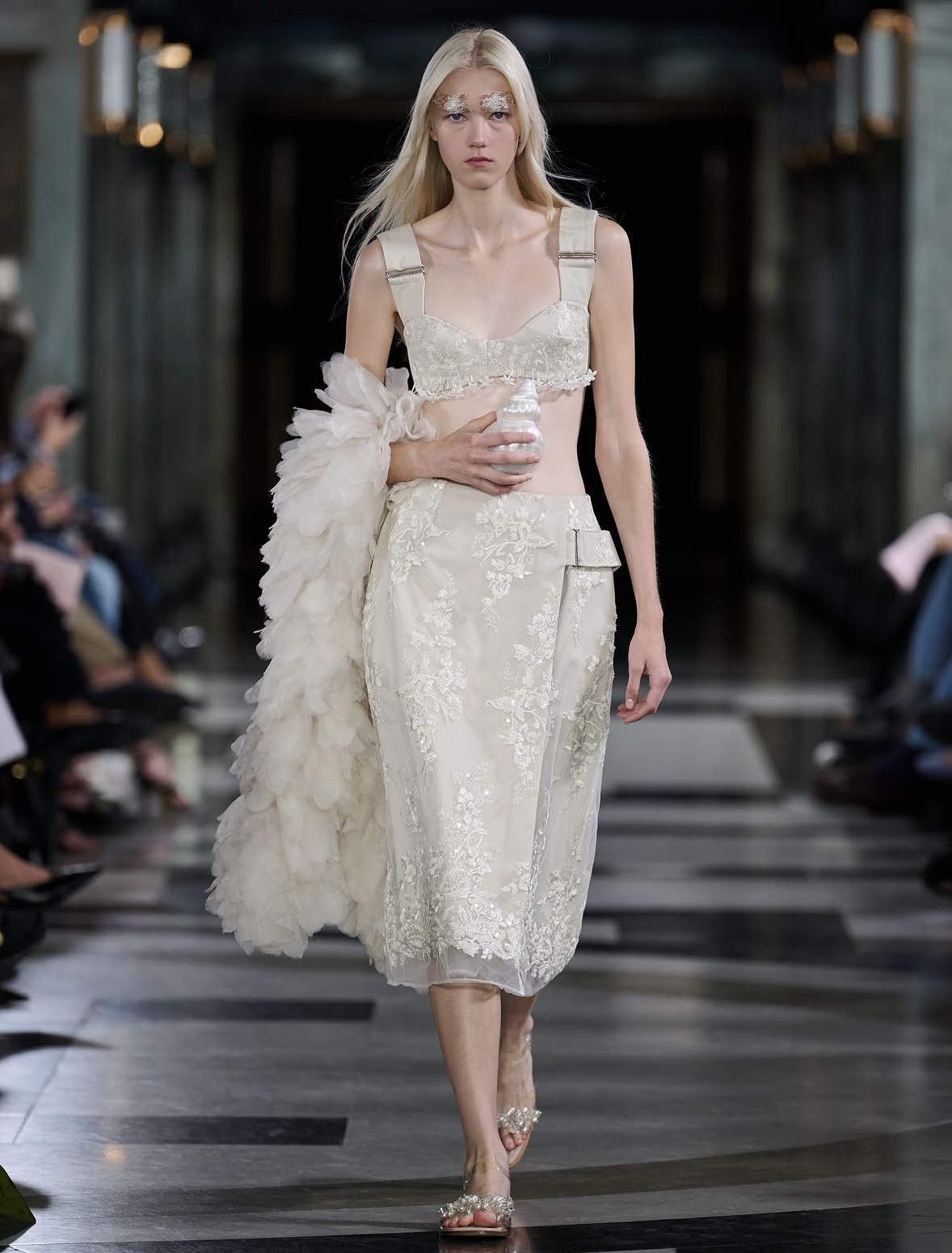
Rocha wanted garments to feel more personal, rather than perfectly constructed onto a body. Sleeves are rolled. Jackets remain open. Layers appear displaced. Underwear becomes part of the silhouette rather than something hidden underneath it.
That makes the clothes feel lived in.
And this is crucial because contemporary luxury has become obsessed with the immaculate image.
Perfect skin.
Perfect tailoring.
Perfect casting.
Perfect location.
Perfect content.
Rocha introduces a different luxury: the luxury of looking slightly undone.
Not careless.
Not unfinished.
Just human.
FIFTEEN YEARS LATER
There is something satisfying about seeing this collection now.
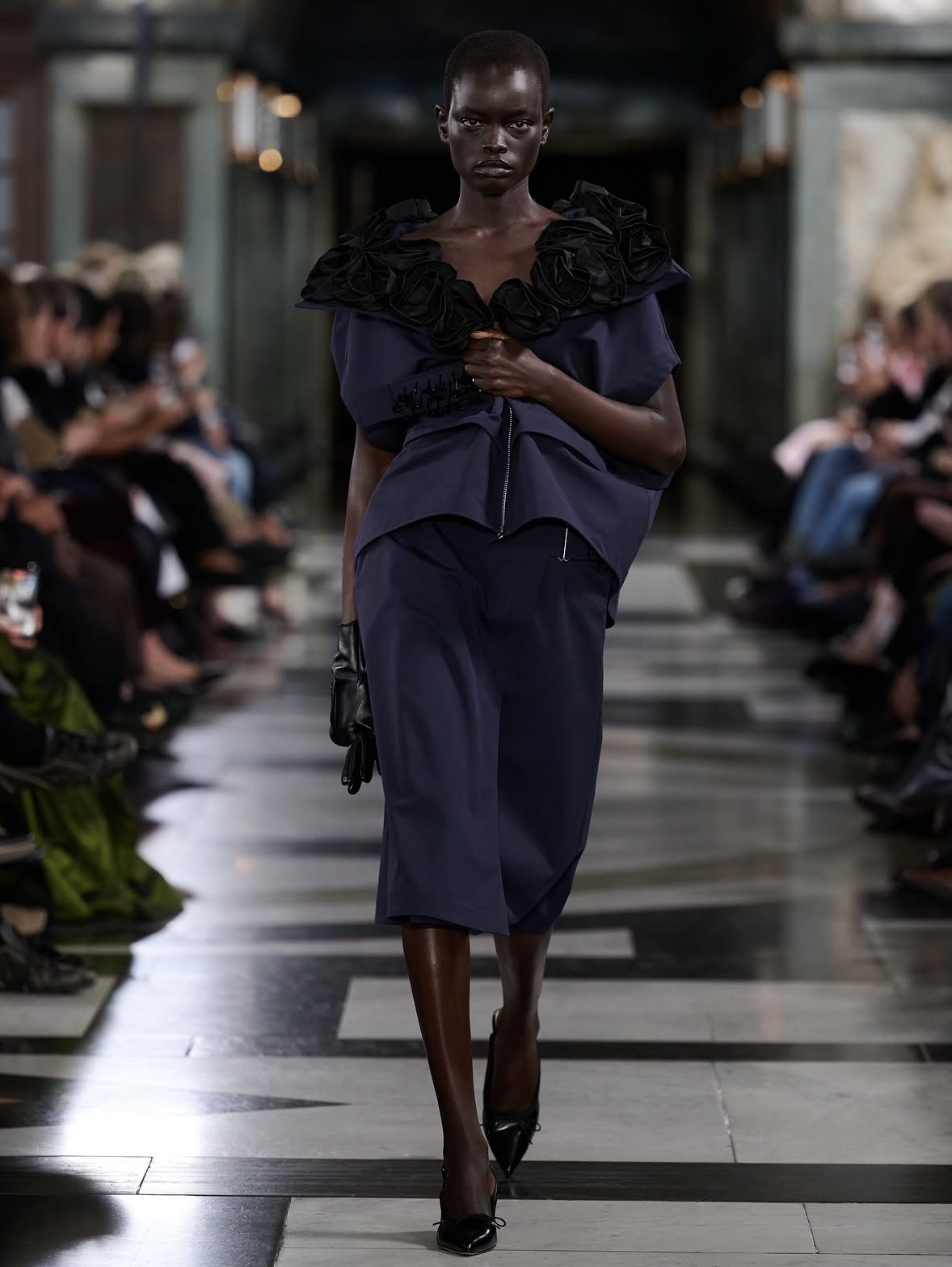
Rocha began with a language that was already recognisable. Fifteen years later, she doesn’t need to reinvent it.
She can interrogate it.
The SS27 collection therefore feels like a conversation with her own archive.
The tulle is still there.
The flowers are still there.
The lace is still there.
The romance is still there.
But their relationship to the body has changed.
And perhaps that is what maturity looks like in fashion.
Not abandoning your codes.
Making them answer new questions.
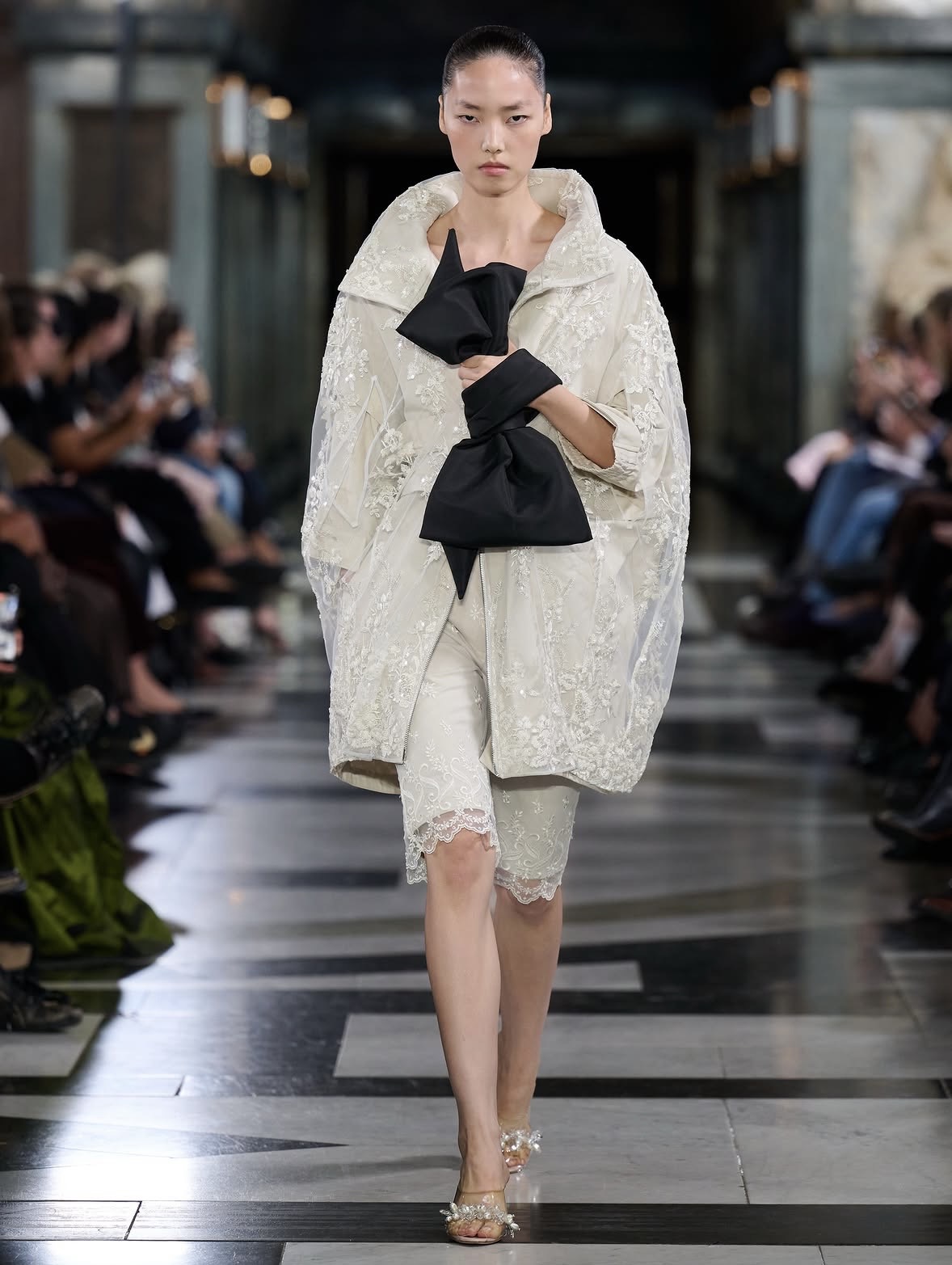
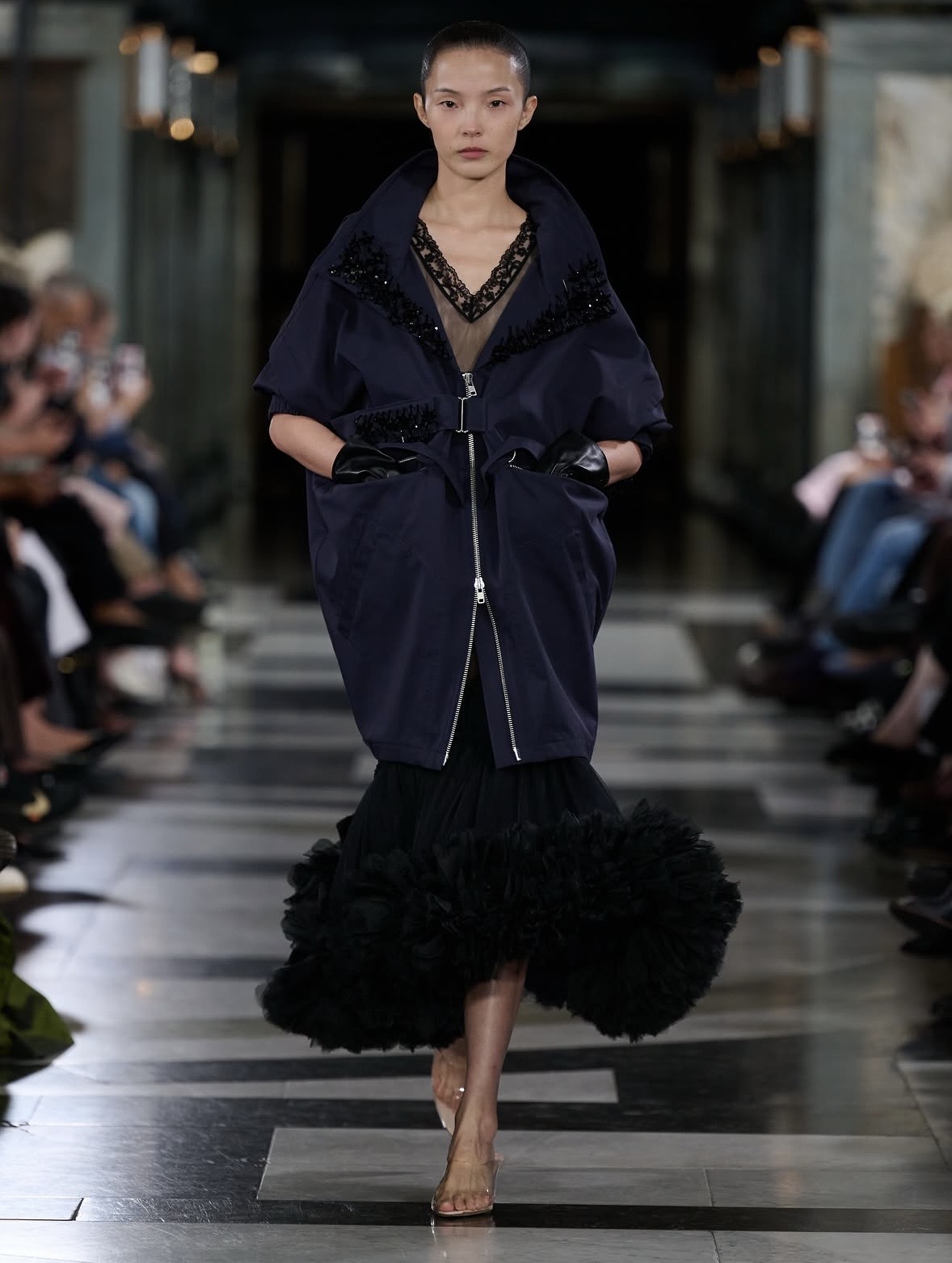
SIMONE ROCHA’S WOMAN, 2026
What makes I Was Trying To Love You compelling is that it doesn’t propose a new kind of woman.
It proposes a woman who is allowed to be contradictory.
Protected and exposed.
Romantic and sexual.
Fragile and aggressive.
Decorated and naked.
Beautiful and uncomfortable.
Certain and confused.
Seen and still unknowable.
That last contradiction is perhaps the most contemporary one.
Because we live in a culture in which everyone is visible all the time: photographed, posted, filmed, interpreted, judged.
Rocha takes that condition and turns it into clothes.
The exposed body becomes the subject.
The courtroom becomes the setting.
Love becomes the question.
And the rose becomes the evidence.
Maybe Simone Rocha has never really been designing romantic clothes.
Maybe she has been designing ways of surviving being seen.
And for Spring/Summer 2027, for once, she lets us see what is underneath.