
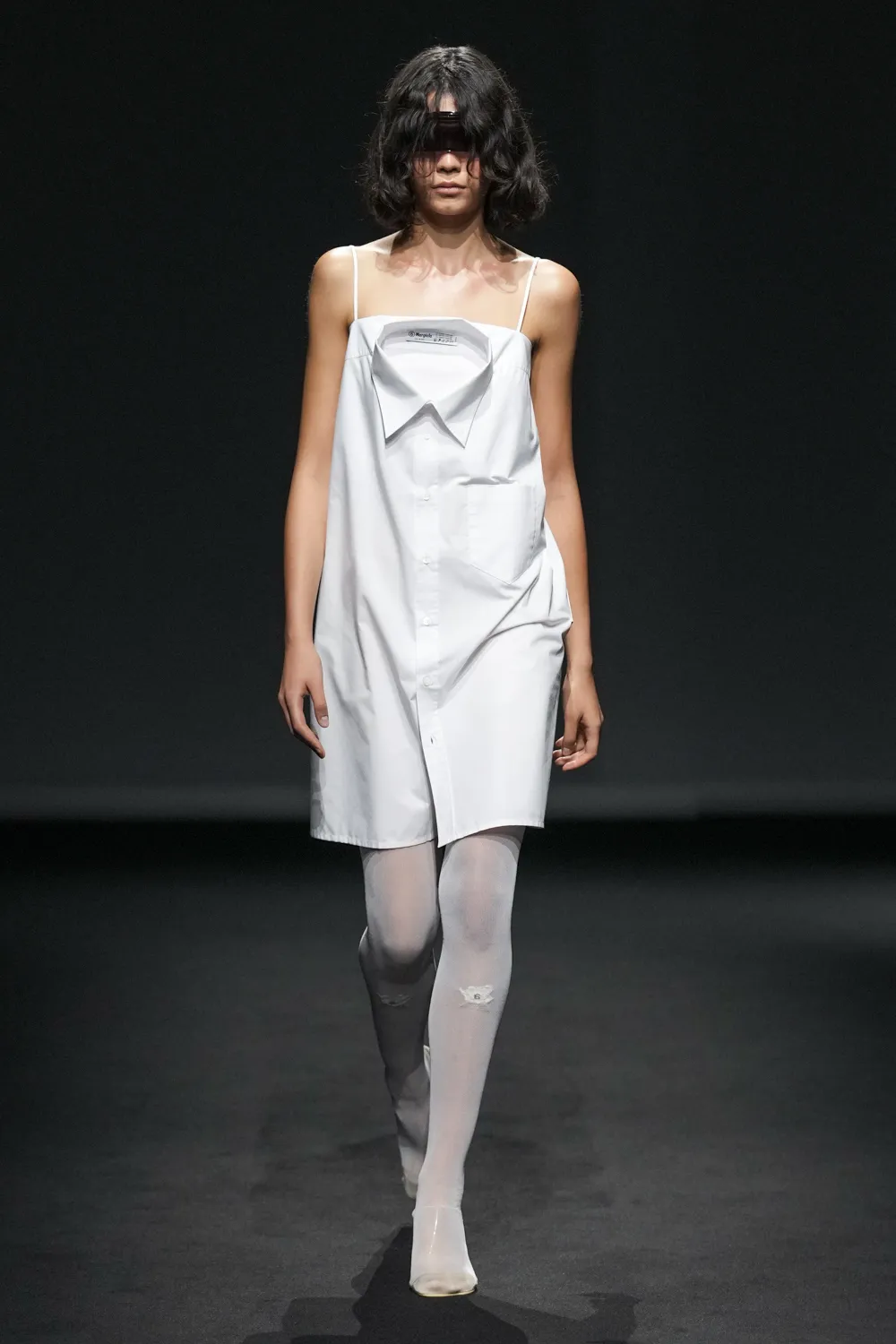
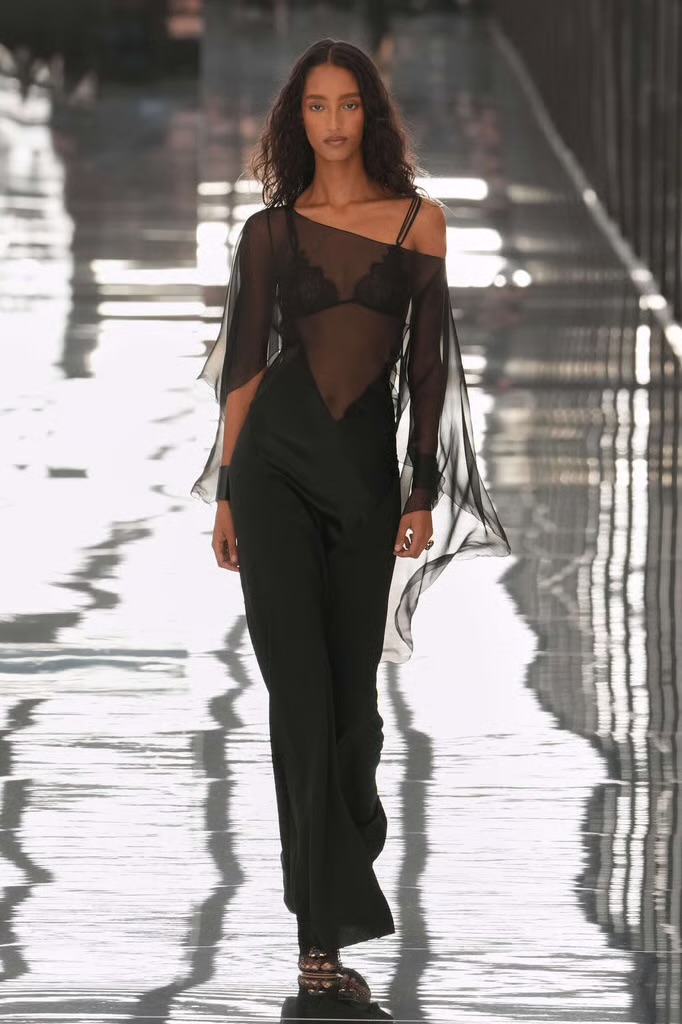
After decades of defining modern luxury through reduction, Jil Sander Spring Summer 2027 is asking a different question: how much imperfection can a perfect system survive

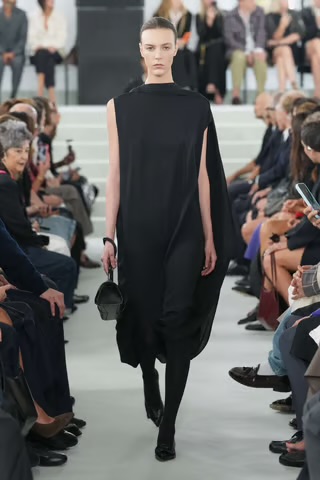
What is minimal today? Why Jil Sander Spring Summer 2027 is making a point
Can minimalism still be radical? It is a strange question to ask in 2026, when minimalism has become less a radical position than a retail category. Clean lines, neutral colours, quiet branding, expensive fabrics: the language that once challenged fashion’s obsession with excess has itself become an instantly recognisable product.
But Jil Sander was never simply about simplicity.
When Jil Sander founded her company in Hamburg in 1968, the radicalism was not in making fewer clothes. It was in changing what clothes could communicate. Throughout the 1980s and 1990s, she developed a new idea of luxury based on precision, proportion, fabric and construction rather than ornament or display. The suit became desirable without becoming decorative. The shirt became an object of desire without needing a logo. A coat could communicate status precisely because it refused to perform status.
Jil Sander’s minimalism was therefore never empty. This is why Jil Sander Spring Summer 2027 is telling a new tale.
It was intellectual, material and deeply modern. It treated reduction not as an absence, but as a form of concentration. That distinction matters now. Because the question facing Simone Bellotti is not whether Jil Sander should become minimal again. The world already knows what Jil Sander looks like. The question is whether that language can still feel necessary.
A house built on reduction
Jil Sander became one of fashion’s defining modernists by making restraint feel radical. The clothes were disciplined but never cold for the sake of being cold. They were expensive without needing to announce their expense. They belonged to a world in which tailoring, industrial materials, functional design and the body could coexist without the mediation of spectacle.
This is why reducing Jil Sander to “90s minimalism” misses the point.The minimalism was the consequence of a much larger idea: that fashion could create desire through intelligence.
Over time, however, that language became so successful that it became a convention. What was once oppositional became familiar. The very codes that had destabilised luxury eventually became part of luxury’s standard vocabulary.
This is the paradox Bellotti inherits. How do you reinvent a house whose most powerful invention was the refusal to constantly reinvent itself?
The new creative direction: Simone Bellotti
Bellotti arrived at Jil Sander in 2025 after sixteen years at Gucci and a period as creative director of Bally. His background is almost the opposite of the supposedly pure Jil Sander silhouette: tailoring, leather, fashion history, decoration, commercial luxury, eccentricity, archive.
That makes his appointment more interesting than a straightforward return to minimalism.Bellotti did not arrive as an outsider trying to impose a new language on the house. He arrived as someone who seemed to understand that Jil Sander already had one.
His first collection, SS26, was consequently an exercise in reduction. He spoke about removing fabric, refining the silhouette, finding what was necessary and stripping away what was not. The collection was less a revolution than a study: an attempt to understand the grammar before attempting to rewrite it.
Then came FW26. The system began to move. Ruffles appeared. Slits disrupted coats. Proportions became deliberately awkward. Garments seemed to detach themselves from the body. Something superfluous was allowed to become essential.
It was a subtle but important shift. First, Bellotti learned the rule. Then he started bending it. With Jil Sander Spring Summer 2027 we see a collection that explains his approach and ongoing study to bring his vision to life.
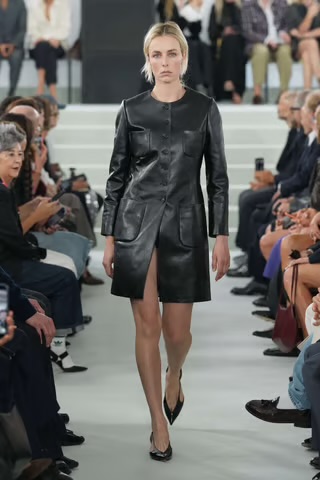
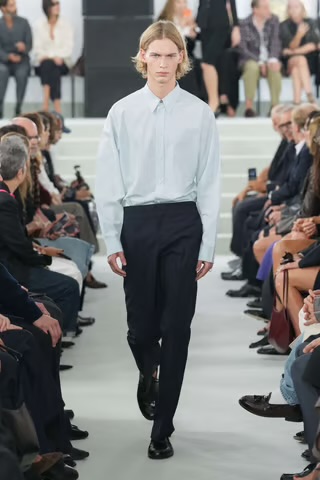
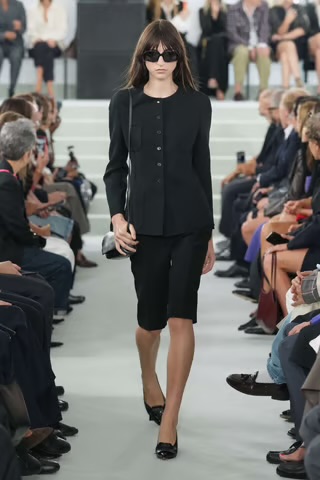
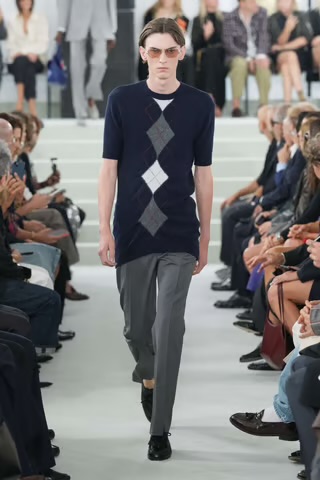
Spring Summer 2027 the disruption
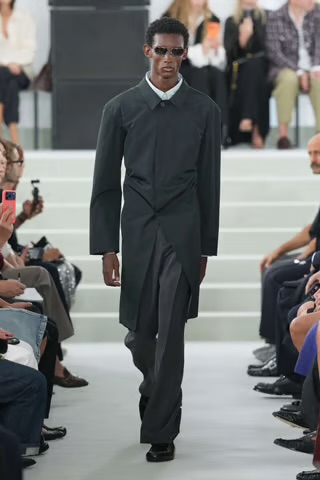
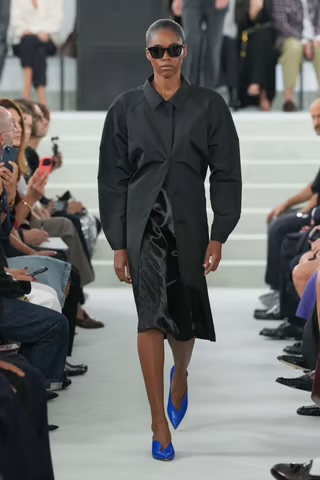
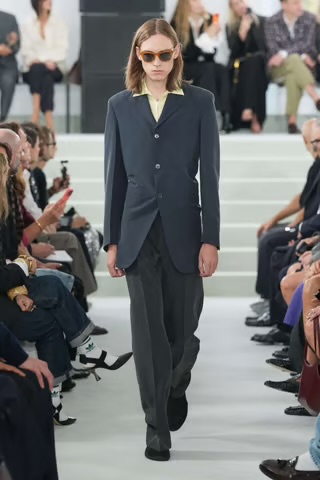
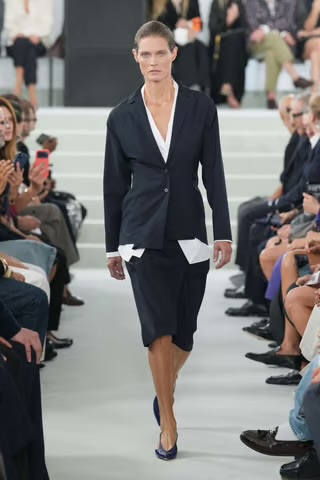
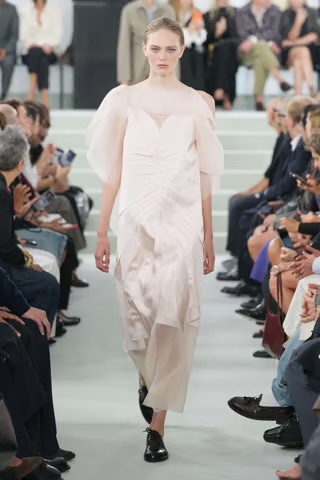
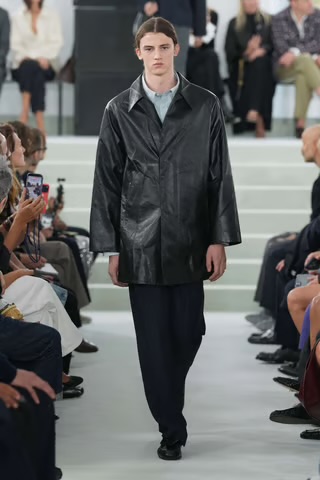
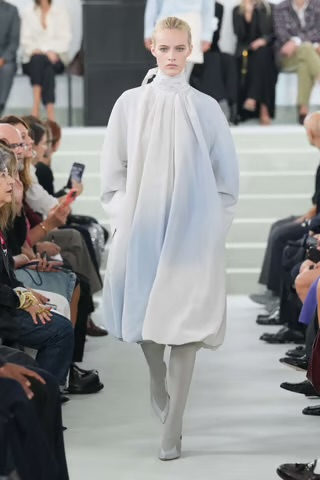
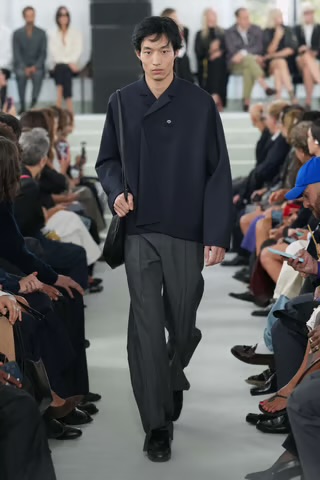
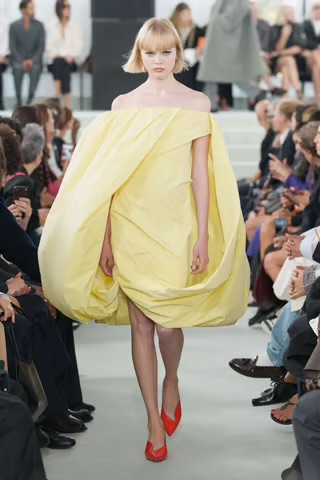
Jil Sander Spring Summer 2027 takes indeed that process further. The official language of the collection speaks of movement arriving in waves — conceding, receding — and the clothes seem to operate according to exactly that principle. Nothing is completely static.
A seam moves. A proportion slips. A fastening lands somewhere unexpected. A garment folds, opens, contracts or expands. The clothes retain the architectural discipline associated with Jil Sander, but something inside that architecture appears to have shifted.
The most revealing idea may be imperfection. Not imperfection as decoration. Not the deliberately “messy” garment that has become another fashion cliché. Something more precise: the controlled appearance of an error.
A seam that looks slightly wrong. A proportion that refuses to settle. A construction that appears to have been interrupted.The effect is subtle, but conceptually important. The perfect Jil Sander Spring Summer 2027 begins to show evidence of the human hand. The error becomes a way of making the system visible.
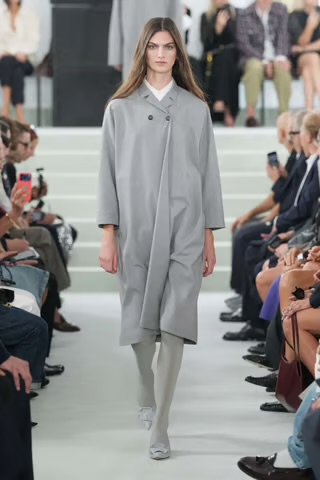
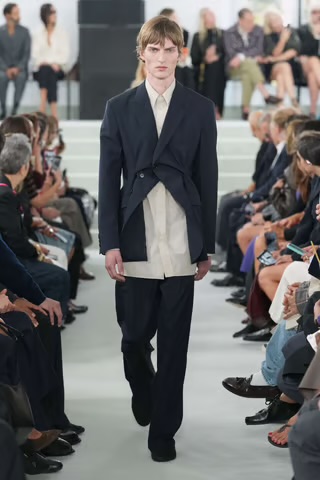
The human variable in Jil Sander Spring Summer 2027
This is where Bellotti’s approach becomes more than an exercise in brand heritage. The history of Jil Sander is inseparable from control. Control of fabric. Control of proportion. Control of colour. Control of the image. The power of the clothes came partly from their refusal to appear accidental.
The Jil Sander Spring Summer 2027 collection introduces the accident without actually surrendering control. That contradiction gives the collection its tension.
The clothes remain recognisably Jil Sander, but they are less interested in appearing untouchable. The body becomes more present. Fabric moves around it rather than simply framing it. Structure gives way in places. The uniform begins to admit the person wearing it.
It is almost as if Bellotti is asking whether perfection can become more modern once it learns to reveal its own vulnerability. And perhaps this is where the collection speaks most clearly to the present. We live in a culture saturated with optimisation: perfect images, perfect bodies, perfect branding, perfect personal identities. Everything is edited before it is seen.
Fashion has spent years responding with deliberate imperfection, but even imperfection has become aestheticised. Bellotti’s proposition is quieter.
What if the radical gesture is not to destroy perfection, but to allow it to bend?
Jil Sander Spring Summer 2027 is Jil Sander without nostalgia
The danger, of course, is that returning to a house’s foundational codes can quickly become archival cosplay.
Jil Sander has one of the most recognisable visual histories in modern fashion. Minimalism, tailoring, technical fabrics, purity, restraint: these are not references that need to be rediscovered. They are already embedded in the brand. Bellotti seems aware of this.
His collections do not attempt to reproduce the 1990s. Instead, they treat the archive as a set of principles. That distinction is crucial. A reference says: this is what Jil Sander used to look like.
A principle says: this is how Jil Sander used to think. The second is far more useful. Because the real legacy of Jil Sander is not a beige coat, a white shirt or a perfect black suit. It is the belief that removing something can be an intellectual act.
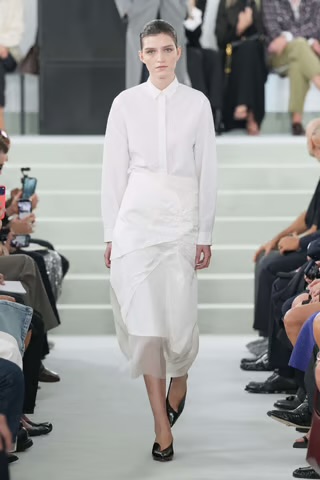

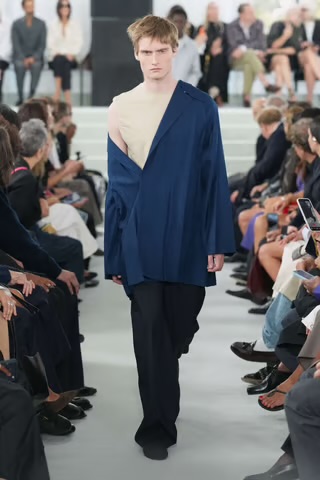
The new minimalism
Perhaps this is why calling Bellotti’s work a “return to minimalism” is both accurate and insufficient. Yes, the clothes are controlled. Yes, the silhouettes are restrained. Yes, there is a renewed emphasis on proportion, material and construction.
But the interesting part is what happens inside that restraint. Bellotti is slowly introducing friction. SS26 reduced. FW26 disrupted. Jil Sander Spring Summer 2027 moves.
It is beginning to look less like a designer restoring a brand and more like a designer testing how elastic its original idea can be. How much can Jil Sander change before it stops being Jil Sander? And perhaps even more importantly:
How much can it stay the same before it stops being relevant?
A different kind of luxury
There is also something sociological happening here. After years in which fashion has been increasingly driven by maximal visibility – logos, collaborations, spectacle, viral objects, accelerated trend cycles – restraint inevitably feels different. Not necessarily radical. But different.
The return of interest in precision, quality and discretion can easily be dismissed as nostalgia or commercial quiet luxury. Yet Jil Sander’s historical proposition was always more demanding than that.
It was never about being quiet. It was about making the object speak without shouting. That is a much harder proposition to reproduce today. And perhaps that is why Bellotti’s imperfections matter. They prevent restraint from becoming silence.
The Simone Bellotti Spring Summer 2027 is anything but a test
The most convincing thing about Bellotti’s Jil Sander so far is that he does not seem desperate to leave his signature everywhere.
That may sound like a strange compliment in an industry obsessed with authorship. But Jil Sander is a house where authorship works differently. The designer is not necessarily successful when you can immediately identify their handwriting. They are successful when they can make the house’s handwriting feel alive again.
Bellotti seems to understand that distinction. His own voice is appearing slowly, almost indirectly. It arrives through proportion, distortion, repetition, movement and the controlled failure of perfection. That makes the project more interesting than a simple return to the past. He is not trying to make Jil Sander look like Jil Sander.
He is trying to make Jil Sander think like Jil Sander again. Simone Bellotti’s answer, for now, seems to be neither nostalgia nor revolution. It is refinement with friction. A perfect system allowed to breathe. Jil Sander Spring Summer 2027 feels like a uniform allowed to become personal. An error allowed to become intentional.
And a house built on reduction discovering that sometimes the most radical thing you can add is a little uncertainty. So, after more than half a century of Jil Sander, perhaps the question is no longer whether minimalism can still be radical.
Can Jil Sander make us believe in it again?