


When did taking what belongs to someone else start to feel like a way to belong?
On youth, looting, social identity, and the psychology of a crowd.
There is a particular kind of phrase that can change the meaning of a scene before anyone has time to question it: Come quick, there’s free stuff.
I came across accounts from Milan in which young people were reportedly calling their friends to tell them to hurry over. The language was casual, almost playful. The reality behind it was different. The goods were not free. They had been taken from shops, from people who had invested money, time, and work into keeping those businesses alive.
The gap between those two realities stayed with me.
I live on Rue de Lancry, in Paris.
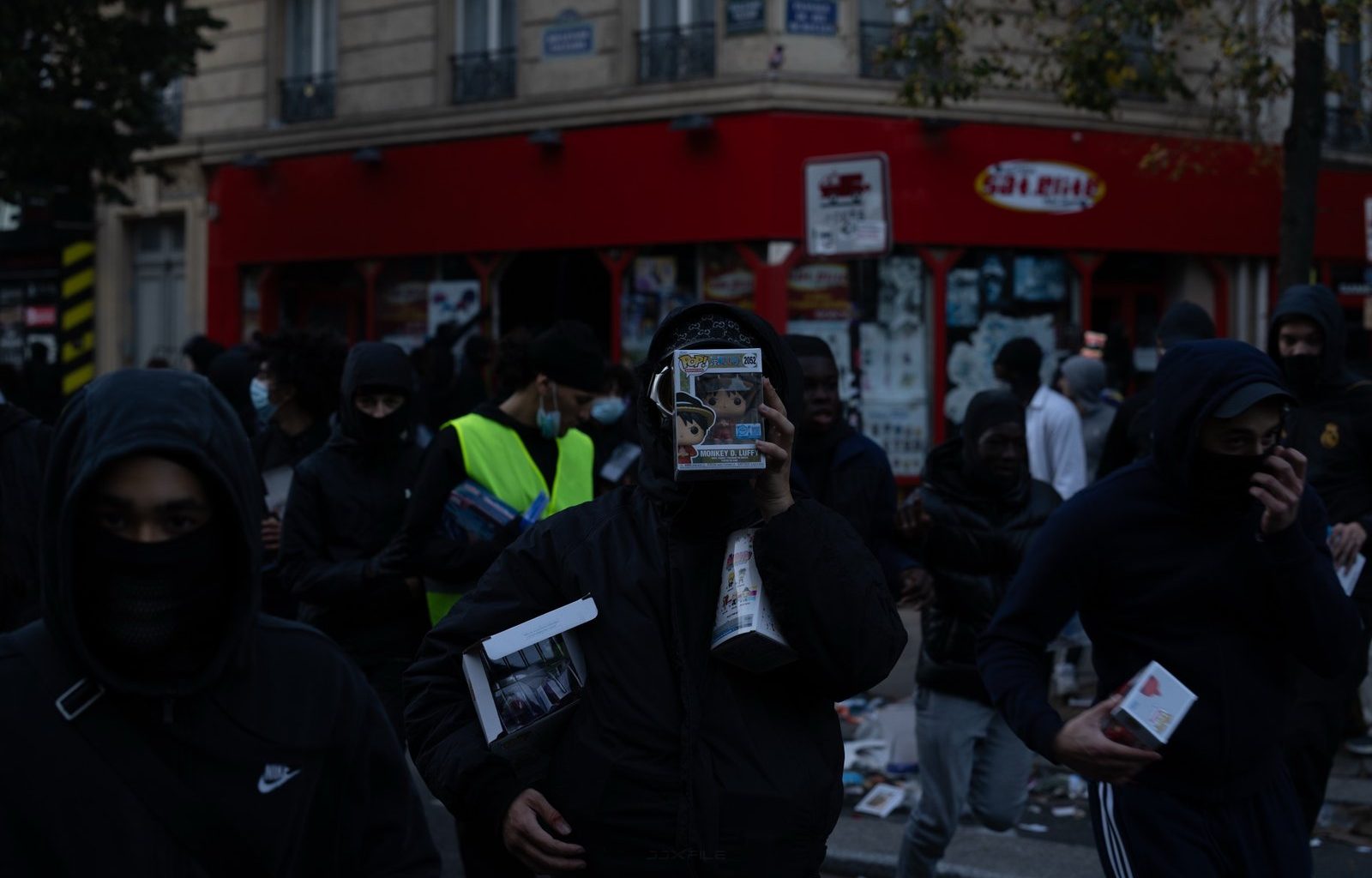
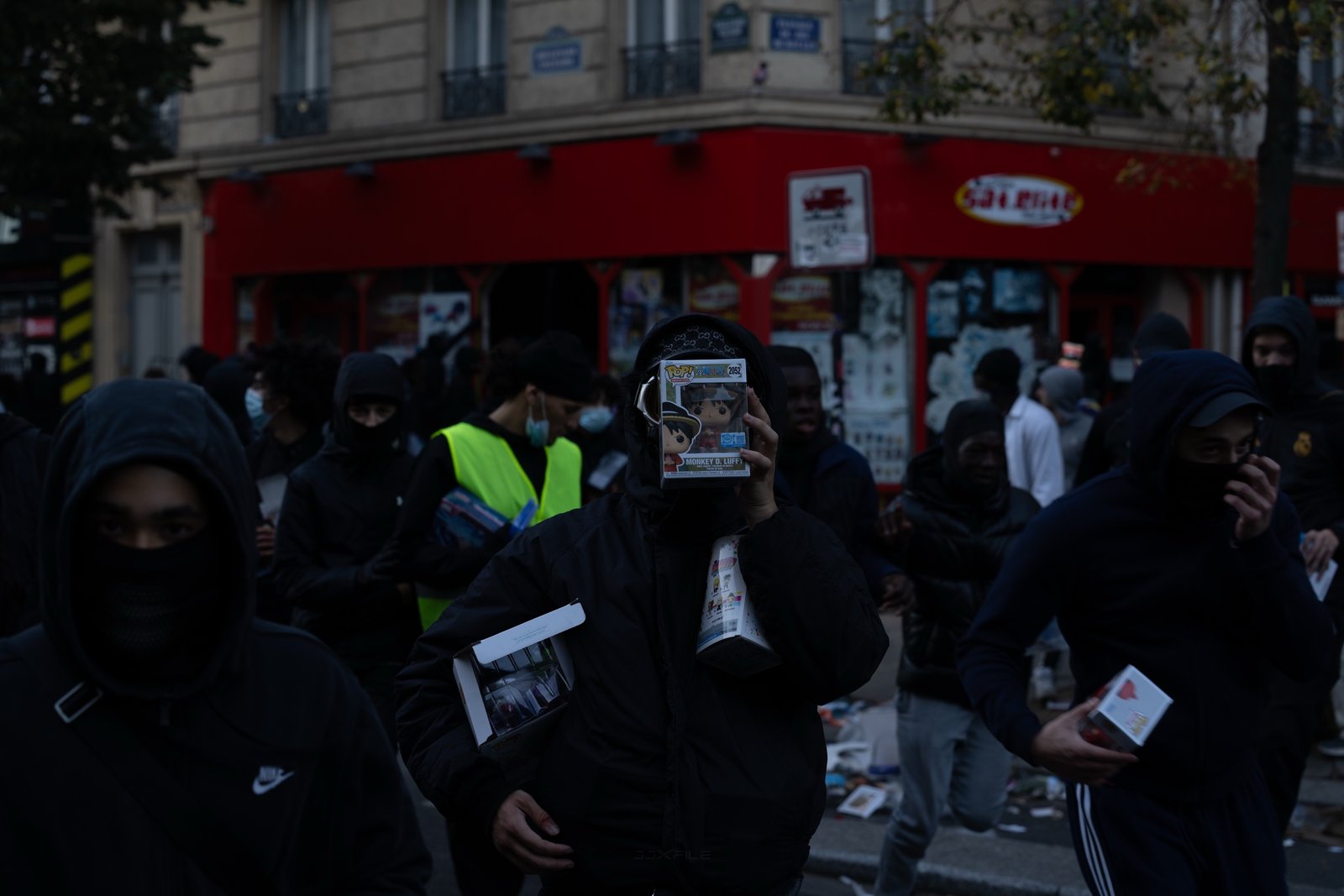
During the unrest on October 17, I saw young people exchanging goods taken from shops beneath my windows. Some of the businesses around me were attacked and looted. What I witnessed was immediate and concrete: people moving objects from one place to another, goods changing hands, the street becoming a space in which the usual rules seemed temporarily suspended.
My first reaction was anger.
It would have been easy to stop there, to interpret the scene as evidence of a generation that had lost its sense of limits. The longer I thought about it, the less satisfying that explanation became.
Anger described my response. It did not explain the behavior.
The question that remained was more uncomfortable: what has to happen, socially and psychologically, for taking something that belongs to someone else to begin feeling like an opportunity to participate, belong, or be seen?
That question does not assume a single motive. It opens a way into the layers beneath the act.
THE MOMENT THE RULES CHANGE
Looting is often presented through images that seem to explain everything: broken glass, open storefronts, crowds moving through damaged streets. These images document real events, yet they can make the people involved appear psychologically interchangeable, as though the crowd itself were a personality and every individual inside it were acting for the same reason.
Research into crowd behavior offers a more complex picture.
Psychologist John Drury’s work on crowd psychology, alongside research by social psychologists Clifford Stott and John Drury on riots and collective conflict, challenges the familiar idea that crowds simply dissolve individual judgment. A crowd can develop its own sense of identity, shared expectations, and boundaries between those who belong and those who do not. People do not necessarily stop thinking as individuals. Their understanding of the situation, including what feels legitimate or possible, can shift according to the group around them.
This distinction matters.
In an ordinary setting, entering a shop and taking merchandise without paying carries an obvious meaning. In a rapidly changing collective situation, the same act may be interpreted by some participants through a different set of immediate signals: other people are doing it, the opportunity may disappear, the usual authority seems absent, and the chance to join in is happening now.
None of these conditions makes the act inevitable. None tells us what any particular person was thinking. Together, however, they help identify a question worth investigating: how does the social meaning of an action change when the people around you begin treating it differently?
A crowd can create momentum without creating a shared ideology. Some people may arrive out of anger, others out of curiosity, others because friends are there. Some may see an opening to take goods. Others may simply follow a movement already underway. Similar actions do not guarantee similar intentions.
The scene may look unified from a window or on a screen. Its motivations can be far less uniform.
BELONGING IS A SOCIAL FORCE
Adolescence is a period in which identity is still taking shape. Peer relationships can carry enormous emotional weight, partly because acceptance, status, and exclusion become especially salient during these years. Research on adolescent decision-making has found that social context can influence risk-taking, including how attractive an immediate reward appears when peers are present.
That research does not mean teenagers are incapable of making considered decisions. It does suggest that a decision made in front of friends may not feel exactly like the same decision made alone.
A risky act can acquire an additional reward when it is witnessed. The reward may be material, but it can also be social: a reaction, a laugh, a moment of recognition, a story to tell later. In some settings, refusing to participate may carry its own perceived cost if a young person believes that hesitation will be read as weakness, fear, or distance from the group.
The possibility deserves attention without becoming a ready-made explanation for every teenager involved.
What does participation offer in that moment? Is it access to goods, a sense of excitement, a way of testing limits, a performance of confidence, or an opportunity to be part of something larger than oneself? Could several of these motives coexist? Could the answer be different for two people standing only a few feet apart?
The psychology of belonging is not a defense of harmful behavior. It is a way to examine why the social rewards of an action might temporarily compete with its consequences.
There is also a difference between belonging to a group and believing in what the group is doing. A person may be drawn into a situation by friends without sharing their motivations. Someone may participate because an opportunity appears available, then continue because leaving feels socially difficult. Another person may arrive with a clear intention from the start.
Treating all these possibilities as one story would make the analysis simpler. It would also make it less accurate.
WHEN THE STREET BECOMES A FEED
The contemporary crowd does not exist only in physical space. It also exists through phones, messages, clips, group chats, and the continuous circulation of images.
A disturbance can be documented while it is unfolding, transmitted beyond the street, and watched by people who are nowhere near it. Digital networks can help people exchange practical information, but they can also spread emotional cues, expectations, and perceptions of what others are doing. Research on social media and collective action has explored how online communication can influence coordination, motivation, and group identity.
The important distinction is between making an event visible and explaining why it happened.
A video of someone carrying goods out of a shop can turn an action into a spectacle. A message telling friends to come quickly can frame the moment as a fleeting opportunity. A clip shared repeatedly may make participation appear more widespread, more exciting, or more socially rewarded than it would seem to someone encountering the event alone.
Visibility changes the audience. It may also change the experience of the person being watched.
Once an action can be recorded and circulated, the immediate crowd is no longer necessarily the only audience that matters. The imagined audience online can become part of the situation itself. A gesture may be performed for friends who are physically present, for people who will see it later, or for both.
This is a possibility to investigate, not an assumption about everyone who takes part. Not every person involved is filming. Not every act is designed for attention. Digital circulation does not create every impulse, and a smartphone cannot explain the social conditions that brought people into the street.
Still, the combination of physical opportunity and digital visibility raises a question specific to our moment: when an event becomes content, does the prospect of being seen alter the way some participants assess its risks and rewards?
The distinction between an experience and its representation can become difficult to maintain. The street is where the act happens; the feed is where its meaning may be amplified, edited, and repeated.
THE CONTEXT BEYOND THE CROWD
Social behavior rarely has a single cause. Economic insecurity, unequal access to opportunity, strained relationships with institutions, neighborhood conditions, and expectations about the future can all form part of the environment in which young people make decisions.
These factors should not be treated as a checklist that automatically explains looting. Many people experience hardship without taking part in it. People from similar backgrounds can respond to the same circumstances in radically different ways. Social context shapes the possibilities people perceive; it does not erase individual differences or determine an outcome.
The harder task is to understand how wider conditions intersect with immediate situations.
A young person’s relationship with the future may influence how they value the present, although this cannot be inferred from appearance or behavior alone. When a reward is immediate and visible while its consequences feel distant or uncertain, the balance between them may shift. The presence of friends, the atmosphere in the street, the apparent availability of goods, and the perceived likelihood of being stopped can all become part of a decision made under pressure.
That decision may unfold in seconds. The conditions surrounding it may have developed over years.
This is why broad labels such as a lost generation or a culture of entitlement offer so little analytical value. They turn a question about social processes into a fixed judgment about people. They also risk confusing the visible event with the entire life of those involved.
A serious account must be able to hold several realities together: social disadvantage can matter without explaining every action; peer influence can matter without eliminating agency; collective dynamics can change behavior without making everyone in the crowd the same.
Understanding these intersections is more demanding than choosing a single cause. It is also closer to how social behavior actually works.
LIVING IN A LIQUID WORLD
Sociologist Zygmunt Bauman described contemporary society as “liquid”: a world in which relationships, identities, institutions, and expectations are increasingly fluid, difficult to hold onto, and constantly changing.
The idea offers an interesting way to look at youth culture today.
For many young people, identity is no longer shaped exclusively by family, school, neighborhood, or a single community. It is also constructed through digital spaces, social interactions, consumption, and the continuous negotiation of how others perceive them. Belonging can feel temporary. Recognition can be immediate, highly visible, and just as quickly disappear.
In this environment, the question of who you are may become closely connected to what you experience, what you possess, what you share, and how others respond.
Consumption occupies an important place in this equation. Objects are not always experienced simply as things. They can also represent status, access, taste, independence, or the possibility of participating in a world that otherwise feels out of reach. The social meaning of an object can sometimes become more immediate than the process through which it was produced, purchased, or owned.
This does not mean that consumer culture explains looting. It raises a more specific question: what happens when the desire to acquire something intersects with a moment in which ownership, social expectations, and collective behavior appear temporarily unstable?
The word free becomes particularly revealing here. In a culture where access to goods can communicate identity and recognition, the possibility of obtaining something without paying may carry meanings beyond its material value. Those meanings will differ from person to person, shaped by individual circumstances and the social environment.
Bauman’s framework also invites us to consider the relationship between immediate experience and longer-term commitment. In a world often experienced as uncertain, a moment of excitement, recognition, or participation can feel unusually tangible. The consequences of an action, meanwhile, may belong to a future that seems distant or difficult to imagine.
This is not a description of an entire generation, nor a claim that instability inevitably produces harmful behavior. It is a way of examining how contemporary social conditions may influence the value people attach to immediate opportunities, relationships, and experiences.
The deeper question is whether the search for recognition and belonging becomes more complicated when the structures that traditionally provided them feel less stable.
The street, the group, and the digital feed may then become temporary spaces in which identity is performed and negotiated. What happens there cannot be understood through the idea of a liquid society alone. Individual choices, peer relationships, material circumstances, and the specific atmosphere of an event remain essential.
Still, Bauman’s perspective adds another layer to the investigation: the possibility that the meaning of participation is shaped not only by what people take, but by what they believe the moment offers them.
In that sense, the question is not simply why something becomes desirable.
It is how desire, identity, and belonging interact in a society where the conditions for feeling secure, recognized, and connected are constantly being renegotiated.
THE PEOPLE LEFT WITH THE BILL
From the perspective of a small business owner, the event does not end when the crowd moves on.
A damaged storefront can mean repair costs, lost trading hours, disrupted deliveries, missing inventory, and days spent dealing with insurers or suppliers. Goods taken from a shop are not an abstract collection of objects. They represent money already committed, sometimes through loans or credit, and stock that was expected to generate the revenue needed to pay rent, wages, and other expenses.
For an independent business, a few days of disruption can have consequences that extend well beyond the immediate damage. Staff may lose shifts. Customers may find the shop closed. A business owner may have to decide whether reopening is financially possible. The uncertainty can continue long after the images of the unrest disappear from public attention.
There is a neighborhood dimension, too. Small shops are not only commercial spaces. They are part of the daily infrastructure of a street: places where residents buy what they need, recognize familiar faces, and develop ordinary relationships over time. When a business is damaged, the effects can travel through that network.
From my position on Rue de Lancry, the contrast was difficult to ignore. Beneath my windows, goods were being exchanged as though they had become detached from the circumstances that made them valuable. Nearby, businesses had to absorb the consequences of those exchanges.
The person taking an object may experience a brief opportunity. The person who owns the shop may inherit a problem that lasts for weeks or months.
Those experiences are not equivalent, and the social analysis should not blur them. Looking at the circumstances surrounding an act does not require overlooking who bears its cost. The economic consequences are part of the story, not a footnote to it.
The question is how to understand the relationship between a moment of collective opportunity for some and a prolonged period of material uncertainty for others.
WHAT DOES “FREE” REALLY MEAN?
The word free is revealing because it removes the history of an object from view. It makes a product appear to exist without a chain of labor, investment, ownership, and responsibility. In the phrase “there’s free stuff,” the shop, its owner, its employees, and the people who supplied the goods disappear. What remains is the possibility of getting something.
That transformation may be one of the most important features of the scene: not necessarily a rejection of every social rule, but a temporary narrowing of attention to what can be obtained, what others are doing, and what might be gained by joining them.
The same phrase can mean different things to different people. For one person, it may be an invitation to participate. For another, it may signal a chance to acquire something they could not otherwise afford. For someone else, it may simply be a message about where the action is. The words alone cannot tell us which interpretation applies.
The task is to investigate what happens between the message and the action: the social expectations, emotional rewards, perceived risks, and immediate circumstances that might connect them.
That also means resisting the temptation to turn video games, social media, or youth culture into convenient villains. Digital environments and entertainment can shape the ways people encounter images of risk, competition, and status, but the existence of a parallel in popular culture does not establish a cause. A credible analysis needs evidence about actual behavior, not an assumption that what young people watch or play determines what they do.
The same caution applies to the idea that all looting expresses political anger, economic frustration, or a desire to challenge authority. Those motives may be relevant in particular situations. They should not be assigned to people without evidence, especially when the same event may bring together participants with very different intentions.
The point is not to replace one stereotype with a more sympathetic one. It is to make room for complexity without losing sight of what happened.
THE DISTANCE BETWEEN SEEING AND UNDERSTANDING
The scene beneath my window remains with me, not because it offers a simple answer, but because it refuses one. I saw an act whose consequences were tangible. I did not see the full set of circumstances, relationships, expectations, and impulses that brought those young people there.
The distance between those two things is where the investigation begins.
Understanding that distance does not mean turning away from the damage. It means looking beyond the most visible moment and asking what preceded it, what sustained it, and what it reveals about the world these young people inhabit.
A crowd is not a single mind. Adolescence is not a diagnosis. Social disadvantage is not a universal explanation. Digital visibility is not proof of motive. Each is one part of a wider picture, and none can stand in for the whole.
The challenge is to examine how individual decisions and collective conditions meet in a specific place, at a specific moment. What made participation feel possible? What made the immediate reward compelling? What did belonging offer, if anything? How did the presence of others alter the perceived stakes? Which consequences were visible to the people involved, and which remained outside their field of attention?
The answers will not be identical from one person to another, or from one city to the next. That is precisely why the questions matter.
On Rue de Lancry, I first saw the scene through anger. Looking at it again has not made the material damage disappear, nor has it supplied a complete explanation. It has made the limits of what I know more apparent.
The most useful question may be less about what kind of people these young people are than about the interaction between the social moment, the group, the individual, and the opportunity in front of them.
What did they believe was happening? What did the people around them make possible? What did the word free conceal?
The task is not to excuse, condemn, or explain everything in advance. It is to look closely enough to understand what we are actually seeing.