Twenty-five years afterAmélie, a return to the film that taught us to look at ordinary life differently.
A quarter of a century later, one of cinema’s most beloved modern fairy tales feels less like a memory to revisit than a way of seeing the world again. One screening, one living-room projector, one Parisian morning. The magic was still there. The person watching had changed.
What if growing up doesn’t mean losing the magic, but learning where to look for it?
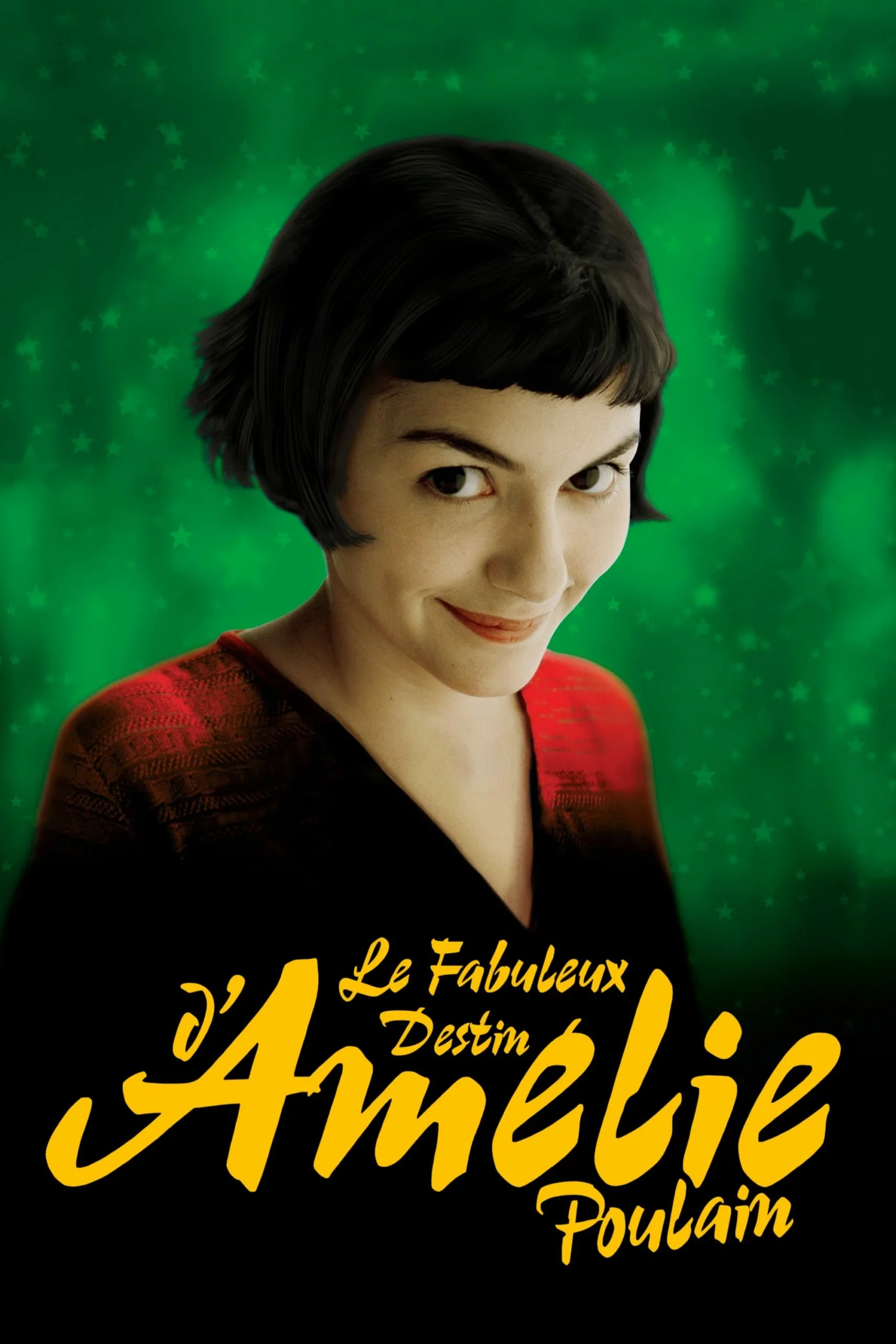
On the night of 25 October 2026, I watched Le Fabuleux Destin d’Amélie Poulain for the first time in twenty-five years. My partner and I had been talking about doing it for months. The film’s twenty-fifth anniversary felt like the right excuse, although the truth is that I had been carrying the idea around for much longer. We finally settled onto our sofa, switched on the projector, and let Paris take over the room.
I had not watched the film again since seeing it at the cinema in 2001. Not because I had forgotten it. Quite the opposite. I had loved it so intensely that I wanted to preserve the emotions it had left behind, sealed in the precise moment of my younger self. Some films become memories before they become films again. You keep them somewhere safe, away from the risk of discovering that time has altered their colours.
I wanted my first encounter with Amélie to remain untouched: the strange mixture of nostalgia and amusement, the feeling of being young enough to recognize a little of yourself in a character who seemed to live in a world more vivid than your own. Rewatching it meant opening that box.
The surprising thing was that nothing had been lost. The emotion had simply grown up.
A FAIRY TALE WITH A VERY GOOD EYE
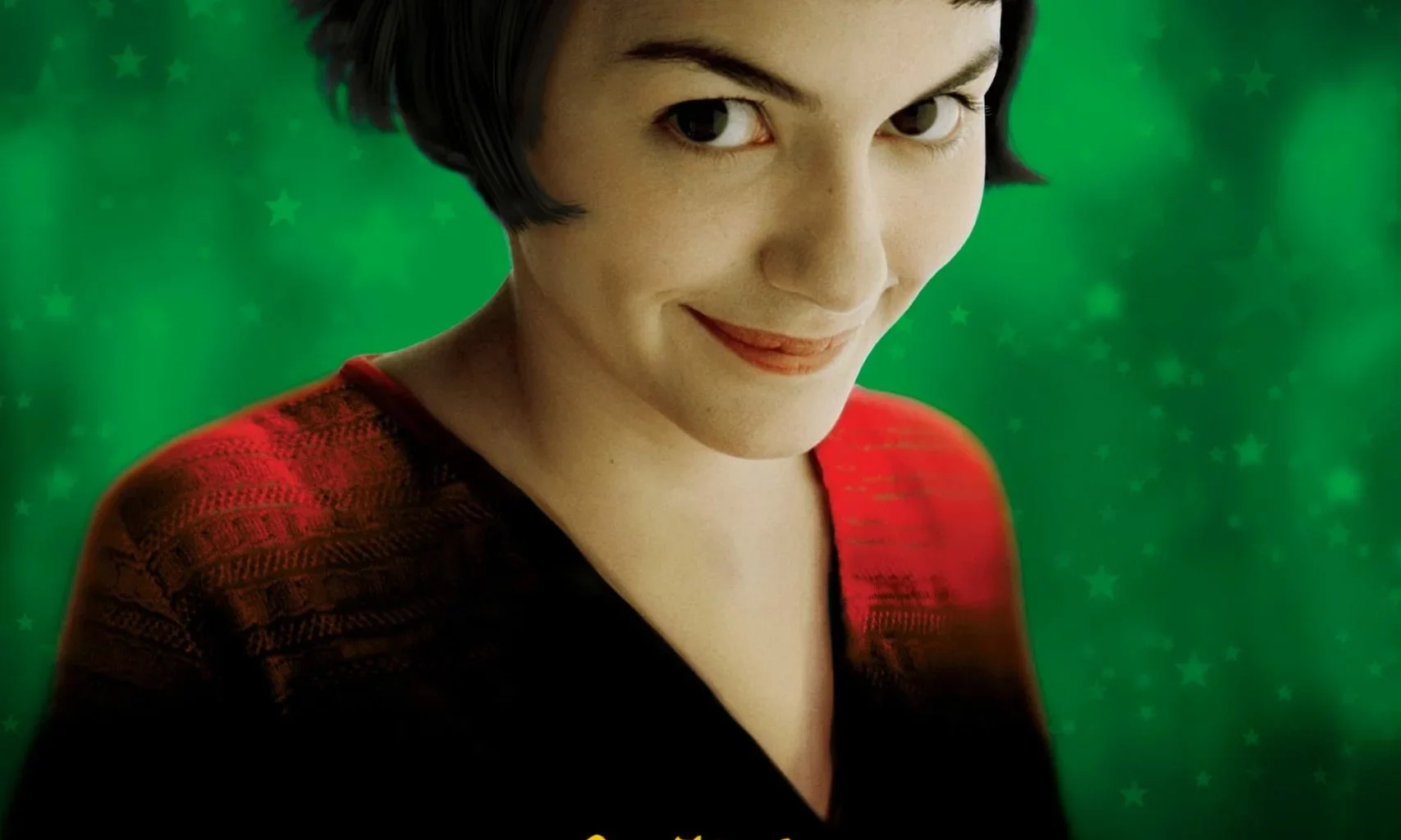
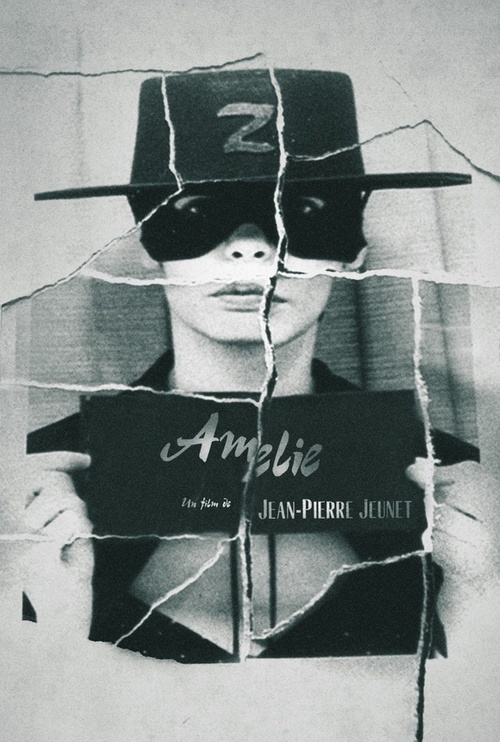
Released in France on 25 April 2001, Jean-Pierre Jeunet’s Amélie arrived dressed as a fairy tale, with Audrey Tautou at its centre and a Paris that seemed to have been dreamt into existence. The film’s world is tactile, mischievous, meticulously composed. Red, green and gold saturate the frame. Faces become landscapes. Objects acquire personalities. Small gestures are granted the dramatic weight of major events.
Every image appears to know exactly where it belongs.
Twenty-five years later, the craftsmanship is impossible to ignore. The photography does not merely make Paris look beautiful; it creates a system of feeling. The colours are emotional cues. The framing turns everyday spaces into miniature stages. The editing makes coincidence feel like destiny, while the narration moves through lives and private habits with the delighted curiosity of someone opening drawers in a stranger’s house.
Jeunet’s Paris is not documentary reality. Its streets were carefully polished, its visual clutter controlled, its imperfections selectively edited out. The result is an artificial world that feels strangely intimate. This is cinema as an act of design, an elaborate construction that somehow makes room for the unplanned texture of human experience.
There is something wonderfully contradictory about that. A film so meticulously manufactured invites us to notice the things we usually overlook.
The pleasure of cracking the crust of a crème brûlée. The sensation of slipping a hand into a sack of grain. The sound of a stone skipping across water. The private satisfaction of helping someone without asking for recognition. Amélie’s universe is built from details that might otherwise disappear between one appointment and the next.
Its real special effect is attention.
THE FILM STAYED THE SAME. I DIDN’T.
Watching the film again, I found myself paying attention to things that had barely registered in my first encounter. The structure. The precision of the screenplay. The way seemingly insignificant details return with the quiet inevitability of a well-planted idea. The balance between intimacy and spectacle, between the very small and the almost absurdly theatrical.
The storytelling is playful, occasionally extravagant, yet its emotional architecture is remarkably clear. Amélie observes the world with extraordinary sensitivity while struggling to participate fully in it. She is a person who can imagine a thousand ways to improve someone else’s life, but finds it harder to make a direct move towards her own happiness.
Her imagination is both her superpower and her hiding place.
That tension feels different when you watch the film as an adult. The younger viewer may fall in love with the possibility that the world is full of secret doors, invisible connections and wonderful coincidences. The older viewer begins to wonder how many of those doors remain closed because opening them would require something more frightening than imagination: action.
Amélie is a modern fairy tale, although its emotional DNA feels much older. There is a recognizable folklore logic at work: a mysterious object, a chain of clues, a hidden identity, a journey, a transformation. The ordinary world becomes enchanted through rituals, symbols and small acts of courage. The film could almost have been told twenty-five years earlier, or twenty-five years before that, with different clothes, different objects and another city. Its visual language belongs to a particular moment; its central longing does not.
We all want to believe that our lives contain a pattern waiting to be discovered. We also want to believe that we might be the ones capable of changing it.
WHEN THE PROJECTOR GOES DARK
The film ended. The projector rose back into its resting position. We switched everything off.
There is a particular silence that follows a film watched at home, when the room returns to itself and the images are still hanging somewhere in the air. No credits can quite prepare you for it. For a few moments, the world outside seems to be running at a different speed.
I went to bed thinking about simplicity. Not simplicity as an aesthetic trend, a perfectly arranged interior or another lifestyle promise. Simplicity as a way of being present. The possibility that depth does not always announce itself with a grand revelation, that inspiration can emerge from repetition, that a life can begin again without first having to be dismantled.
The thought stayed with me through the night. It was still there when I woke up.
Amélie herself is, of course, a fictional character. A luminous one, in the purest sense of the word: a figure who brings certain things into focus simply by looking at them differently. Her world is not a set of instructions for living, and her benevolent interventions come with their own complications. The film can be accused of turning Paris into a postcard, of smoothing away the roughness of ordinary life, of making kindness look easier than it is.
Those reservations have not disappeared with time. They matter. Yet perhaps the film’s enduring appeal lies in the space between its artificial perfection and the imperfect lives it asks us to notice. Its Paris is a fantasy. The need for connection is not.
The morning after our screening, I stepped outside and walked towards the Canal Saint-Martin, a few minutes from where I live.
THE FISH, THE GNOME, AND THE REST OF US
I found myself thinking about Amélie’s suicidal goldfish, the tiny creature whose distress becomes an early sign of the heroine’s own sense of dislocation. I thought about the garden gnome belonging to her father, and the photographs that transform its disappearance into an unexpected journey around the world. One creature longs to escape its enclosure; the other travels far beyond the limits of its familiar garden.
Standing by the canal, I wondered which one I was.
The fish and the gnome are comic figures, small enough to be carried around, yet each contains a question larger than itself. What does it mean to leave? What does it mean to stay? Can we change our lives without abandoning the places and people that have made us who we are? Is escape a form of freedom, or simply another way of postponing the difficult business of living?
I could recognize myself in both. The part that wants to leap beyond the familiar, and the part that understands the value of having somewhere to return to. The impulse to explore, and the desire to find meaning in the life already unfolding.
The canal was there, flowing through the city with no particular interest in my cinematic revelations. The iron footbridge, the water, the morning light: ordinary things, entirely themselves. No saturated colour palette was needed. No orchestral cue had to arrive at the right moment.
The film had followed me outside, although nothing in the street had changed to accommodate it.
That, perhaps, is the most generous thing a film can do. It does not need to make reality resemble cinema. It can send us back into reality with our eyes slightly more open.
TWENTY-FIVE YEARS IS A LONG TIME TO LEARN TO LOOK
The twenty-fifth anniversary of Amélie invites the usual reassessment of a film’s legacy: its influence, its imagery, its place in the history of French cinema, the extraordinary durability of its Paris. The film has become an international shorthand for a certain idea of the city, one made of café tables, winding streets, secret lives and romantic possibility.
Its legacy is visible in the places it made famous and in the way people continue to seek out its locations. Its style remains instantly recognizable. Its soundtrack can summon an entire emotional landscape in a few notes.
My own anniversary was smaller. There was no cinema auditorium, no special screening, no collective gasp from a room full of strangers. There was a projector, a sofa, my partner beside me, and a walk to the canal the following morning.
The scale was different. The feeling was not.
Twenty-five years ago, I watched Amélie and felt the world become a little more magical. This time, I felt something quieter and, in its own way, more transformative: the possibility that magic is not a rare interruption to everyday life. It is something we can learn to recognize within it. It lives in attention, in curiosity, in the willingness to begin again. It appears when we stop waiting for life to become extraordinary before we decide that it matters.
Perhaps growing up is not the process of outgrowing fairy tales. Perhaps it is learning that the fairy tale was never the point.
The point was always the life waiting on the other side of the screen.
The film ended last night. This morning, Paris was still here.