MM6 Spring Summer 2027 proves once again that the most enduring legacy of Martin Margiela is not a specific silhouette, but a way of questioning how clothes are worn and understood.
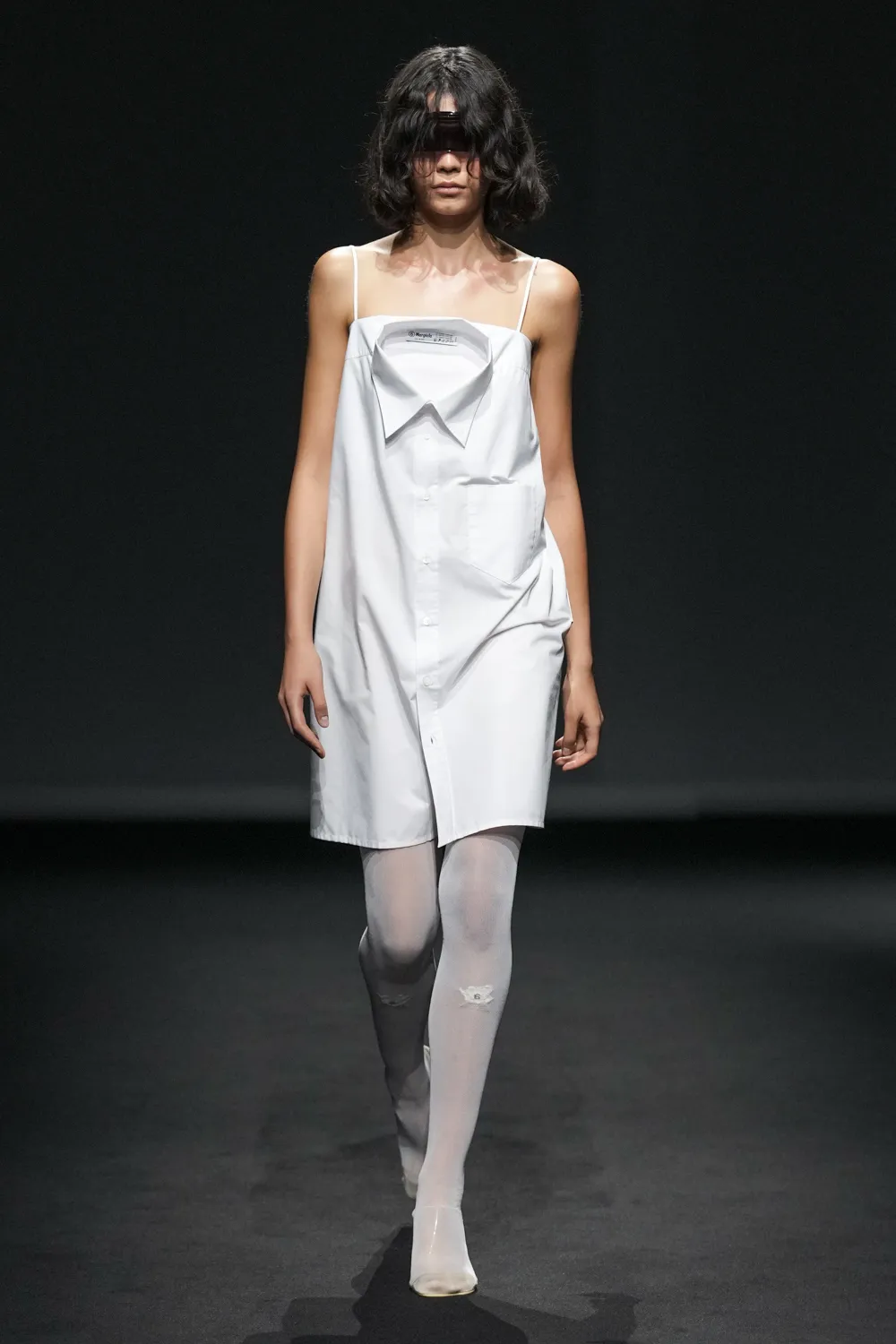
Fashion comes with an unwritten set of instructions: shirts belong on torsos, skirts sit at the waist, collars frame the neck. At MM6 Spring Summer 2027 begins by quietly ignoring them.
Rather than inventing an entirely new wardrobe, MM6 takes the most familiar pieces — shirts, tailoring, biker jackets, T-shirts, skirts and trousers — and asks how far their function can be stretched and manipulated before their identity disappears.
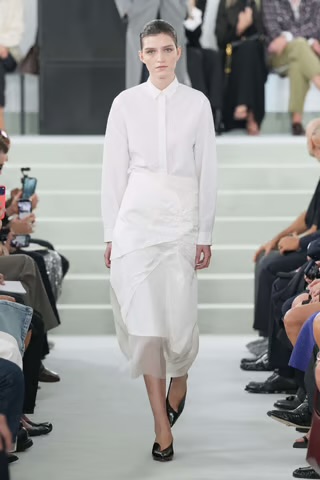
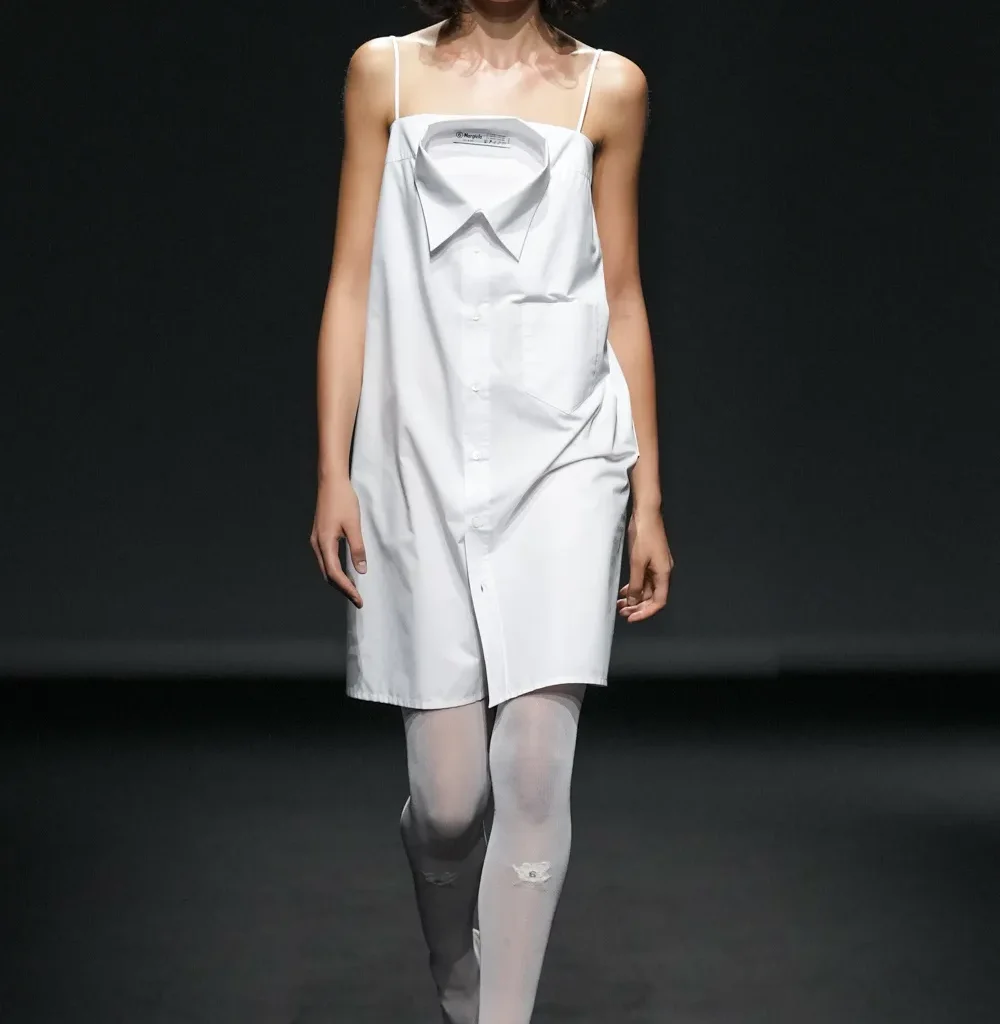
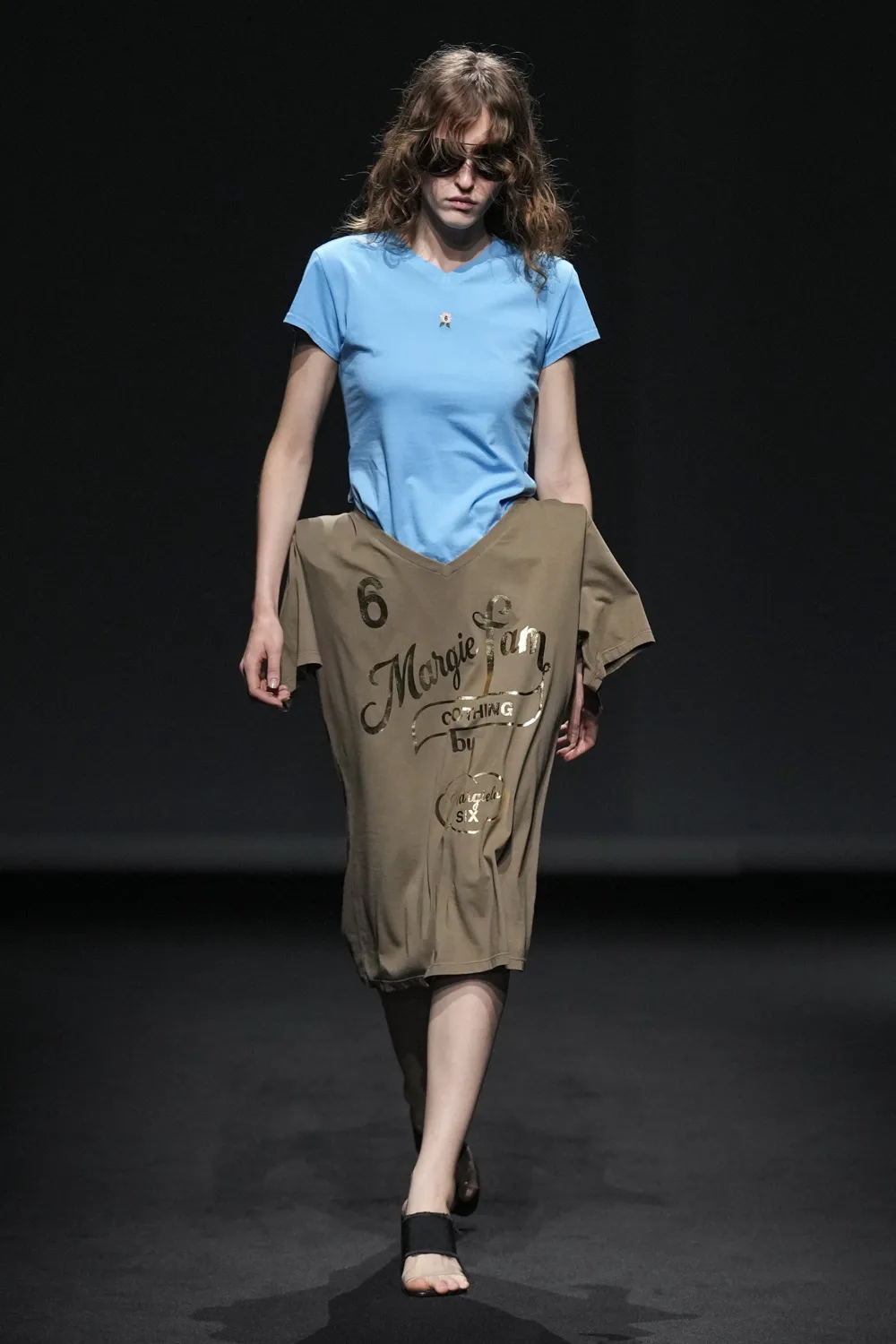
A shirt drops to the hips and becomes a skirt. A V-neck top can move below the waist. A skirt climbs upwards and turns into a dress. Garments are folded, displaced, doubled and fastened again, while their original construction remains deliberately recognizable. The interest lies precisely in that tension: the shirt never completely stops being a shirt, even when it is worn as something else.
This instinct feels deeply connected to the original language established by Martin Margiela. Deconstruction, displacement, altered proportions, exposed construction and the transformation of everyday objects have always belonged to the Maison’s vocabulary. MM6 Spring Summer 2027 continues to preserve these codes, but perhaps more importantly, it knows how to translate them rather than simply reproduce them.
Why MM6 Spring Summer 2027 is relevant
MM6 has ultimately become something close to a living testament to Margiela’s creative philosophy. Not an archive frozen in reverence, but a continuously evolving interpretation of the idea that clothes do not need to behave in the way we expect them to.
That distinction is important. What makes the line particularly relevant today is its ability to bring the Margiela universe closer to a younger audience without diluting its intelligence.
For a generation discovering the Maison through social media, resale platforms, archive fashion and a renewed fascination with experimental design, MM6 offers an accessible point of entry into a much larger creative language. The references are there for those who recognize them, but understanding fashion history is not a prerequisite for enjoying the clothes.
The concept remains immediate: wear it differently. In womenswear, that freedom is expressed by moving garments around the body. Sometimes two versions of the same piece coexist within one look; elsewhere, familiar archetypes simply migrate from one position to another. Shrunken proportions inspired by dolls’ clothing introduce another Margiela-adjacent disruption of scale, with simplified fastenings making the effect feel spontaneous rather than theatrical.
MM6 Spring Summer 2027 is a co-ed show
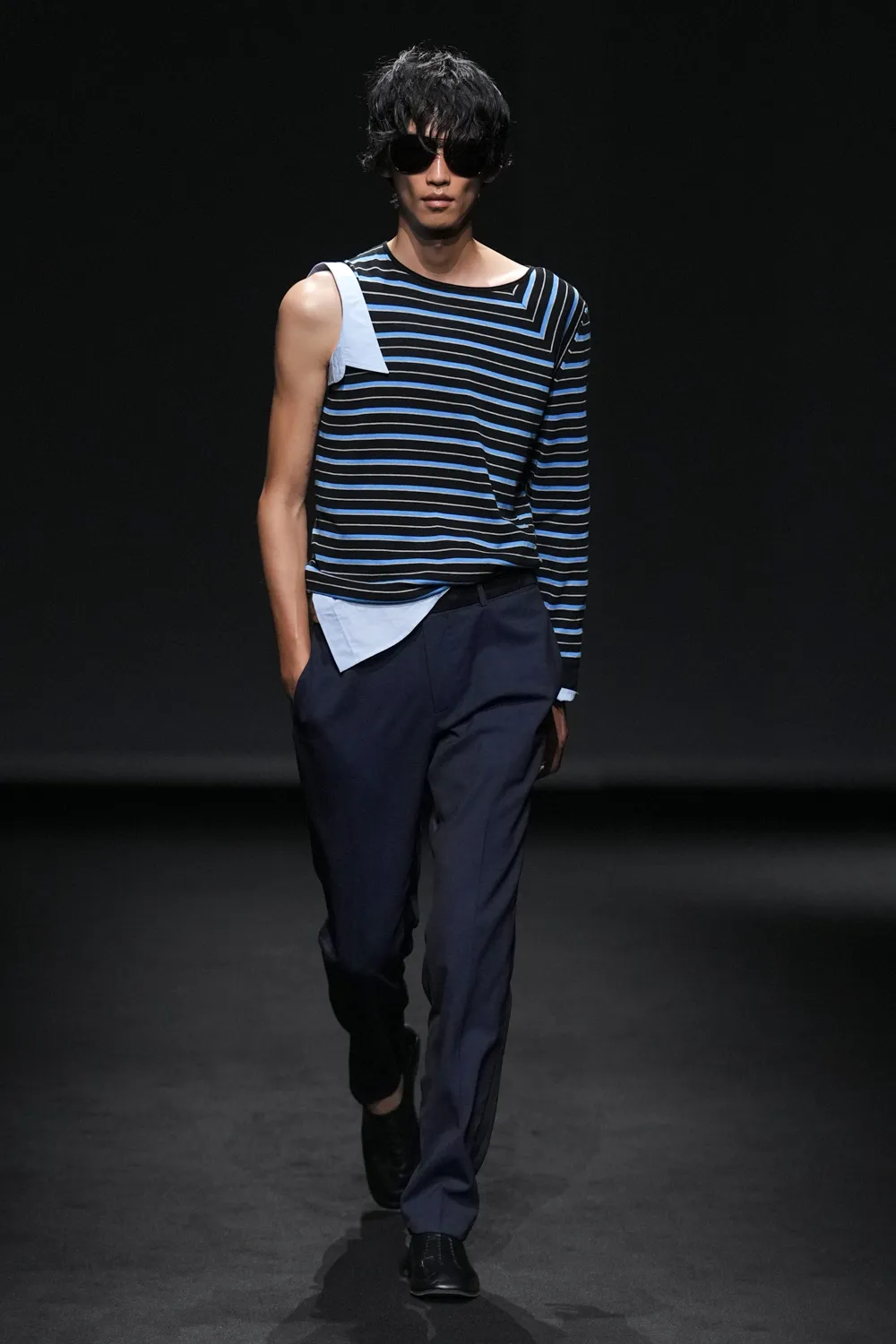
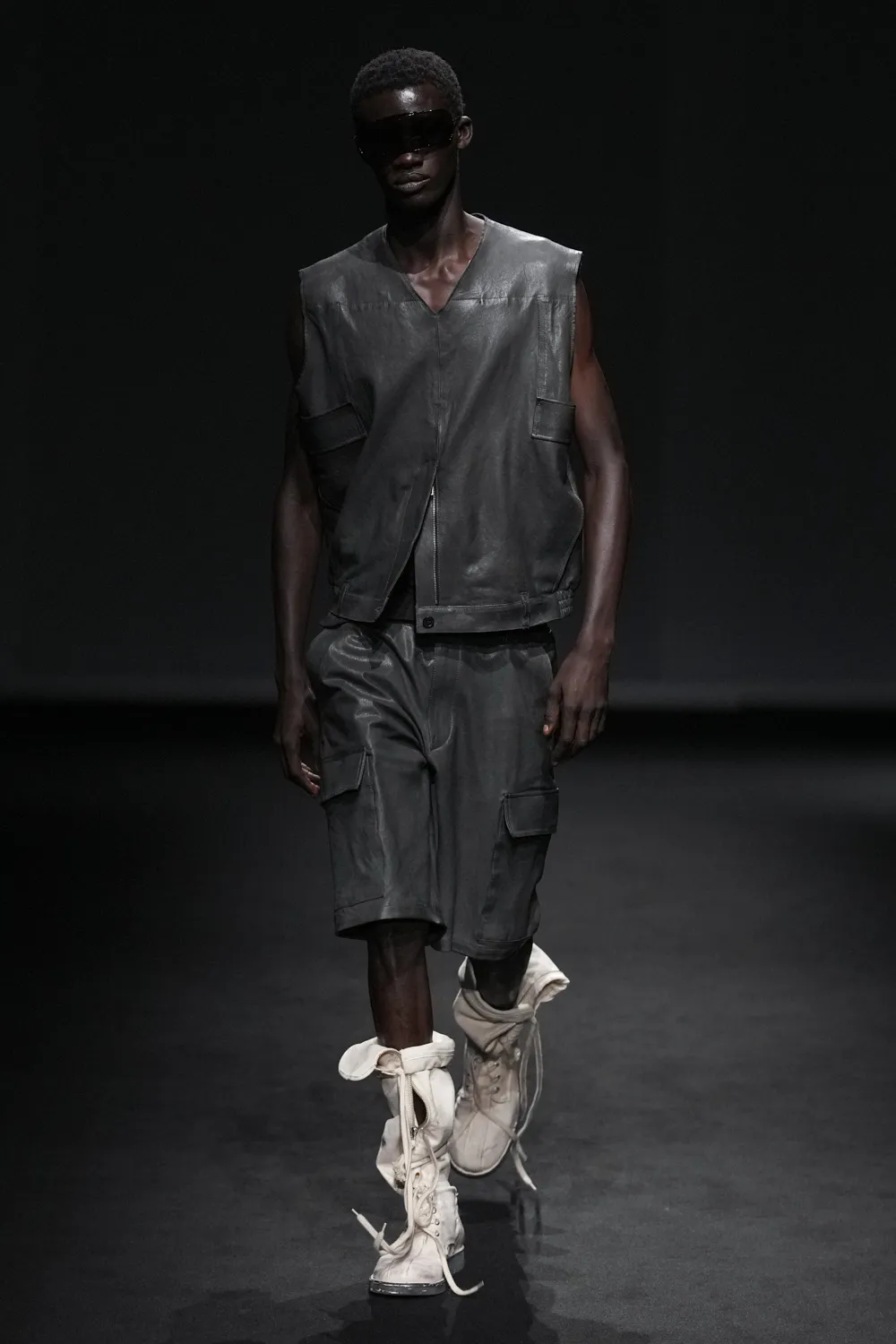
Menswear follows the same logic more subtly. Collars and button plackets slide away from the centre of shirts, while otherwise recognizable staples remain deliberately straightforward. Suits, biker jackets and trousers are not dismantled beyond recognition. Instead, small shifts in construction destabilize what the eye assumes to be normal.
That balance between conceptual thinking and real-life dressing is one of MM6’s strengths.
Nothing feels overly intellectualized. Snaps, reduced closures and uncomplicated fabrics reinforce the idea that these pieces are meant to move with the wearer. Surface treatments — overdyeing, starch, painted and paper-like finishes — transform ordinary materials without overwhelming the garments themselves.
Accessories push the exercise further.
A glove becomes a bag. Another is translated into a five-toed shoe. The Soft Bauletto changes depending on how it is handled, moving between recognizable handbag and collapsed object tucked under the arm. Again, transformation comes not necessarily from redesigning the object completely, but from changing the gesture around it.
The collaboration with Havaianas is perhaps the most playful expression of the idea. One of the most democratic footwear archetypes in the world is filtered through the MM6 vocabulary: toes separate, an extra one appears, soles multiply and the number six becomes part of the construction itself.
It is humorous, slightly absurd and instantly understandable — exactly the kind of conceptual gesture that makes Margiela’s language resonate beyond fashion insiders.
The living testament to Martin
What continues to fascinate about Margiela is that the obvious simply does not exist. There is always a shift, a surprise, another reading waiting to be discovered. And while the clothes can sometimes appear complex, their strength does not necessarily lie in complexity of construction, but in the freedom of interpretation they offer.
A garment can turn, fold, move or change function, but it never dictates a single way of being worn. Its meaning is completed by the person who chooses it.
MM6 Spring Summer 2027 understands this perfectly: these are clothes with a strong identity, but never a fixed one. The final interpretation always belongs to the wearer.